
If you’ve shopped for a new laptop, SSD, RAM stick, or graphics card recently, you’ve probably felt it: laptop prices in India have climbed sharply, and PC components aren’t far behind.
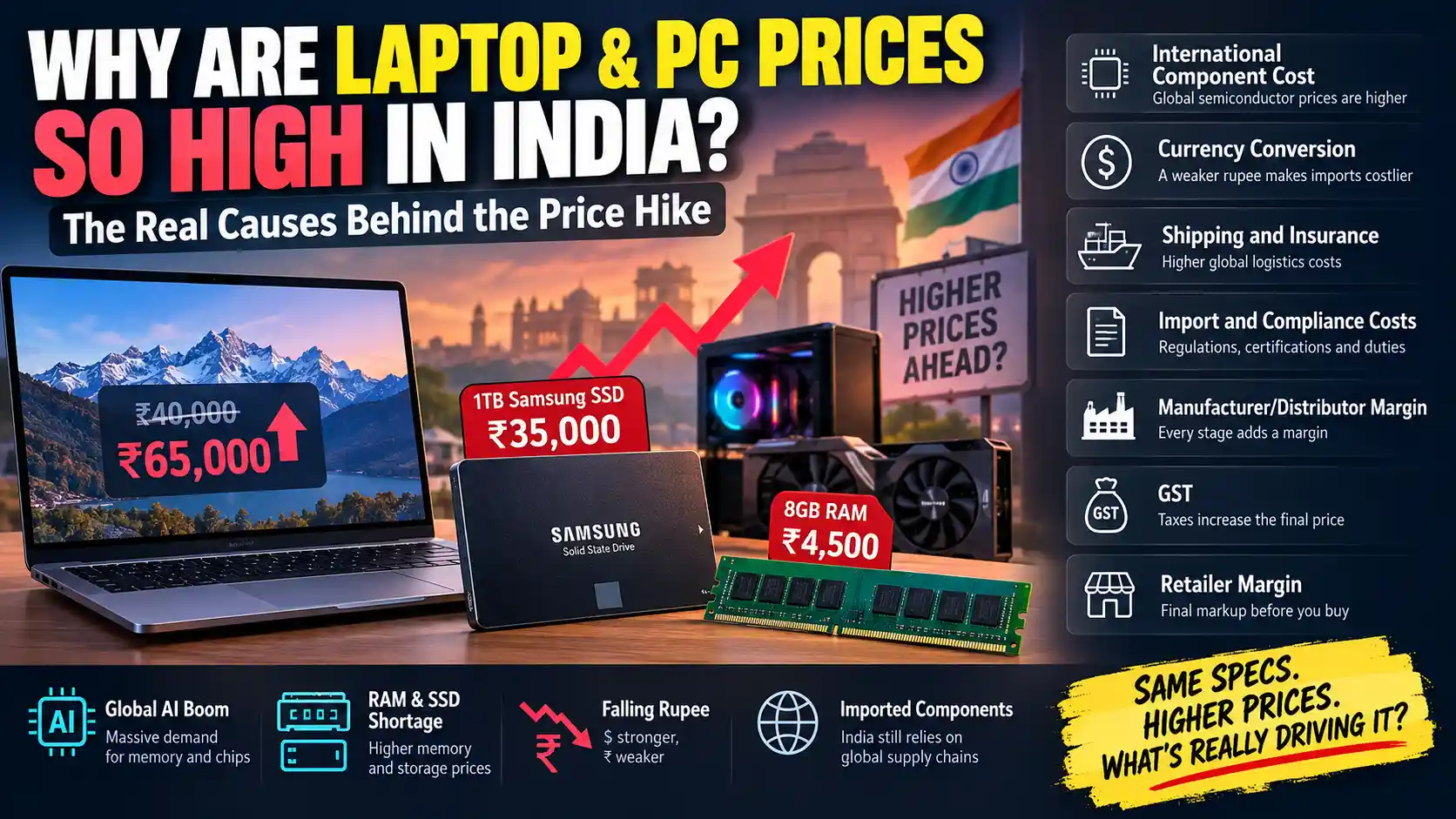
A laptop that cost around ₹40,000 a couple of years ago can now cost ₹65,000 or more for a similar configuration. A 1TB Samsung SSD that used to be a budget upgrade now runs close to ₹35,000. Even something as basic as 8GB of DDR4 RAM has crossed ₹4,500.
So why are laptop prices in India rising so fast? Is it government taxes? The falling rupee? Global chip shortages?
The honest answer: it’s not one single cause. It’s a combination of currency movement, global demand, and India’s continued dependence on imported chips.
Quick Answer: Why Are Laptop Prices in India Going Up?
The biggest driver is not a single tax hike. Laptop prices in India are rising because of:
- 💵 A weaker rupee — the exchange rate now sits near ₹95.56 per US dollar, making dollar-priced components far costlier to import
- 🤖 The global AI boom — soaring demand for GPUs, high-bandwidth memory and advanced chips
- 🧠 India’s continued reliance on imported chips — most CPUs, GPUs and memory modules still come from abroad
- 🚢 Global supply chain and shipping costs — these get added on top of the base component price
- 🏭 India’s semiconductor manufacturing ecosystem is still developing — local production hasn’t caught up with demand yet
- 🏛️ Compliance and regulatory costs — these add to the final price, though they’re not the main driver
In short: if a laptop now costs ₹25,000 more than it did before, that gap isn’t simply an import-tax increase. It’s the combined effect of currency depreciation, global chip prices, tighter memory supply, and everything it takes to get that laptop into an Indian retail store.
Let’s break each factor down.
1. Are Import Taxes the Real Reason Laptop Prices in India Are Rising?
This is the most common explanation people reach for — but it’s more nuanced than it sounds.
India is part of the WTO Information Technology Agreement (ITA-1), under which most laptops and many core IT components still carry zero or very low Basic Customs Duty (BCD).
What buyers do pay is 18% IGST, applied at the point of sale for most imported electronics. But an 18% tax alone doesn’t explain a laptop jumping from ₹40,000 to ₹65,000 — that’s closer to a 60%+ increase, far more than tax alone can account for.
The bigger story isn’t the tax rate. It’s everything that happens to the price of a component before it even reaches Indian shores.
2. The Rupee’s Fall Against the Dollar Is the Hidden Culprit
This is the factor most Indian buyers overlook — and arguably the biggest one.
Most global electronics components — CPUs, GPUs, memory chips, SSD controllers — are priced internationally in US dollars. As the rupee weakens, the same dollar-priced component automatically becomes more expensive in India.
With the exchange rate now near ₹95.56 per $1, here’s what that means in practice:
A component priced at $200 internationally now costs approximately:
₹200 × 95.56 = ₹19,112
Compare that to a few years ago, when the rupee traded closer to ₹68 per dollar:
₹200 × 68 = ₹13,600
That’s a difference of roughly ₹5,500 on a single $200 component — before GST, shipping, distributor margins or retailer markup are even added.
The component itself hasn’t gotten more expensive in dollar terms. The rupee has simply lost purchasing power against it — and that cost gets passed straight down to the customer buying a laptop, SSD or RAM kit in India.
3. The AI Boom Is Squeezing the Memory Market
Artificial intelligence infrastructure is quietly reshaping the price of ordinary consumer hardware — including the RAM and SSDs in your laptop.
AI data centres consume enormous quantities of High Bandwidth Memory (HBM) and advanced chips. To meet this demand, major manufacturers like Samsung, SK hynix and Micron are shifting production capacity toward these high-margin AI products.
That leaves less manufacturing capacity for everyday consumer memory — the kind used in:
- Laptop and desktop RAM (including standard 8GB DDR4 kits)
- SSDs (including drives like a 1TB SSD)
- NAND flash storage generally
When global memory supply tightens while AI-driven demand keeps climbing, consumer prices rise too — which is a major reason 8GB DDR4 RAM now costs around ₹4,500 and a 1TB Samsung SSD sits near ₹35,000, well above older price points.
You may never touch an AI data centre directly, but it draws from the exact same global chip supply that stocks your local electronics store.
4. India Still Imports Most of Its Advanced Chips
This is the long-term structural issue behind rising laptop prices in India.
India has made real progress in electronics assembly, but it still lacks a mature domestic supply chain for advanced semiconductors — CPUs, GPUs, NAND flash and high-end memory are largely imported from:
- Taiwan
- South Korea
- China
- The United States
- Other Asian semiconductor hubs
That means every laptop, SSD or RAM stick sold in India carries the combined weight of:
Global chip prices + currency conversion + shipping + import compliance + distribution margins + GST
Every link in that chain adds cost — and any disruption anywhere along it shows up in the final price tag.
How a ₹40,000 Laptop Becomes a ₹65,000 Laptop
Here’s the simplified price journey:
International component cost ↓ Currency conversion (₹95.56/$) ↓ Shipping & insurance ↓ Import & compliance costs ↓ Manufacturer/distributor margin ↓ 18% GST ↓ Retailer margin ↓
Final price you pay
Each step compounds the one before it — which is exactly why a modest rise in global chip prices or a small currency shift can translate into a much bigger jump at the checkout counter.
Current PC Component Prices in India (2026)
| Hardware | Earlier Typical Price | Current Typical Price* | Main Driver |
|---|---|---|---|
| Budget–mid laptop | ₹40,000 | ₹65,000 | Rupee depreciation + component costs |
| 8GB DDR4 RAM | ₹1,800–₹2,500 | ~₹4,500 | Tight memory supply, AI demand |
| 1TB Samsung SSD | ₹6,500–₹8,500 | ~₹35,000 | NAND shortage, AI-driven demand shift |
| Mid-range GPU | ₹18,000–₹22,000 | ₹32,000–₹38,000 | GPU demand + exchange rate |
*Prices vary by brand, model, specification, retailer and market conditions. Treat these as directional examples, not fixed listings.
Who Feels the Impact of Rising Laptop Prices in India the Most?
Students and parents — A ₹20,000+ jump on a laptop needed for college, coding or online classes is a serious hit for middle-class households.
Small businesses — Billing, accounting and office systems all rely on computers that now cost significantly more to replace or upgrade.
Freelancers and professionals — Editors, designers and developers who depend on RAM- and storage-heavy machines are especially exposed to memory price spikes.
Gamers and PC builders — With GPU and RAM prices both up, a full gaming PC build now costs meaningfully more than it did a year or two ago.
Is the Indian Government to Blame?
Government policy is one factor among several — not the whole explanation.
Import taxes on laptops remain largely stable and low under the ITA-1 framework. What has changed is everything happening outside India’s borders:
- Rupee depreciation — now near ₹95.56/$, directly inflating the cost of every imported component
- Global semiconductor pricing — driven by demand India doesn’t control
- AI-driven chip and memory demand — reallocating manufacturing capacity worldwide
- Global supply chain costs — shipping, logistics and geopolitical friction
- India’s still-developing local manufacturing base — reducing reliance on imports will take years, not months
Will Laptop Prices in India Come Down?
There’s a longer-term case for optimism. India is investing heavily in semiconductor and electronics manufacturing through initiatives like Make in India and production-linked incentive (PLI) schemes.
If that investment matures, India could eventually see:
- Shorter, more localized supply chains
- Lower logistics and shipping costs
- Greater domestic competition
- More stable pricing, less exposed to rupee swings
- More electronics manufacturing jobs at home
But building advanced chip manufacturing capacity takes years of sustained investment — it isn’t a quick fix.
The Bottom Line
Why are laptop prices in India rising in 2026?
It’s not one villain — it’s a combination: a rupee trading near ₹95.56 to the dollar, an AI boom reshaping global memory supply, India’s continued dependence on imported chips, and the layered costs of shipping, compliance, and margins along the way.
That’s why a laptop that once cost ₹40,000 is now closer to ₹65,000, why 8GB DDR4 RAM has crossed ₹4,500, and why a 1TB Samsung SSD now runs near ₹35,000.
The simple formula: Global chip prices + weaker rupee + import dependence + supply-chain costs + taxes = higher laptop prices in India.
Until India’s domestic semiconductor ecosystem matures, laptop and PC prices here will keep moving with events happening thousands of miles away — in Taiwan, South Korea, China, the United States, and the broader global chip market.