
Published: September 12, 2026
Updated: September 12, 2026
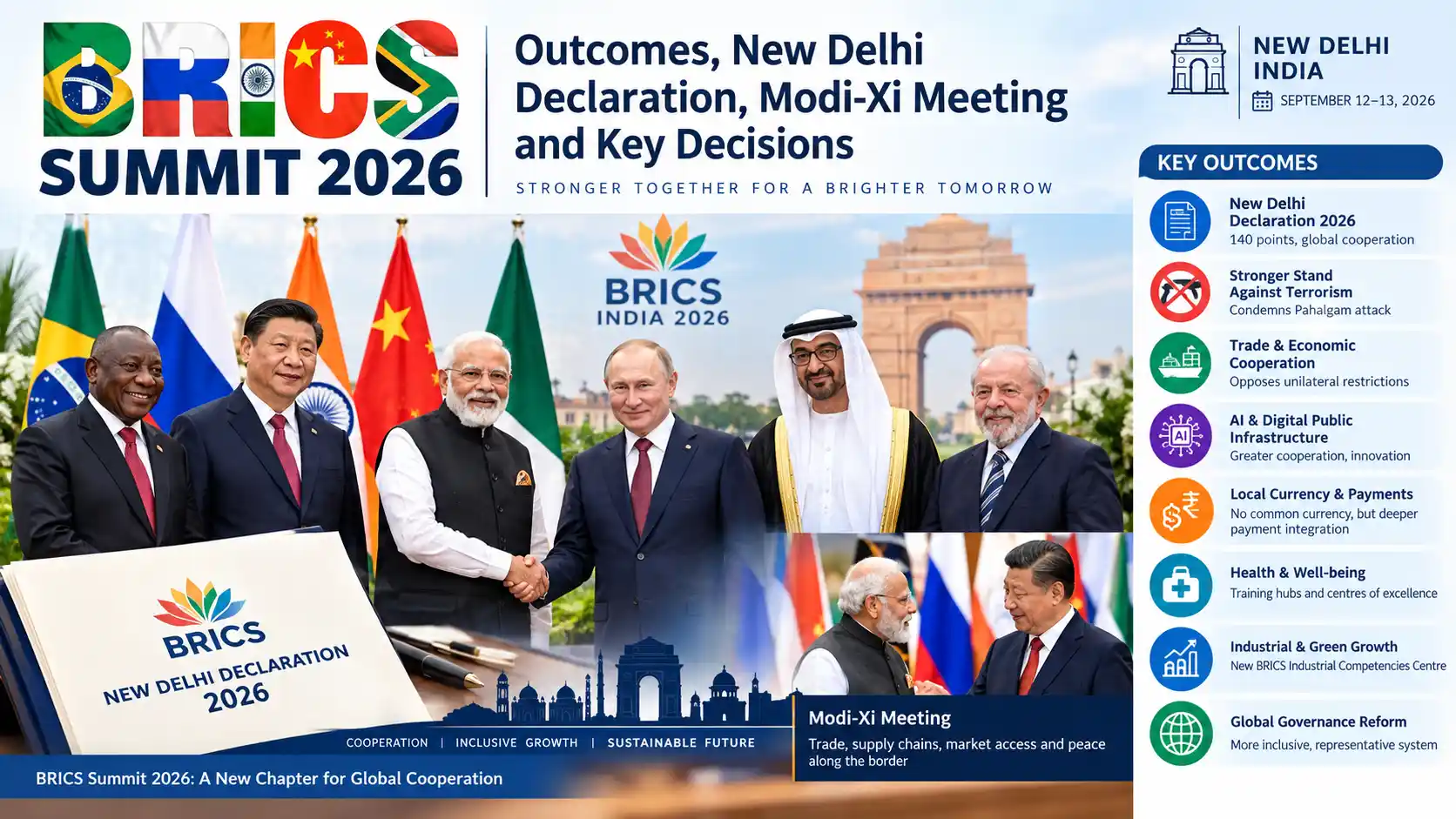
BRICS Summit 2026 outcomes are now taking shape in New Delhi, with BRICS leaders adopting the New Delhi Declaration 2026 and announcing several important decisions. BRICS leaders adopted the declaration by consensus on September 12, covering issues including global governance, international trade, terrorism, artificial intelligence, cross-border payments, local currencies, sustainable development, and geopolitical conflicts.
The summit is being hosted by India under its 2026 BRICS chairship and is taking place at Bharat Mandapam in New Delhi on September 12–13. The declaration also marks an important milestone as BRICS reaches two decades since its formation.
For India, some of the most important developments include the bloc’s stronger language against terrorism, cooperation on digital public infrastructure and artificial intelligence, discussions on local-currency payments, and Prime Minister Narendra Modi’s meeting with Chinese President Xi Jinping.
BRICS Summit 2026 Outcomes Latest Update
The 18th BRICS Summit has adopted the New Delhi Declaration 2026 by consensus. The declaration contains 140 points and sets out the group’s common positions on global governance, economic and financial cooperation, international security, technology, sustainable development and people-to-people cooperation.
A particularly important development for India was the meeting between Prime Minister Narendra Modi and Chinese President Xi Jinping on the sidelines of the summit. The two leaders discussed improving business and transport links, addressing trade imbalances and supply-chain issues, and improving market access. Xi’s visit is his first to India in seven years.
Related: BRICS Summit 2026: How Much Is India Spending, What Will India Gain and Why Does It Matter?
What Is the New Delhi Declaration 2026?
The New Delhi Declaration is the main joint outcome of the 18th BRICS Summit.
The document reaffirms the group’s commitment to cooperation based on sovereign equality, mutual respect, inclusiveness and consensus. It also calls for stronger cooperation under BRICS’ three broad pillars:
- Political and security cooperation
- Economic and financial cooperation
- Cultural and people-to-people cooperation
The declaration says BRICS wants to strengthen a more representative and inclusive international system and increase cooperation among emerging markets and developing countries.
The document also recognises India’s work during its 2026 chairship. According to the declaration, more than 400 BRICS meetings and engagements were held across 30 cities in India involving ministers, parliamentarians, officials, experts, businesses and other participants.
The BRICS Summit 2026 outcomes are particularly significant because the declaration covers economic cooperation, global governance, security and emerging technologies.
1. BRICS Takes Stronger Position Against Terrorism
One of the most significant BRICS Summit 2026 outcomes for India is the declaration’s strong language on terrorism.
The BRICS declaration condemns terrorism and specifically addresses the April 2025 Pahalgam terrorist attack, in which 26 people were killed.
It also highlights concerns surrounding:
- Cross-border movement of terrorists
- Terrorist financing
- Safe havens
- Radicalisation
- Extremism
- International counter-terrorism cooperation
The declaration also says terrorism should not be associated with any particular religion, nationality, civilisation or ethnic group.
For India, this is diplomatically significant because BRICS decisions are based on consensus and include countries with differing positions on international security issues.
The declaration’s language therefore represents an important diplomatic outcome for New Delhi.
2. BRICS Opposes Unilateral Trade Restrictions
Trade was another major focus of the summit.
The New Delhi Declaration criticises unilateral coercive measures and restrictive trade practices that BRICS members argue can undermine international trade and economic cooperation.
This comes at a time when tariffs and trade restrictions have become a major issue in global commerce.
For India, the issue is particularly important because the country is trying to increase exports while reducing excessive dependence on imports.
India also wants BRICS cooperation to create better market access for Indian companies.
What could this mean for India?
If BRICS countries reduce regulatory barriers and improve market access, Indian businesses could potentially benefit in sectors such as:
- Pharmaceuticals
- Engineering
- Agriculture
- Automobiles
- Electronics
- Information technology
- Financial services
- Manufacturing
- Startups
However, the declaration itself does not automatically increase India’s exports. Actual benefits will depend on implementation by individual member countries.
3. No Common BRICS Currency — But Local-Currency Payments Get a Push
One of the biggest misconceptions surrounding BRICS is the idea that the group has created a new common currency.
That has not happened.
The New Delhi Declaration does not establish a common BRICS currency.
Instead, BRICS members are continuing to explore greater use of local currencies for trade and investment and improved cross-border payment systems.
The declaration supports work by the BRICS Payment Task Force, which is examining ways for member countries’ payment and messaging systems to work more effectively together.
The objective is to make cross-border payments:
- Faster
- Cheaper
- More accessible
- Safer
The New Development Bank has also been encouraged to expand local-currency financing and mobilise resources for infrastructure and development projects.
For India, this could eventually make international trade settlements easier and potentially reduce transaction costs.
4. BRICS Moves Forward on Artificial Intelligence
Artificial intelligence has emerged as another important area of cooperation.
The New Delhi Declaration recognises AI as both an economic opportunity and a major governance challenge, particularly for developing countries.
BRICS members are supporting greater access to AI resources while emphasising:
- Safety
- Security
- Inclusiveness
- Reliability
- Energy efficiency
- Trustworthy AI
- The interests of the Global South
The declaration also recognises India’s role in hosting the AI Impact Summit in February 2026 and supports implementation of the BRICS Leaders’ Statement on the Global Governance of Artificial Intelligence.
This could become an important area of cooperation for Indian technology companies, startups and research institutions.
5. India Pushes Digital Public Infrastructure
Another important India-led initiative involves Digital Public Infrastructure (DPI).
The declaration notes a proposal to establish a BRICS repository for digital public infrastructure and explore pilot projects using DPI solutions across member countries.
India has developed large-scale digital systems such as Aadhaar, UPI and other public digital platforms.
Greater cooperation in this area could provide opportunities for Indian technology companies and institutions to share expertise with other developing economies.
It could also strengthen India’s image as a major provider of scalable digital infrastructure solutions.
6. New BRICS Industrial Competencies Centre in India
The summit also welcomed the establishment of an India Centre for BRICS Industrial Competencies.
The initiative is intended to help manufacturing companies and small businesses adopt Industry 4.0 and advanced digital technologies.
Industry 4.0 generally involves technologies such as:
- Automation
- Artificial intelligence
- Robotics
- Smart manufacturing
- Internet-connected industrial systems
- Data analytics
For India’s MSMEs, this could eventually become important if cooperation results in technology transfer, training and access to international markets.
7. Health Cooperation Gets a Major Push
Healthcare is another area where India is expected to benefit from increased BRICS cooperation.
The declaration supports the development of a BRICS Training Hub Network and Centres of Excellence focused on mental well-being.
India’s NIMHANS in Bengaluru is identified as the coordinating centre for the mental-well-being cooperation initiative.
The broader objective is to improve knowledge sharing, training and cooperation among health institutions in BRICS countries.
For India, this could provide opportunities to expand its role in healthcare, pharmaceuticals, medical education and health technology.
8. BRICS Calls for Restraint Over West Asia Conflict
The ongoing conflict in West Asia was one of the most difficult diplomatic issues facing the summit.
BRICS includes countries with different positions and interests in the conflict.
Despite those differences, members reached consensus on language expressing deep concern about the escalation of tensions and calling for maximum restraint, dialogue and diplomacy.
The declaration also expresses concern about civilian infrastructure and nuclear facilities and stresses the importance of maintaining international trade, energy flows and supply chains.
The declaration addresses the humanitarian situation in Gaza and supports continued humanitarian access and a political solution.
The ability to reach consensus despite differences between members was itself an important diplomatic outcome.
9. BRICS Pushes for Global Governance Reform
India has repeatedly called for greater representation of developing countries in global institutions.
The New Delhi Declaration reiterates BRICS’ support for reforming global governance structures and strengthening multilateralism.
The declaration argues for a more representative, fair and effective international system that reflects the changing balance of the global economy and population.
For India, this issue is strategically important because New Delhi has long sought a greater role for developing countries in institutions such as the United Nations Security Council.
10. Modi-Xi Meeting Becomes a Major India-China Development
One of the most closely watched developments surrounding the summit was the meeting between Narendra Modi and Xi Jinping.
The two leaders discussed improving business and transport links, increasing mobility and addressing economic concerns.
According to Reuters, the leaders specifically discussed the structural trade imbalance, supply-chain problems and predictable market access.
This is particularly important for India because China remains India’s largest source of imports.
Bilateral trade reached a record $155.6 billion in 2025, while India’s imports from China rose to around $132 billion in FY2025–26, leaving India with a trade deficit of more than $100 billion with China alone.
This connects directly to the broader BRICS challenge discussed in our earlier article: India needs more balanced trade, not simply more trade.
What Does BRICS Summit 2026 Mean for India?
The summit gives India several potential advantages.
Diplomatic influence
India has demonstrated that it can bring countries with different interests together and reach consensus on major international issues.
Trade opportunities
Improved market access and payment systems could help Indian exporters.
Technology
Cooperation in AI, digital public infrastructure and Industry 4.0 could create opportunities for Indian technology companies.
Healthcare
India can strengthen its role in health education, research and medical cooperation.
Financial cooperation
Greater use of local currencies and improved payment connectivity could eventually reduce transaction costs.
Global South leadership
India has used its BRICS chairship to promote a larger role for developing countries in international decision-making.
However, these are potential benefits, not guaranteed economic returns.
Is the BRICS Summit 2026 a Success for India?
The answer depends on what happens next.
Diplomatically, India has several reasons to claim success.
The group adopted a joint declaration despite significant differences among members. More than 400 meetings and engagements were held across 30 Indian cities during the chairship.
India also succeeded in placing issues such as terrorism, digital public infrastructure, AI, health and global governance reform prominently in the BRICS agenda.
But the economic test will take longer.
India needs to see whether BRICS cooperation leads to:
- Higher Indian exports
- More foreign investment
- Better market access
- More balanced trade
- Cheaper international payments
- Technology partnerships
- More opportunities for Indian MSMEs
The results will not be visible immediately after the summit.
What Happens After the BRICS Summit 2026?
The summit is only one stage in India’s BRICS chairship.
The more important question is whether the agreements and initiatives announced during the summit are actually implemented.
India will need to work with BRICS members on payment systems, technology, trade, investment, health, agriculture and industrial cooperation.
The declaration also confirms that China will take over the BRICS chairship in 2027 and host the next BRICS summit.
That means India will now have to work with China and other members to ensure that the initiatives launched during its chairship continue.
BRICS Summit 2026: Key Takeaways
Here are the most important developments in simple terms:
- New Delhi Declaration 2026 adopted by consensus.
- BRICS strengthened its position on terrorism and counter-terrorism cooperation.
- Members opposed unilateral trade restrictions and called for stronger multilateral cooperation.
- No common BRICS currency was created.
- BRICS continued work on local-currency trade and cross-border payments.
- AI cooperation received significant attention.
- India pushed Digital Public Infrastructure cooperation.
- A new India Centre for BRICS Industrial Competencies was welcomed.
- Health cooperation and mental-well-being initiatives received support.
- BRICS called for restraint and diplomacy over the West Asia conflict.
- Modi and Xi discussed trade, supply chains, business links and border peace.
- China will chair BRICS in 2027.
Frequently Asked Questions
What were the major outcomes of BRICS Summit 2026?
The major outcomes include the adoption of the New Delhi Declaration, stronger counter-terrorism cooperation, work on local-currency payments, AI cooperation, digital public infrastructure initiatives, health cooperation, industrial technology cooperation and calls for global governance reform.
Did BRICS create a common currency in 2026?
No. The 2026 New Delhi Declaration did not create a common BRICS currency. Instead, members supported continued work on using local currencies for trade and improving cross-border payment systems.
What did Modi and Xi discuss at BRICS Summit 2026?
Modi and Xi discussed improving business and transport links, trade imbalances, supply-chain issues, market access and bilateral relations. Modi also stressed the importance of peace along the India-China border.
What did India gain from BRICS 2026?
India gained greater diplomatic visibility and successfully promoted initiatives involving terrorism, AI, digital public infrastructure, health, industrial technology and global governance reform. The long-term economic benefits will depend on implementation.
Who will host BRICS in 2027?
China will hold the BRICS chairship in 2027 and host the 19th BRICS Summit.
The long-term impact of the BRICS Summit 2026 outcomes will depend on how quickly these announcements are converted into practical cooperation.
Conclusion
The BRICS Summit 2026 in New Delhi has delivered several important outcomes for India, with the adoption of the New Delhi Declaration emerging as the biggest development.
The summit did not produce a new BRICS currency, but it advanced discussions around local-currency settlements and cross-border payments. It also gave India an opportunity to push cooperation in AI, digital public infrastructure, health and advanced manufacturing.
The Modi-Xi meeting adds another important dimension because India and China are attempting to improve economic ties while continuing to manage unresolved border issues and a major trade imbalance.
For India, however, the real test begins after the summit.
Overall, the BRICS Summit 2026 outcomes give India several diplomatic and economic opportunities, but their real value will be measured by implementation.
The success of BRICS 2026 will ultimately depend on whether today’s declarations become tomorrow’s trade, investment, technology, jobs and economic opportunities.
Sources:
Official New Delhi Declaration — Prime Minister of India
Government of India — BRICS 2026 Backgrounder