
7 Most Toxic Mushrooms: Identification, Symptoms & Safety Tips for Foragers
Learn about the 7 most Toxic mushrooms, including Death Cap, Destroying Angel, and Deadly Galerina. Discover key identification features, symptoms of poisoning, and essential safety tips for safe mushroom foraging.
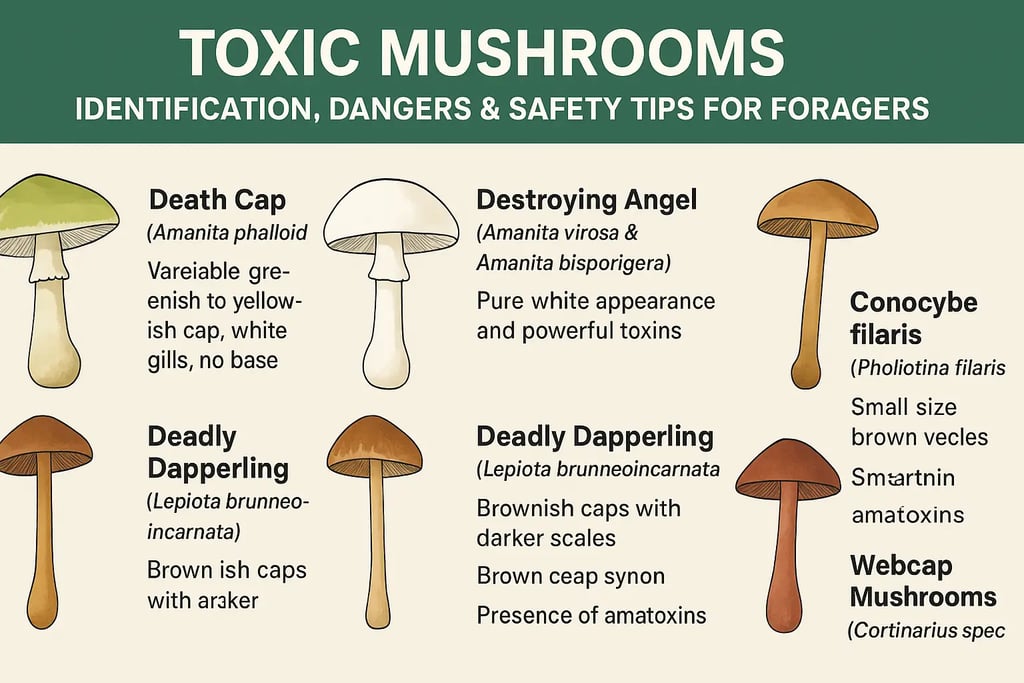
Toxic Mushrooms: Identification, Dangers & Safety Tips for Foragers
Click here to discover more Health Benefits of Mushroom
Introduction to Toxic Mushrooms
While mushrooms are widely praised for their nutritional value and culinary versatility, some species pose serious risks to human health. Among the thousands of mushroom varieties found worldwide, several are toxic—and some are fatally poisonous. Accidental ingestion of these toxic species leads to numerous poisoning cases every year, making awareness and identification essential for hikers, foragers, and nature lovers.
Misidentifying wild mushrooms can cause severe gastrointestinal issues, organ failure, or even death. This guide aims to educate readers about the appearance, habitat, and toxic effects of some of the most dangerous mushrooms on earth.
In this article, you will learn about seven highly toxic mushroom species:
Amanita phalloides (Death Cap)
Amanita muscaria (Fly Agaric)
Galerina marginata (Deadly Galerina / Funeral Bell)
Gyromitra esculenta (False Morel)
Cortinarius rubellus (Deadly Webcap)
Paxillus involutus (Brown Roll-rim)
Omphalotus olearius (Jack-O’-Lantern Mushroom)
By the end, you’ll be better equipped to identify these poisonous mushrooms and stay safe during outdoor activities.
1. Death Cap (Amanita phalloides)
The Death Cap is considered one of the deadliest mushrooms in the world. Its greenish-yellow to pale white cap (5–15 cm wide) has a smooth, silky surface with faint patches. Its white gills are free from the stalk and densely packed, while the stipe features a distinct sac-like volva at the base—a major identifying feature.
Habitat
Common in Europe, North America, and Australia
Thrives in deciduous forests, often near oak, chestnut, and other broad-leaved trees
Toxins & Symptoms
Death Caps contain amatoxins, which shut down liver cell protein synthesis. Symptoms appear 6–24 hours after ingestion and include:
Abdominal pain
Vomiting
Diarrhea
Liver and kidney failure
Even a small bite can be fatal.
Identification Tips
White spore print
No noticeable smell
Often confused with edible Straw Mushrooms and puffballs
Extreme caution is essential.
2. Destroying Angel (Amanita virosa & Amanita bisporigera)
The Destroying Angel is another deadly Amanita species, known for its deceptively clean, pure-white appearance. Its cap measures 5–15 cm and features free white gills and a bulbous stipe with a volva.
Habitat
Found in Europe and North America
Grows in moist, nutrient-rich woodland soils
Toxic Effects
Destroying Angels also contain amatoxins, causing:
Nausea, vomiting, diarrhea (6–12 hours after ingestion)
Temporary symptom relief
Violent return of symptoms
Liver and kidney failure
Identification Tips
Completely white cap, gills, and stem
Free gills
Prominent volva
This species is often mistaken for edible white mushrooms—making it extremely dangerous.
3. Conocybe filaris (Pholiotina filaris)
Conocybe filaris is a small but highly toxic mushroom commonly found in lawns, grassy areas, and compost heaps across the Northern Hemisphere.
Appearance
Small conical cap (up to 2 cm)
Bell-shaped when young, flat when mature
Brownish-yellow, smooth, slightly sticky surface
Rusty-brown gills as they age
Thin stem with a small ring
Toxins
Contains amatoxins, causing delayed liver damage and kidney failure.
Symptoms
Stomach cramps
Diarrhea
Vomiting
Liver failure (if untreated)
Often mistaken for harmless Conocybe species, this mushroom demands caution.
4. Deadly Dapperling (Lepiota brunneoincarnata)
The Deadly Dapperling is a small yet extremely poisonous species with a brownish cap patterned with darker scales (2–7 cm diameter).
Habitat
Found in Europe and Asia
Grows in gardens, parks, and grassy soil
Toxicity
Contains amatoxins that can destroy liver and kidney cells.
Symptoms
Start 6–24 hours after ingestion:
Nausea
Abdominal pain
Vomiting
Severe dehydration
Potential organ failure
Identification Tips
Scaly brownish cap
Free white gills
Slender, white or pinkish stem
Numerous poisonings have been traced back to this mushroom due to its resemblance to edible Lepiota species.
5. Galerina marginata (Deadly Galerina / Funeral Bell)
Galerina marginata is a small, brown, wood-loving mushroom with lethal amatoxins.
Appearance
Brown cap (1–4 cm)
Hygrophanous—turns translucent when wet
Cap edges often striated
Small ring on the stem
Habitat
Found on decaying wood
Common in Europe, North America, Asia, and Oceania
Risk
Easily confused with edible Honey Mushrooms or Sheathed Woodtufts.
Toxic Effects
Severe abdominal pain
Vomiting, diarrhea
Liver failure
Immediate medical care is crucial.
6. Webcap Mushrooms (Cortinarius species)
Webcaps, especially Cortinarius rubellus, are known for containing orellanine, a toxin that causes slow but severe kidney damage.
Appearance
Cobweb-like veil (cortina) present in young mushrooms
Cap colors vary: brown, yellow, red, or purple
Gills turn rusty-brown with age
Habitat
Temperate forests
Often grow under pine, spruce, or oak trees
Symptoms
Appear days to a week later:
Nausea
Vomiting
Fatigue
Kidney failure
Many poisoning incidents occur because of confusion with edible mushrooms.
Best Practices for Identifying Toxic Mushrooms
To safely forage mushrooms, follow these essential guidelines:
1. Use Reliable Identification Resources
Reputable field guides with detailed photos
Regional mushroom books
Trusted educational websites
2. Consult Experts
Local mycological societies
Professional foragers
Guided mushroom walks
3. Use Scientific Methods
Spore prints for accurate differentiation
Avoid tasting—dangerous and unnecessary
4. Learn Key Toxic Traits
Many poisonous mushrooms share features such as:
White gills
Bulbous base
Rings on the stem
But these alone are not enough for identification.
5. Avoid Myths
False ideas—like toxic mushrooms turning silver black—can be deadly.
6. When in Doubt, Do Not Consume
The safest rule for foraging: If you are not 100% sure, leave it.
MicroNews © 2025
MicroNews empowers the generation of tomorrow for a brighter future and hope for every individual.
Thanks For Touch with us
We care about your data in our privacy policy.
Popular Post
Top 10 Calcium-Rich Vegetables for Strong Bones & Better Health
Patala Garuda (Rauvolfia serpentina): Health Benefits, Ayurvedic Uses
Ganga Siuli (Parijata Tree): Benefits, Uses, and Medicinal Properties
Freelancing Explained: How to Start, Earn, and Succeed as a Freelancer
Turmeric Benefits: Uses, Nutrition, Ayurveda Importance & Side Effects
Science of Longevity: New Research Reveals How Diet May Shape Lifespan