
Understanding X-Rays: Discovery, Benefits, Risks & Latest Technological Advancements
X-rays are a powerful form of electromagnetic radiation with wavelengths shorter than ultraviolet light but longer than gamma rays. Since their discovery in 1895 by Wilhelm Conrad Röntgen, X-rays have transformed modern science—especially medical imaging. Their ability to visualize internal body structures without surgery has made them one of the most valuable diagnostic tools in healthcare.
What Are X-Rays?
X-rays fall under ionizing radiation, meaning they can remove electrons from atoms and create charged particles. This unique characteristic allows X-rays to penetrate the human body and produce detailed images.
When X-rays pass through the body:
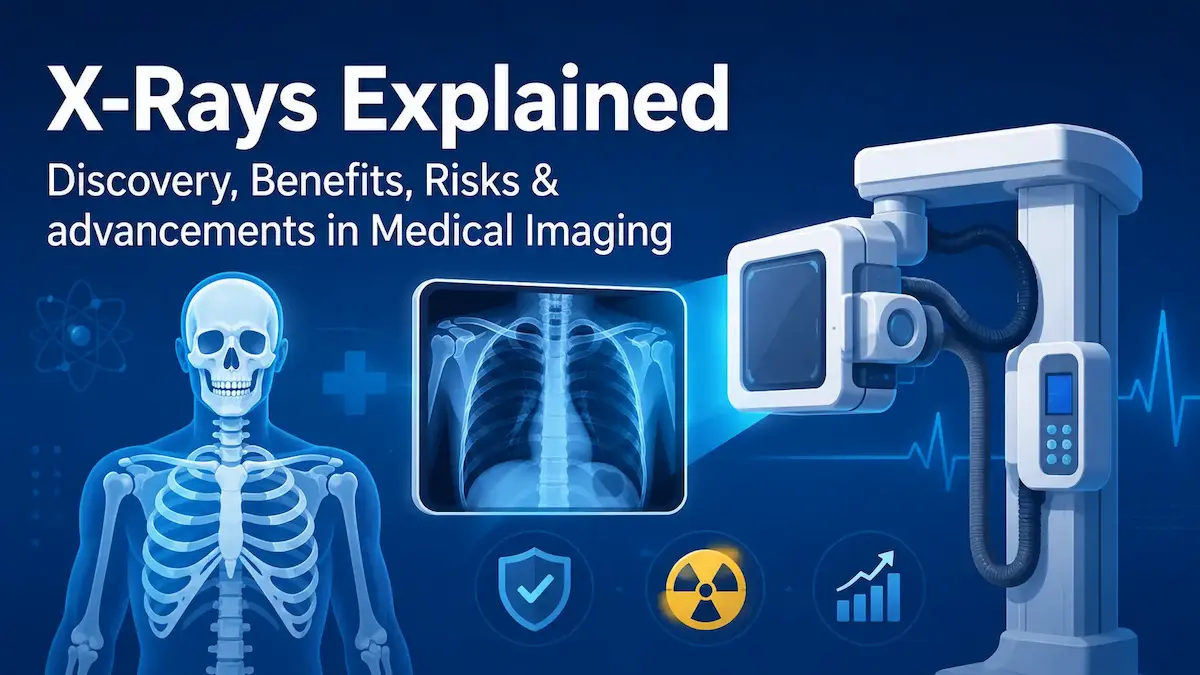
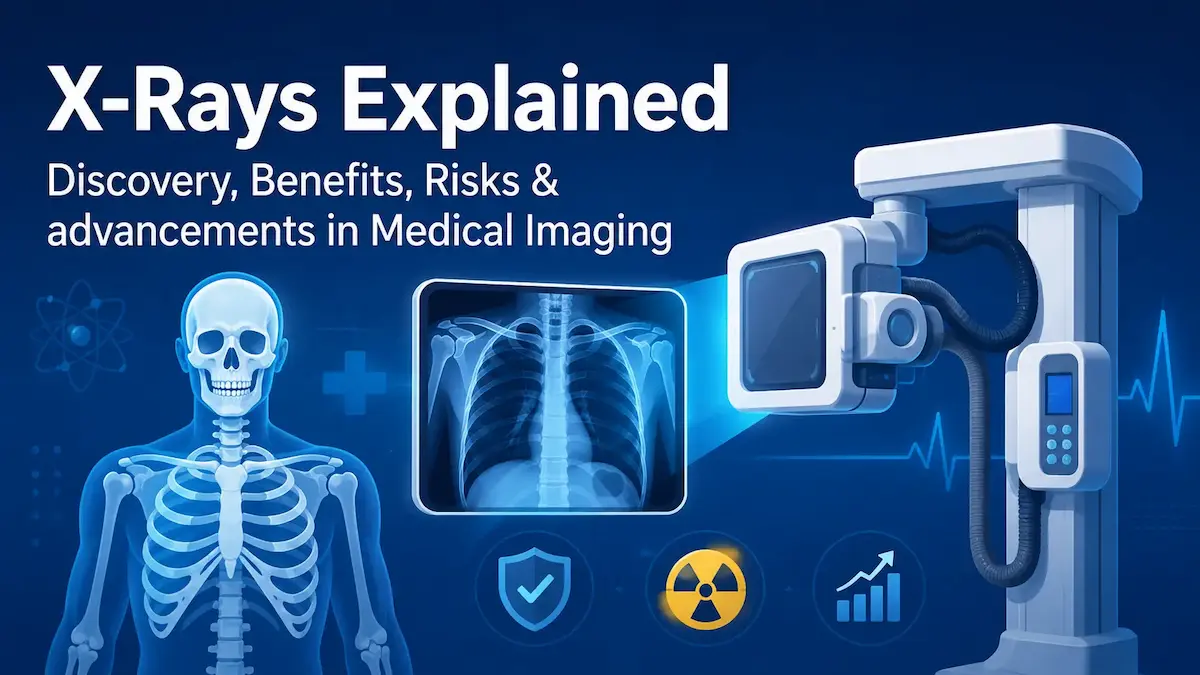
Dense tissues like bones absorb more radiation and appear white.
Soft tissues allow more X-rays to pass through and appear darker.
This contrast makes it possible to accurately diagnose fractures, infections, and various medical conditions.
Beyond medicine, X-rays are widely used in:
Industrial inspection (checking welds, pipelines, machinery)
Security screening (airport baggage scanners)
Scientific research (X-ray crystallography for studying molecular structures like DNA)
Also read: MRI Scan: How It Works, History, Safety, and Diagnostic Accuracy
The Discovery of X-Rays
The discovery of X-rays is one of science’s most significant breakthroughs. In 1895, German physicist Wilhelm Conrad Röntgen observed a new, mysterious ray while experimenting with cathode tubes. These rays could pass through wood, paper, and human tissue—yet were blocked by metal and bone.
Röntgen’s first-ever X-ray image was of his wife’s hand, clearly revealing her bones and wedding ring. This groundbreaking moment paved the way for:
Diagnostic radiology
Non-invasive imaging
Advanced medical technologies like CT scans and fluoroscopy
In recognition of his work, Röntgen received the first Nobel Prize in Physics in 1901.
Benefits of X-Rays
X-rays play a crucial role across various fields, with their most profound impact in medicine.
1. Medical Diagnostics
X-rays help doctors:
Detect bone fractures
Identify infections like pneumonia
Diagnose arthritis, tumors, and digestive issues
Guide surgical procedures
Monitor treatment progress
Specialized X-ray technologies include:
Mammography – early detection of breast cancer
Dental X-rays – detection of cavities, root issues, and jaw problems
2. Security and Surveillance
Airport security scanners use X-rays to examine luggage for weapons, explosives, and prohibited items—ensuring passenger safety without manual inspections.
3. Industrial Applications
X-rays are essential for non-destructive testing, including:
Inspecting welds in pipelines
Detecting cracks or weaknesses in machinery
Evaluating product quality in manufacturing
4. Scientific Research
X-rays contribute to breakthroughs in:
Physics
Chemistry
Archeology
Art restoration
Techniques like X-ray crystallography have been instrumental in discovering molecular structures, including DNA.
Side Effects and Risks of X-Rays
While X-rays are generally safe, they do involve exposure to ionizing radiation. Understanding the risks helps ensure safe usage.
Potential Risks
Cell damage due to radiation exposure
Increased risk of cancer with repeated or high-dose exposure
Rare radiation burns in high-intensity imaging procedures
How Risks Are Minimized
Medical professionals follow strict safety practices, including:
Using lead aprons and thyroid shields
Keeping exposure levels As Low As Reasonably Achievable (ALARA)
Using modern machines designed to minimize radiation
Conducting X-rays only when medically necessary
Global health authorities like WHO and radiological boards regularly update guidelines to ensure patient safety.
Recent Advances in X-Ray Technology
X-ray technology has evolved tremendously, improving imaging quality while reducing risks.
1. High-Definition Digital Imaging
Modern detectors and image-processing systems produce sharper, clearer images, enabling:
Better diagnosis
Faster reporting
Reduced need for repeat scans
2. Reduced Radiation Dose
New techniques—such as adaptive exposure control and iterative reconstruction—ensure minimal radiation exposure.
3. Digital X-Ray Systems
Digital radiography offers:
Instant image viewing
Easy storage and sharing
Enhanced contrast and detail
4. Computed Tomography (CT)
CT scans use multiple X-ray images to create 3D views of the body, helping detect:
Internal injuries
Vascular issues
5. Dual-Energy X-Rays
These systems can differentiate materials with similar densities—useful in bone density testing and detecting subtle abnormalities.
6. Portable X-Ray Machines
Widely used in emergency rooms, sports fields, ambulances, and remote locations.
7. AI and Machine Learning Integration
Artificial intelligence now assists radiologists by:
Detecting anomalies automatically
Improving accuracy
Speeding up diagnosis
8. Photon-Counting Detectors (Next-Gen)
An emerging technology that promises:
Ultra-high-resolution images
Lower radiation exposure
Better soft-tissue clarity
Conclusion: The Future of X-Ray Technology
From their accidental discovery in 1895 to today’s cutting-edge digital imaging systems, X-rays have revolutionized medicine, security, and scientific research. Despite the risks associated with ionizing radiation, advancements in technology have made X-rays safer and more precise than ever before.
Looking ahead, innovations such as AI-driven diagnostics, portable imaging devices, and high-resolution photon-counting systems are expected to redefine how we use X-rays in healthcare and beyond.
X-rays will continue to be an indispensable tool—helping save lives, enhance safety, and drive scientific discovery.