
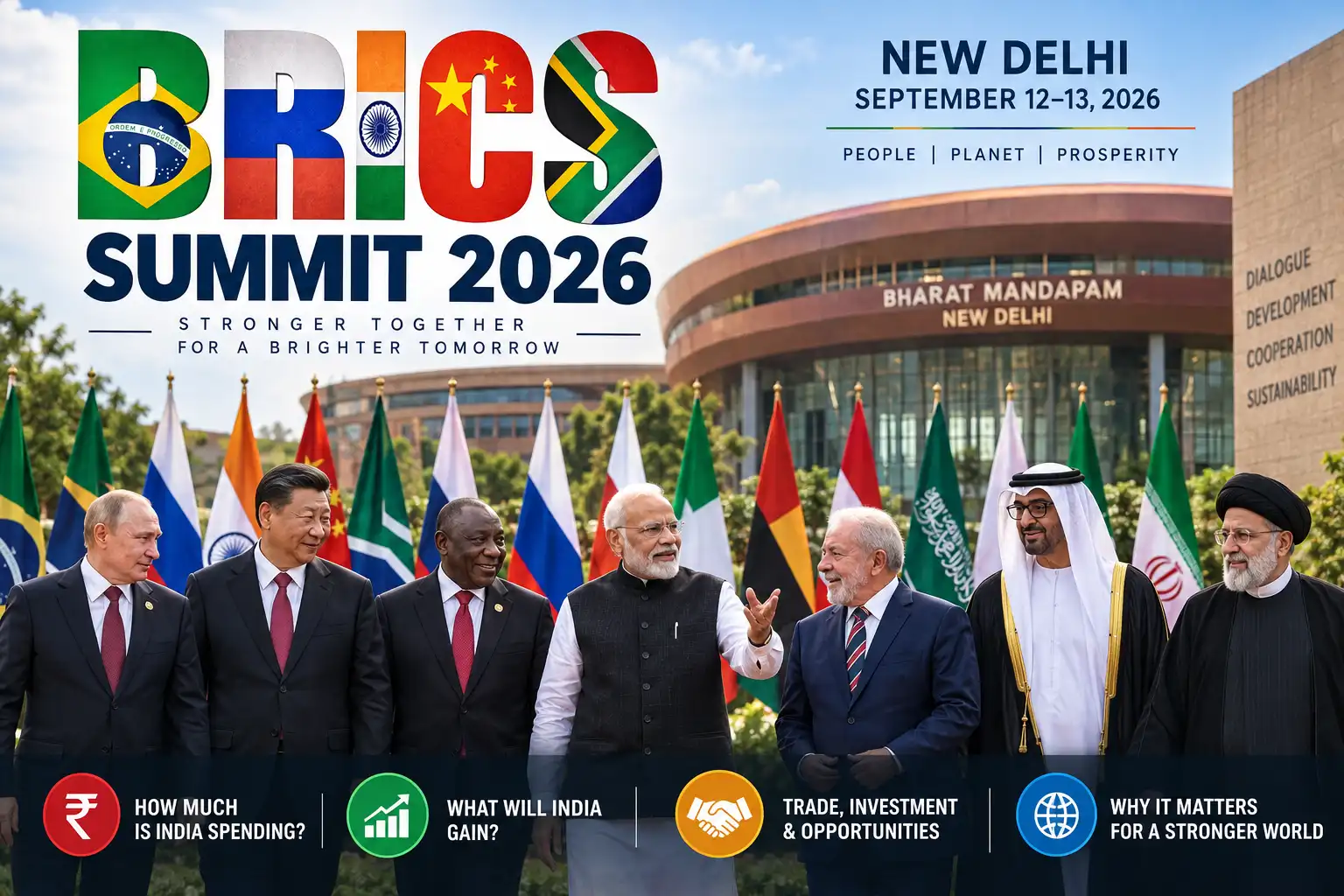
BRICS Summit 2026 is taking place in New Delhi on September 12 and 13, 2026, with India hosting the 18th BRICS Summit at Bharat Mandapam. India assumed the BRICS chairship on January 1, 2026, for the fourth time since the grouping was established. The summit comes at an important moment for India as BRICS expands its economic and geopolitical influence while India simultaneously faces a major trade deficit with the bloc.
But one question is increasingly important for ordinary Indians:
How much is India spending on BRICS, and what does India actually gain from hosting it?
The answer is not as simple as looking at the cost of the two-day summit. India has conducted hundreds of BRICS-related meetings throughout 2026, while the potential benefits involve trade, investment, diplomacy, technology, energy security and India’s influence among developing economies.
BRICS Summit 2026 Latest Update
The 18th BRICS Summit is being held in New Delhi on September 12–13, 2026. India is hosting the summit under its 2026 BRICS chairship, with discussions focused on trade, investment, technology, energy security and cooperation among emerging economies.
BRICS Summit 2026: Quick Facts
| Detail | Information |
|---|---|
| BRICS Summit | 18th BRICS Summit |
| Host country | India |
| Venue | Bharat Mandapam, New Delhi |
| Main summit dates | September 12–13, 2026 |
| India’s BRICS chairship | January 1–December 31, 2026 |
| India’s theme | Building for Resilience, Innovation, Cooperation and Sustainability |
| BRICS members | 11 |
| Major focus areas | Trade, finance, technology, energy, food security and global governance |
| Major concern for India | Growing trade deficit with BRICS countries |
India’s official BRICS backgrounder says the grouping currently consists of Brazil, China, Egypt, Ethiopia, India, Indonesia, Iran, Russia, Saudi Arabia, South Africa and the UAE. Together, these countries account for around 49.5% of the world’s population, 40% of global GDP and 26% of global trade.
How Many Days Will BRICS Summit 2026 Continue?
The main leaders’ summit will take place over two days — September 12 and September 13, 2026.
However, India’s BRICS chairship is not a two-day event.
India assumed the chairship on January 1 and has conducted more than 350 meetings and high-level engagements across more than 25 cities during the year. These activities cover political and security cooperation, economic and financial cooperation, and cultural and people-to-people exchanges.
The two-day leaders’ summit is therefore the culmination of a much larger year-long programme.
What Is BRICS and Why Is It Important?
The first BRICS summit took place in Yekaterinburg, Russia, on June 16, 2009. The acronym BRIC was created in 2001 by economist Jim O’Neill of Goldman Sachs to describe fast-growing markets. An annual meeting of leading emerging economies. Stands for Brazil, Russia, India, China, and South Africa (plus newly added members). Political cooperation started in 2006 when foreign ministers from Luiz Inácio Lula da Silva (Brazil), Dmitry Medvedev (Russia), Manmohan Singh (India), and Hu Jintao (China) attended in New York City. The leaders of these four nations launched the first official summit in 2009. South Africa joined in 2010, changing the name to BRICS.
BRICS began as a grouping of major emerging economies and has gradually developed into an important platform for cooperation among countries of the Global South.
Its agenda is no longer restricted to economic growth.
BRICS now discusses:
- International trade
- Investment
- Development finance
- Digital technology
- Artificial intelligence
- Food security
- Energy security
- Supply chains
- Cross-border payments
- Global governance reform
- Political and security cooperation
For India, BRICS provides an additional diplomatic platform alongside organisations such as the G20, the United Nations and other international forums.
India’s 2026 chairship is being guided by the theme “Building for Resilience, Innovation, Cooperation and Sustainability.” The government says its approach is centred on practical cooperation and a people-centric vision described as “Humanity First.”
How Much Is India Spending on BRICS Summit 2026?
This is probably one of the most searched questions around the summit, but it needs a careful answer.
There is currently no single officially published figure showing the complete cost of India’s entire BRICS 2026 chairship.
That is because BRICS 2026 is not one event.
India has organised hundreds of meetings across more than 25 cities. Expenses can include:
- Security arrangements
- Accommodation
- Transportation
- Venue preparation
- Event management
- Technology infrastructure
- Communication facilities
- Delegation arrangements
- Media facilities
- Cultural programmes
- Exhibitions
- City preparation and beautification
Individual government procurement documents and reports have identified spending on specific BRICS-related activities. However, those individual amounts should not be added together and presented as the total cost of BRICS 2026 unless the government publishes a consolidated figure.
This distinction is important because a number of websites may publish estimates that look like the “BRICS cost”, even though they represent only one project or one category of expenditure.
For MicroNews readers, the safest conclusion is:
India has incurred substantial expenditure on BRICS-related activities, but the final consolidated cost of the entire 2026 chairship has not yet been publicly established in one official figure.
That figure may become clearer after the chairship and associated government accounts are finalised.
Why Is India Spending Money on BRICS?
If hosting an international summit costs money, why does India do it?
The answer is that the government views international summits as an investment in diplomacy, economic cooperation and international influence.
The benefits are not necessarily received immediately in the form of tax revenue.
They may appear later through:
- New trade opportunities
- Foreign investment
- Business agreements
- Technology partnerships
- Better payment systems
- Diplomatic cooperation
- Tourism and hospitality activity
- Greater influence in global institutions
The real test, therefore, will be what happens after the summit.
India’s Biggest BRICS Opportunity: Trade
Trade is one of the most important reasons India wants stronger BRICS cooperation.
According to the Indian government, BRICS countries account for nearly one-fourth of global trade. Commerce and Industry Minister Piyush Goyal has called for deeper and more balanced intra-BRICS trade, easier market access and simpler regulatory procedures.
India is particularly interested in expanding exports in sectors including:
- Pharmaceuticals
- Agriculture
- Engineering
- Electronics
- Automobiles
- Services
- Startups
- Emerging technologies
The government has also called for stronger payment-system connectivity and greater use of member countries’ local currencies in trade.
For Indian businesses, that could eventually mean easier access to a very large group of international markets.
But There Is a Major Problem: India’s BRICS Trade Deficit
This is where the BRICS story becomes much more complicated.
India’s trade with BRICS has increased significantly, but imports have grown much faster than exports.
India’s merchandise exports to BRICS countries increased from approximately $64.3 billion in FY2021 to $95.7 billion in FY2026.
But imports increased from approximately $138.8 billion to $321.8 billion over the same period.
As a result, India’s trade deficit with the BRICS bloc reached approximately $226.1 billion in FY2025–26.
This creates an important question:
Is India actually benefiting from BRICS trade?
The answer is yes, but unevenly.
India gets access to large markets, energy supplies, raw materials, investment and technology.
But the country also imports significantly more from several BRICS partners than it exports to them.
China is particularly important in this equation.
Therefore, simply increasing BRICS trade is not enough for India.
India wants more balanced trade, which means increasing the value and volume of Indian exports while reducing unnecessary import dependence.
Can BRICS Help India Reduce Its Trade Deficit?
Potentially, but there is no guarantee.
India is pushing BRICS countries to:
- Open their markets further
- Reduce regulatory barriers
- Improve customs procedures
- Connect payment systems
- Promote trade using local currencies
- Increase investment
- Strengthen supply chains
If Indian pharmaceutical companies, engineering companies, technology firms, automobile manufacturers, agricultural businesses and service providers gain greater access to BRICS markets, India’s exports could increase.
But this will depend on actual agreements and implementation.
A declaration at a summit does not automatically increase exports.
BRICS Currency: Is a Common Currency Coming?
Another popular search topic is the BRICS common currency.
There has been considerable discussion internationally about reducing dependence on the US dollar in international trade.
However, readers should distinguish between:
A common BRICS currency
and
greater use of national currencies and alternative payment mechanisms.
India has shown interest in improving payment connectivity and facilitating trade in local currencies. The Indian government has also emphasised linking payment systems among BRICS members.
That does not mean India has agreed to replace the rupee with a new BRICS currency.
For India, a practical approach could be more important than creating a completely new currency.
If Indian companies can settle some transactions directly in rupees or partner-country currencies, transaction costs and dependence on intermediary currencies could potentially be reduced.
What Will India Gain From BRICS 2026?
India’s potential gains can be divided into several areas.
1. Greater Diplomatic Influence
Hosting the summit allows India to shape discussions rather than simply participate in them.
India can place issues such as development, technology, trade and Global South representation higher on the international agenda.
2. Trade Opportunities
India can use BRICS to seek better access for Indian products and services.
3. Investment
The expanded BRICS grouping creates opportunities for investment partnerships between businesses and financial institutions.
4. Technology Cooperation
India is particularly interested in cooperation involving artificial intelligence, digital technologies, agriculture technology and innovation.
5. Energy Security
BRICS includes major energy producers and consumers.
Greater cooperation could help India strengthen energy partnerships and diversify sources of supply.
6. Food and Agricultural Cooperation
India has promoted cooperation in agriculture, including research, digital agriculture and sustainable farming.
The government has announced BRICS initiatives involving agricultural research, digital agriculture and agro-input cooperation during India’s chairship.
7. Stronger Global South Voice
BRICS gives India another platform for arguing that developing countries should receive greater representation in global institutions.
Why Xi Jinping’s Visit Matters
China is one of India’s most important BRICS partners and simultaneously one of its biggest economic challenges.
Therefore, any high-level India-China interaction during the summit is closely watched.
The relationship affects:
- Trade
- Investment
- Manufacturing
- Technology
- Border security
- Supply chains
- Regional geopolitics
For India, BRICS provides a forum where cooperation with China is possible even while bilateral differences remain.
That balancing act is one of the biggest strategic challenges for India’s BRICS chairship.
What Are the Major Issues at BRICS Summit 2026?
The two-day summit is expected to focus on several major themes:
- Global governance reform
- International trade
- Investment
- Food security
- Energy security
- Technology
- Artificial intelligence
- Digital payments
- Local-currency trade
- Supply-chain resilience
- Development cooperation
- Political and regional issues
The summit is expected to culminate in the New Delhi Declaration, setting out the group’s collective positions and priorities.
Is Hosting BRICS 2026 Worth the Money?
There are arguments on both sides.
The case for hosting BRICS
India gains international visibility, diplomatic influence and an opportunity to shape the agenda of a major emerging-economy grouping.
The year-long chairship has also brought BRICS meetings to cities across India, creating opportunities for business, government and institutional cooperation.
The case for greater scrutiny
Hosting such a large international programme costs public money.
At the same time, India’s trade deficit with BRICS has reached approximately $226.1 billion.
Therefore, critics can reasonably ask whether India is receiving enough economic benefit from its growing BRICS engagement.
The best answer will not come from political speeches.
It will come from measurable results:
Did Indian exports increase?
Did investment increase?
Did Indian companies gain better market access?
Did payment systems become easier?
Did India reduce its trade imbalance?
Those are the metrics that will ultimately determine whether BRICS 2026 was successful for India.
BRICS Summit 2026: What Happens After September 13?
The end of the summit will not be the end of India’s BRICS work.
The important phase begins after the leaders return home.
India will need to work with other members to turn summit declarations into actual policies and agreements.
For Indian businesses, the most important developments to watch will be:
- New market-access arrangements
- Trade and investment agreements
- Payment-system cooperation
- Local-currency settlement
- Technology partnerships
- Supply-chain initiatives
- Agricultural cooperation
- Support for MSMEs and startups
If these initiatives produce measurable results, the economic value of India’s BRICS chairship could become much clearer.
BRICS Summit 2026: Frequently Asked Questions
How many days is the BRICS Summit 2026?
The main BRICS Leaders’ Summit will be held for two days, September 12 and 13, 2026, in New Delhi.
Where is BRICS Summit 2026 being held?
The summit is being held at Bharat Mandapam in New Delhi.
How many countries are members of BRICS in 2026?
BRICS currently has 11 full members: Brazil, China, Egypt, Ethiopia, India, Indonesia, Iran, Russia, Saudi Arabia, South Africa and the UAE.
How much is India spending on BRICS 2026?
There is currently no single publicly disclosed official figure for the complete cost of India’s 2026 BRICS chairship. Individual expenditures and procurement contracts do not represent the total cost.
What is India’s BRICS trade deficit?
India’s merchandise trade deficit with BRICS countries reached approximately $226.1 billion in FY2025–26.
Will BRICS have a common currency?
There is no confirmed BRICS common currency replacing national currencies. Current discussions include improving cross-border payment systems and increasing trade in local currencies.
What does India gain from BRICS?
Potential benefits include greater diplomatic influence, trade opportunities, investment, technology cooperation, energy partnerships, agricultural cooperation and stronger representation for developing economies.
Conclusion
The BRICS Summit 2026 is more than a two-day diplomatic event.
India’s chairship has involved more than 350 meetings and high-level engagements across more than 25 cities, culminating in the September 12–13 leaders’ summit in New Delhi.
For India, the opportunity is enormous. BRICS represents a major share of the world’s population, economy and trade.
But the country also faces a major challenge: its trade deficit with BRICS countries has reached approximately $226.1 billion.
That makes the success of BRICS 2026 particularly important.
India does not simply need more BRICS trade.
It needs more balanced BRICS trade.
The ultimate measure of India’s BRICS 2026 chairship will therefore not be the size of the summit, the number of leaders attending or how much attention the event receives.
It will be whether the agreements made in New Delhi eventually create more exports, investment, jobs, technology, business opportunities and economic security for India.
Official Sources:
Government of India — BRICS 2026 backgrounder