
Last updated: September 8, 2026
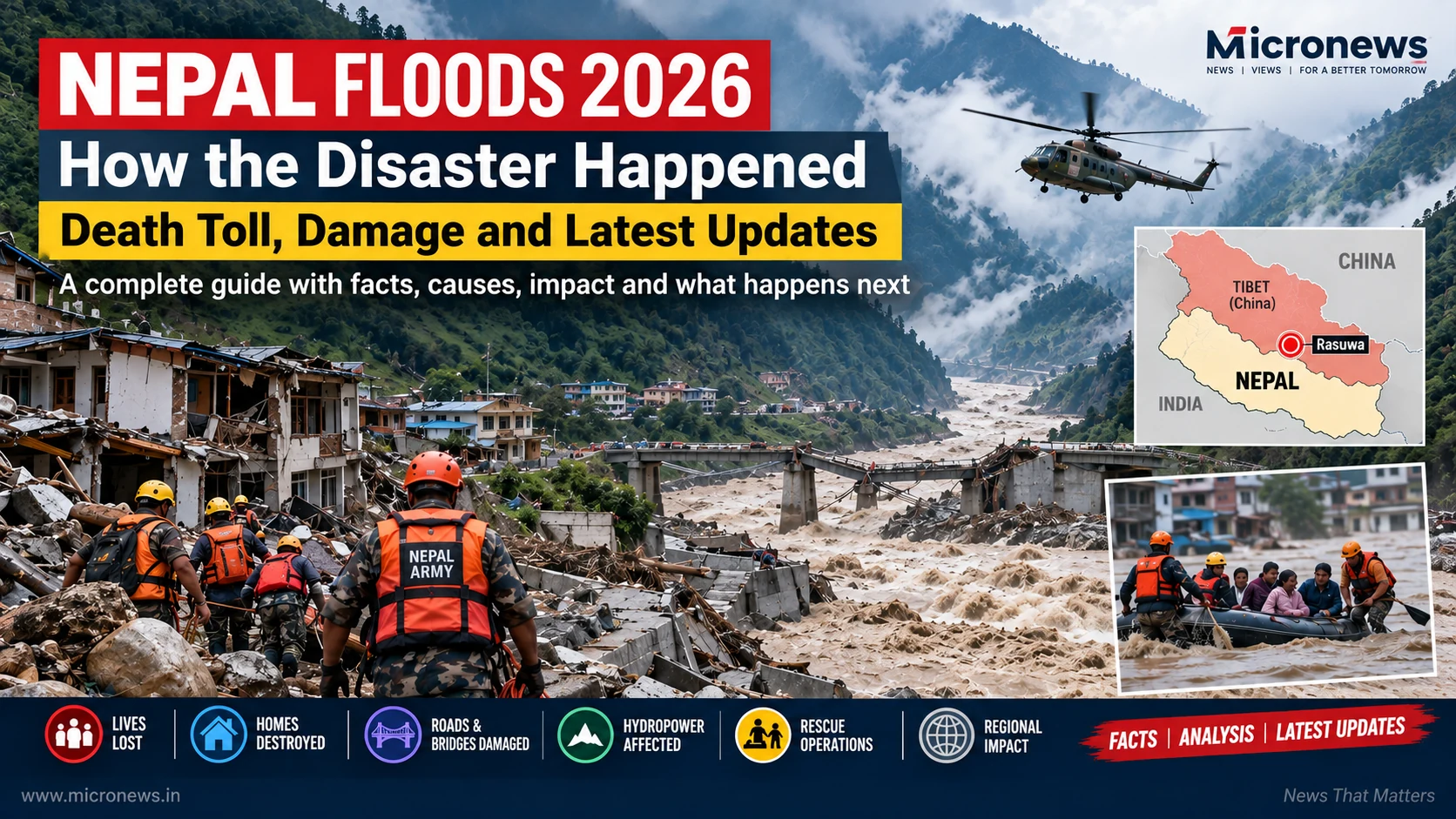
The Nepal floods 2026 disaster has become one of the country’s most devastating recent disasters, causing widespread loss of life, destruction of homes and infrastructure, and a major search-and-rescue operation.
The disaster began on August 26, 2026, when severe flooding affected areas along the Bhote Koshi and Trishuli river corridors in Nepal. The worst-affected areas include Rasuwa, Nuwakot, Dhading and other districts, while the event was also connected to an upstream disaster in the Tibet Autonomous Region of China.
As search and rescue operations continue, the number of confirmed deaths and missing people is still changing.
According to the latest update from Nepal’s Ministry of Foreign Affairs, issued at 2:00 PM Nepal time on September 8, 1,357 bodies had been recovered, around 5,300 people remained missing, and 13,583 people had been rescued. The government stressed that these figures continue to change as search, rescue and identification operations continue.
What Happened in Nepal?
On August 26, a sudden and extremely powerful flood struck the Bhote Koshi River system in northern Nepal.
The flooding rapidly moved downstream, carrying huge quantities of water, mud, rocks and other debris. Communities, roads, bridges, buildings, markets and hydropower facilities were severely damaged.
The disaster particularly affected communities along the Bhote Koshi and Trishuli river corridors. The World Health Organization has identified Rasuwa, Nuwakot, Dhading and Chitwan in Bagmati Province, along with Gorkha and Tanahun in Gandaki Province, among the affected districts.
Nepal’s Ministry of Foreign Affairs said enormous quantities of water, mud and debris moved downstream through Rasuwa and into the Trishuli and Narayani river systems, affecting communities and infrastructure.
When Did the Nepal Floods Happen?
The major Nepal floods 2026 event occurred on August 26, 2026.
Search, rescue and recovery operations continued into September as authorities searched for missing people and workers who may have been trapped inside hydropower tunnels.
By September 8, the government described the response as being in its fourteenth day.
How Did the Nepal Floods Happen?
The exact chain of events is still being investigated.
According to the World Health Organization, preliminary information indicates that the flooding in Rasuwa followed a sudden surge of water into the Bhote Koshi River from the Tibet Autonomous Region of China. The event may have been associated with an upstream ice avalanche and temporary damming of the Lhende River, although assessments were continuing.
Nepal’s government has also said that it continues to study the causes and evolution of the unprecedented event.
Therefore, it is more accurate to describe the disaster as a sudden flood associated with an upstream Himalayan event rather than claiming that one specific cause has been conclusively established.
A simple explanation
The disaster can be broadly understood as:
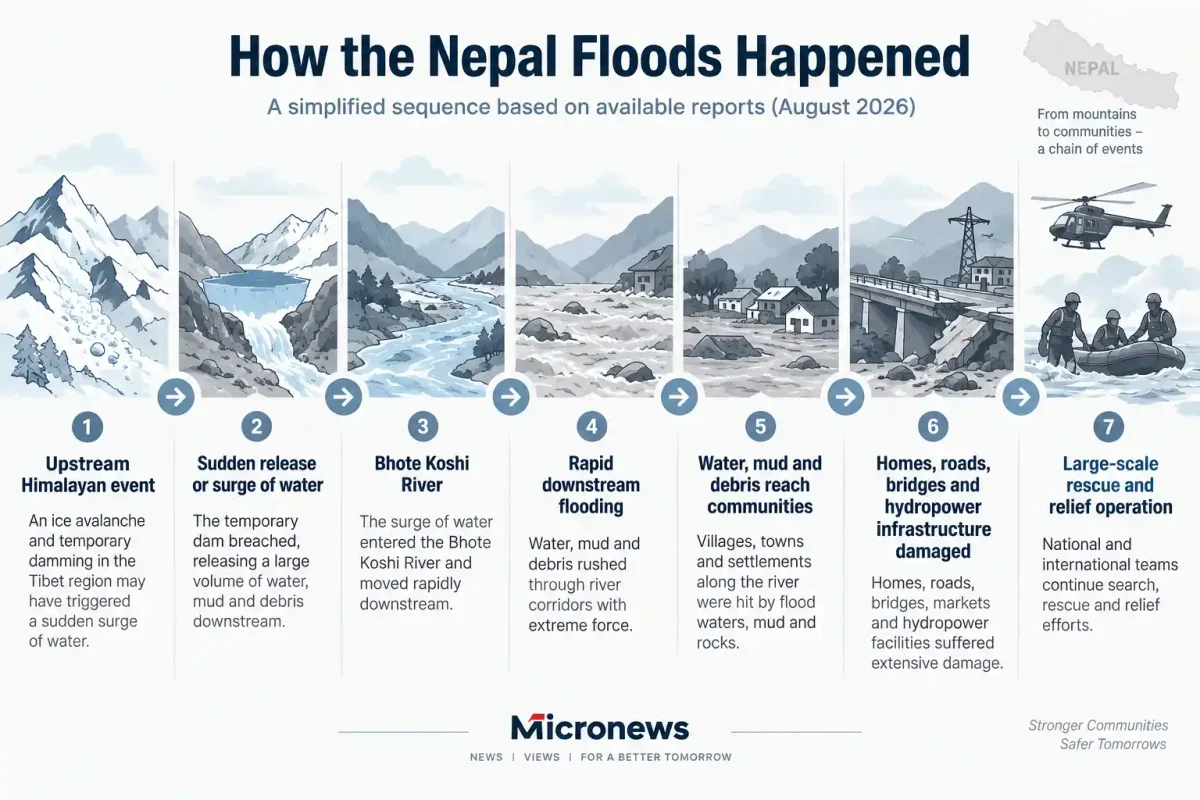
The precise physical sequence is still being assessed by authorities and technical experts.
Which Countries Were Affected?
The disaster affected Nepal and the Tibet Autonomous Region of China.
Nepal suffered extensive damage along the Bhote Koshi and Trishuli river systems.
On the Chinese side, the disaster also affected the Gyirong area near the Nepal-China border. Reuters reported that the disaster destroyed the Gyirong border crossing and caused deaths and missing persons on the Chinese side as well.
Because casualty figures are still being verified separately by authorities in Nepal and China, totals should be treated carefully rather than simply combining different reports.
Nepal Flood Death Toll and Missing People
The human toll continues to change as rescue teams recover bodies and authorities verify reports.
According to Nepal’s Ministry of Foreign Affairs update of September 8, 2026:
- 1,357 bodies have been recovered
- Around 5,300 people remain missing
- 13,583 people have been rescued
- More than 300 foreigners were among those rescued
- Around 600 foreigners from 35 countries were still reported missing
The ministry emphasized that these figures are constantly updated as search and identification operations continue.
This means the September 8 figures should not be treated as the final death toll.
Why Are So Many People Still Missing?
One of the biggest challenges for rescuers is the destruction caused by mud, rocks and debris.
Some people are believed to have been trapped inside buildings or underground tunnels at hydropower projects.
On September 8, Reuters reported that rescue teams were concentrating on several hydropower tunnels where workers were potentially trapped. More than 100 people were believed to be associated with the missing hydropower workers in the tunnel rescue effort.
The difficult terrain, unstable debris, damaged roads and continuing rescue challenges have made the operation extremely difficult.
Rescue Operations in Nepal
Nepal has mobilized the country’s disaster-response agencies, including:
- Nepal Army
- Nepal Police
- Armed Police Force
- National Disaster Risk Reduction and Management Authority
- Provincial and local authorities
International teams have also been assisting Nepal.
The September 8 government update said tunnel rescue teams from India, China and South Korea were working with the Nepali Army. Search-and-rescue teams from the United Arab Emirates, Malaysia and Australia were also supporting the operation.
Rescue teams are using specialized equipment, drones and other technology to search affected areas.
The Nepalese government has also requested additional equipment including high-capacity drones, LiDAR systems, Bailey bridges, DNA-testing kits, underwater drones, generators, pumps and specialized mud and tunnel rescue equipment.
Hydropower Workers Trapped in Tunnels
The disaster caused serious problems for Nepal’s hydropower sector.
Several hydropower projects were affected, including:
- Upper Trishuli 1
- Upper Trishuli 3A
- Upper Trishuli 3B
- Chilime
- Rasuwagadhi
- Langtang
- Mailung Khola
According to the Nepal government, search operations were continuing at several of these projects.
Some workers were subsequently rescued alive after spending days trapped underground.
Reuters reported that two hydropower workers were rescued from the Upper Trishuli 3A tunnel after nine days underground.
These rescues have provided hope that other missing people may still be found.
Damage to Homes, Roads and Bridges
The floods caused extensive destruction to critical infrastructure.
The WHO reported damage to:
- Homes
- Markets
- Roads
- Bridges
- Customs facilities
- Hydropower infrastructure
- Health facilities
Approximately 10,000 households were reported to need immediate relief.
The destruction of roads and bridges has also made it difficult for emergency teams to reach some communities.
Nepal’s Army and engineers have been working to restore road connectivity, including construction of a temporary bridge over the Tadi River along the Galchhi–Trishuli route.
How Much Economic Damage Did the Nepal Floods Cause?
The initial assessment indicates that the disaster caused enormous economic losses.
According to Nepal’s Ministry of Foreign Affairs, an initial assessment by the National Disaster Risk Reduction and Management Authority (NDRRMA) estimated total losses at approximately:
NPR 387.54 billion
or about:
US$2.6 billion
The estimate covers damage to physical infrastructure, human settlements, bridges, health, education, agriculture, energy, electricity and telecommunications.
However, this is not necessarily the final economic loss.
Nepal’s government said more comprehensive assessments were still being conducted to determine the full extent of damage and reconstruction requirements.
Damage to Nepal’s Hydropower Sector
Hydropower is particularly important to Nepal’s economy, and several projects in the affected region suffered damage.
The flooding and debris affected hydropower facilities, access roads and underground tunnels.
The situation also created a major rescue challenge because workers were inside some of these facilities when the disaster struck.
The impact on electricity generation and future reconstruction costs will become clearer as technical assessments continue.
Health Risks After the Floods
The disaster has created health risks beyond the immediate deaths and injuries.
Flooding can damage water and sanitation systems and increase the risk of contaminated drinking water and infectious diseases.
The WHO identified several potential health risks following the Nepal floods, including:
- Injuries
- Unsafe water and food
- Diarrhoeal diseases
- Respiratory illnesses
- Vector-borne diseases
- Mental health and psychological distress
The organization also reported damage to health facilities in affected areas.
WHO has provided emergency medical supplies and released US$150,000 through its South-East Asia Regional Health Emergency Fund to support the response.
What Happened to Foreign Nationals?
The disaster also affected foreign nationals who were working, travelling or living in the affected region.
Nepal’s September 8 government update said more than 300 foreigners had been rescued, while approximately 600 foreign nationals from 35 countries remained missing at that time.
The presence of foreign nationals among those affected has made identification and international coordination an important part of the rescue operation.
Nepal has requested international assistance with specialist rescue equipment and DNA identification capabilities.
Why Was the Flood So Destructive?
Several factors contributed to the severity of the disaster.
Sudden Release of Water
The flood developed extremely rapidly, leaving communities little time to respond.
Mountainous Terrain
The affected areas are located in steep Himalayan terrain, where rivers can move rapidly through narrow valleys.
Mud and Debris
The flood was not simply a large volume of water. Mud, rocks and other debris were carried downstream, increasing the destructive force.
Infrastructure Located Near Rivers
Roads, bridges, hydropower facilities, settlements and other infrastructure were located along river corridors and were therefore vulnerable.
Difficult Rescue Conditions
Once roads and bridges were destroyed, reaching affected communities became much more difficult.
Is Climate Change Responsible for the Nepal Floods?
The relationship between climate change and Himalayan disasters requires careful explanation.
The immediate cause of this particular flood is still being assessed by authorities and scientists.
The WHO has described the upstream event as potentially involving an ice avalanche and temporary damming, while Nepal’s government says technical assessments are continuing.
Therefore, it would be misleading to say that climate change alone caused this particular flood without further evidence.
However, climate change is an important concern for the Himalayan region because changes in temperature, glaciers, snow and high-altitude water systems can influence future flood and glacial-lake hazards.
The exact contribution of climate change to this specific disaster requires further scientific assessment.
What Is Nepal Doing Now?
The government is continuing:
- Search and rescue operations
- Recovery of bodies
- Identification of victims
- Medical assistance
- Food and shelter distribution
- Restoration of roads
- Restoration of electricity
- Restoration of telecommunications
- Hydropower-site rescue operations
- Reconstruction planning
Nepal is also coordinating with neighboring countries and international organizations for additional equipment, technical expertise and humanitarian assistance.
What Happens Next?
The floods also come at a time when Nepal has faced significant political and social developments. For background, read our Understanding the Nepal Protests: Causes and Global Implications.
The immediate priority remains finding missing people and providing assistance to survivors.
After the emergency phase, Nepal will face a major reconstruction challenge.
Authorities will need to assess:
- Damaged homes
- Roads and bridges
- Hydropower projects
- Schools
- Hospitals and health posts
- Telecommunications
- Electricity infrastructure
- Businesses and markets
- Agricultural losses
The final economic impact is therefore likely to become clearer only after comprehensive assessments are completed.
Latest Nepal Flood Update
As of September 8, 2026, 2:00 PM Nepal time:
| Situation | Latest reported figure |
|---|---|
| Bodies recovered | 1,357 |
| People still missing | Around 5,300 |
| People rescued | 13,583 |
| Foreigners rescued | More than 300 |
| Foreigners still missing | Around 600 from 35 countries |
| Initial estimated economic losses | NPR 387.54 billion / US$2.6 billion |
These figures are not final and may change as search, rescue, identification and damage assessments continue.
Conclusion
The Nepal floods of August 2026 have caused an enormous humanitarian and infrastructure disaster.
The flooding began on August 26 and severely affected communities along the Bhote Koshi and Trishuli river corridors. An upstream event in the Himalayan region appears to have played an important role, but authorities and technical experts are continuing to investigate the precise chain of events.
Thousands of people have been rescued, while thousands remain missing. Homes, roads, bridges, hydropower facilities and other critical infrastructure have suffered extensive damage.
As of September 8, Nepal had recovered 1,357 bodies and reported around 5,300 people still missing. The initial assessment of economic losses stood at approximately NPR 387.54 billion, but the final cost is expected to become clearer after detailed assessments.
The disaster also highlights the vulnerability of Himalayan communities and infrastructure to sudden flood events and the importance of early warning systems, resilient infrastructure, emergency preparedness and international cooperation.
The search for missing people and recovery operations are continuing.
Medical / disaster information disclaimer
Disclaimer: This article is provided for general informational and news purposes. Casualty figures, damage estimates and information about the causes of the Nepal floods may change as authorities continue search, identification and technical assessment. Readers should refer to official government and emergency-management updates for the latest verified information.