
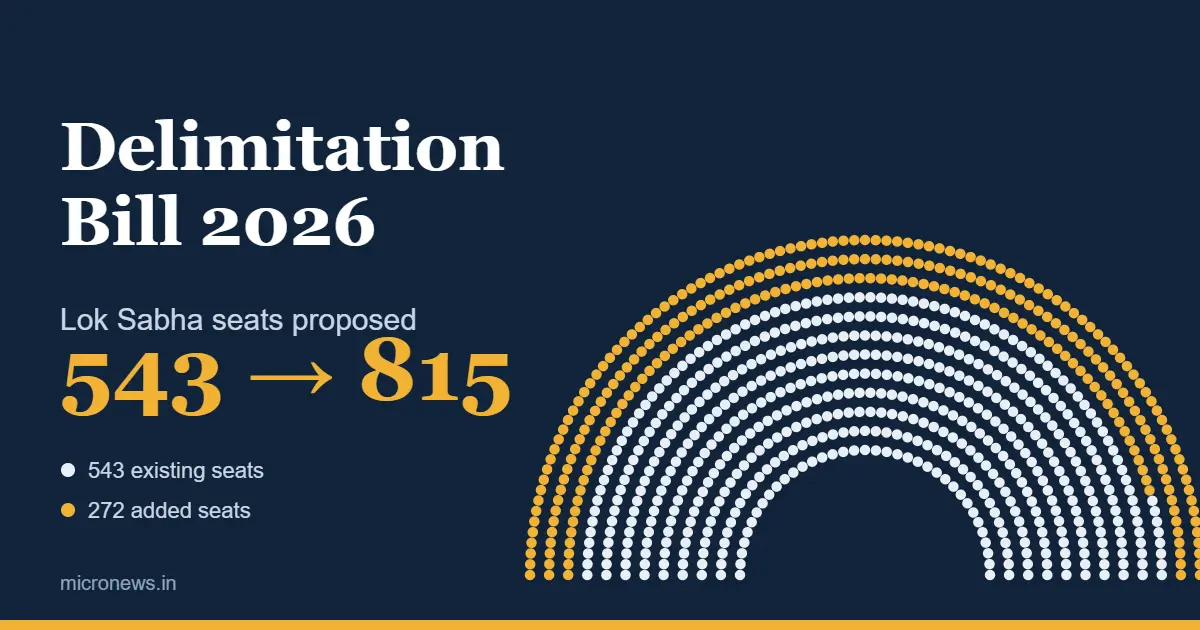
New Delhi: After a defeat in the Lok Sabha, the Centre is preparing to bring back its delimitation bill 2026 proposal. Opposition parties say it is a bid to redraw India’s political map in the ruling party’s favour. The BJP says the process is constitutional and tied to women’s reservation.
What the bills do
Three bills were introduced in Lok Sabha on April 16, 2026: the Constitution (131st Amendment) Bill, the Delimitation Bill and the Union Territories Laws (Amendment) Bill. The proposal would raise Lok Sabha seats from 543 to 815. prsindiabusinesstoday
The legal changes are what worry critics most. The Constitution Amendment Bill lets Parliament decide by law when delimitation happens and which census it uses, and Parliament could make these decisions by simple majority. The bill also removes the requirement to carry out delimitation after each census. The Delimitation Bill says the latest published census will be used, which means the 2011 census. It also lets the central government constitute the Delimitation Commission.
The case critics make
Opposition leaders and commentators make four main arguments.
First, the rules would be easier to change. Delimitation has been tied to the census, and the old constitutional requirement was a safeguard. Critics say that if a simple majority can decide when to redraw seats and which data to use, the process becomes a political tool and stops being a neutral, periodic exercise.
Second, the 2011 census is old. Using a fifteen-year-old count means seats are allocated on stale population figures. Opposition parties, especially from states that have controlled population growth, fear a loss of relative weight in Parliament.
Third, the commission is appointed by the government. Critics say an independent-looking body whose members are chosen by the Centre invites suspicion about where boundaries will be drawn. Rathee has alleged the redrawing could weaken opposition strongholds and favour the BJP, a practice known as gerrymandering. That is a prediction, not an established fact. The commission has not been formed, so no map exists to test it against. nationalheraldindia
Fourth, they say women’s reservation is being used as cover. Raut has alleged that the delimitation exercise is disguised as the women’s reservation law passed in 2023 and meant to benefit the BJP politically. He has argued the quota could be implemented on the current 543 seats instead. Opposition parties have also raised questions about sub-quotas for women from backward communities. Raut targets Shah over Women’s Reservation Bill, alleges ‘delimitation agenda’.
The defeat in the Lok Sabha
A constitutional amendment needs a two-thirds majority, and the government does not have one. The Constitution 131st Amendment Bill was defeated in the Lok Sabha. One report put the vote on taking up the bill at 298 in favour and 230 against, with 352 needed out of 528 MPs present. The Delimitation Bill was shelved after the amendment failed. Parliament updates: Centre’s amendment bill for delimitation defeated in Lok Sabha
Before the vote, the NDA had the support of 294 MPs, while parties with 238 MPs had said they would oppose the bill. The government is short by dozens of votes, which is why the current allegations matter. deccanherald
The Rs 150 crore allegation
With a new session in prospect, opposition leaders say the government is trying to close the gap by winning over opposition MPs.
Raut alleged that the BJP is delaying the winter session and trying to buy MPs’ support at Rs 150 crore each. He also claimed intermediaries had been appointed in several states to approach lawmakers. He questioned why Home Minister Amit Shah visits Mumbai so often, calling it a hub of the alleged horse-trading. He added that MPs who break from their parties to back the bill would not face disqualification. Sanjay Raut Accuses BJP of Offering Rs 150 Crore to MPs for Support
Congress leader Raashid Alvi said the BJP would get it done “by hook or by crook” and claimed it had already broken away 20 MPs from Mamata Banerjee’s party and seven to eight from the Shiv Sena. I could not verify those figures. asianetnews
Raut’s own party opposes the bill, so he is a politically interested source, and the claim rests on his word alone. Neither he nor Rathee has produced documents, recordings or a named MP who received an offer. The allegation is serious and deserves an inquiry if evidence appears, but at present it is an accusation.
The claims of mass defection are also contested within the opposition. A Samajwadi Party spokesperson said there were claims the BJP had broken away SP MPs, but every MP stood firm. thehansindia
Why the defection question matters
Even without proof of cash, critics see a structural concern. Defections that let a party reach a two-thirds majority can change the constitution without a mandate from voters. The Tenth Schedule (the anti-defection law) lets two-thirds of a legislature party merge with another party. Opposition leaders argue that route is a loophole through which constitutional amendments could pass.
What the BJP and government say
The BJP rejects the framing. It maintains that delimitation is a constitutional process and has invited the Opposition for dialogue. Prime Minister Narendra Modi has said no injustice will be done in an attempt to ease fears over delimitation. BJP MP Anurag Thakur has defended the bill and women’s reservation on the grounds of better electoral representation and accused the Opposition of creating hurdles. Parts of the new bill resemble the 2002 law it would replace. I did not find a specific BJP response to the Rs 150 crore allegation.
Supporters point out that Parliament has expanded and redrawn seats before, that women’s reservation has wide public support, and that India’s population has grown enormously since seats were last frozen. They also note that the bill failed in a free vote, which they say shows the system works. Any proposal that needs a two-thirds majority needs opposition votes, and winning votes is ordinary politics. Persuasion is not bribery without evidence.
What to watch
Whether this becomes a threat to democracy or a normal, if bitter, legislative fight depends on facts not yet in hand: whether the government can reach two-thirds, how any new bill changes the census and commission provisions, and whether any MP or agency substantiates the cash allegation. Until then, readers should treat the strongest claims on both sides with caution.