
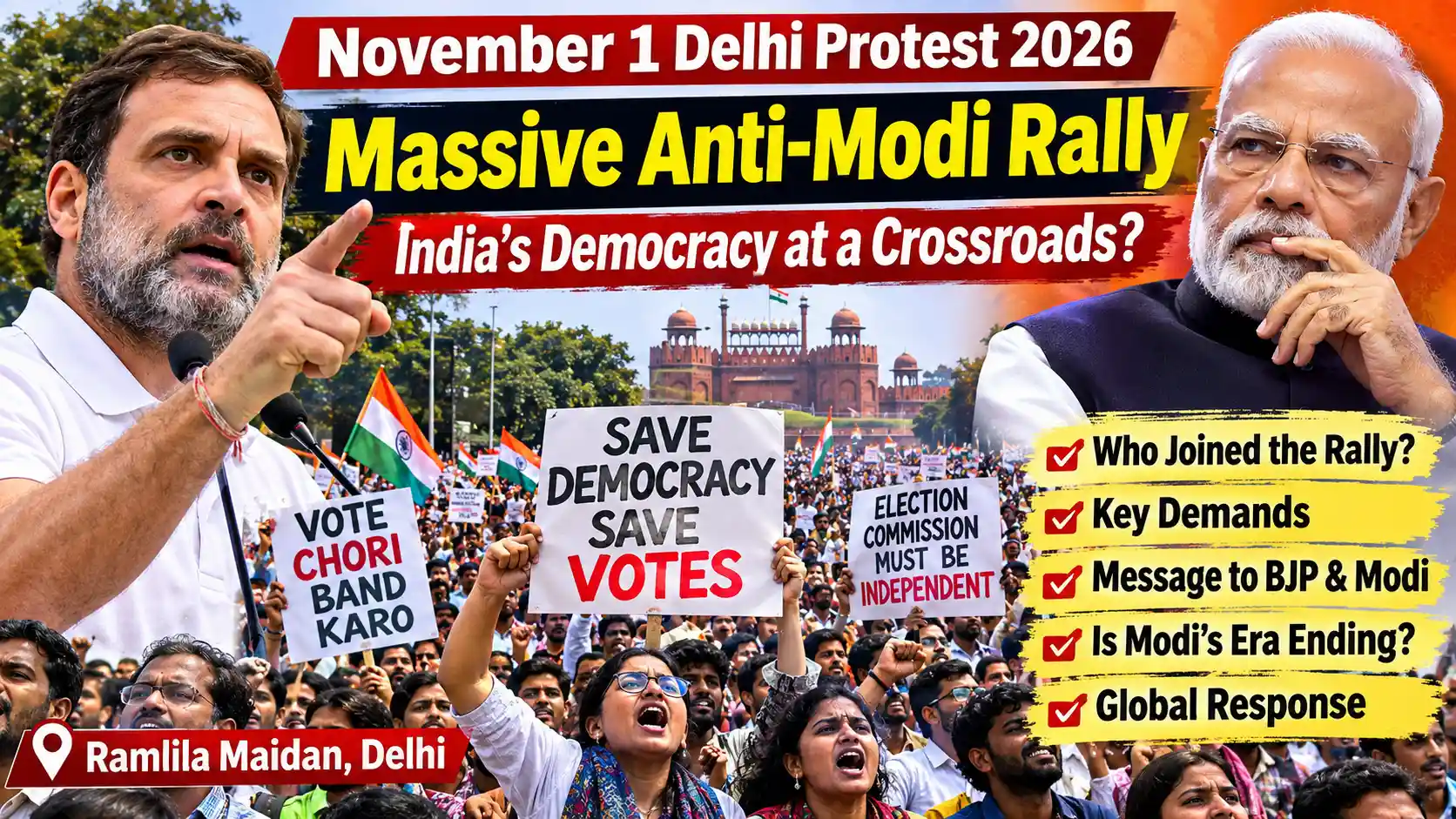
The November 1 Delhi rally put the dispute over India’s voter lists at the centre of national politics. Opposition parties of the INDIA bloc marched to and rallied at Ramlila Maidan under the slogan “Vote Bachao, Desh Bachao”. They targeted the Election Commission’s Special Intensive Revision (SIR) of electoral rolls and demanded the removal of Chief Election Commissioner Gyanesh Kumar. Rahul Gandhi led the event, and the BJP dismissed it as a political show.
What happened at the November 1 Delhi rally
Congress’s Rahul Gandhi, Leader of the Opposition in the Lok Sabha, led the march alongside Mamata Banerjee, Akhilesh Yadav and other leaders. Open buses also carried Mallikarjun Kharge, Priyanka Gandhi Vadra and Tejashwi Yadav. The main demand was the removal of the Chief Election Commissioner over alleged “vote chori” (vote theft) and irregularities in the voter-list exercise.
The build-up was contested. Jantar Mantar had been de-notified as a protest site, after which Congress obtained permission for Ramlila Maidan. Delhi Police allowed the rally but refused permission for a march from Connaught Place. Nearly 10,000 security personnel were deployed. Delhi traders warned that the event during Diwali shopping season could disrupt 21 major markets and cost up to ₹10,000 crore. The BJP also criticised the choice of date, which is the anniversary of the 1984 anti-Sikh riots.
Turnout is disputed. The opposition had said it expected up to 10 lakh people, while Delhi Police expected about 50,000. The BJP said the leaders could not fill the Maidan, and called the event a “flop show”. Independent crowd counts were not available at the time of writing.
Why people are protesting
The Election Commission began the SIR on November 4, 2025. It says the exercise removes dead, duplicate, shifted and ineligible voters and lets wrongly deleted people seek re-enrolment. Critics say the process is opaque and has excluded eligible citizens.
The scale is large. Human Rights Watch puts removals at over 130 million names. A May letter from UN Special Rapporteurs cited a lower figure of nearly 52 million names across 12 states and Union Territories, with West Bengal particularly affected. The figures differ because they cover different periods and areas, and readers should treat them with care.
Legally, the position is mixed. The Supreme Court upheld the legality of the SIR on May 27, saying it advances free and fair elections. The protesters’ case is about how it is being carried out, and “vote theft” remains an allegation. No court or independent body has found that the BJP manipulated results.
The opposition’s demands include:
- Removal of CEC Gyanesh Kumar
- An independent inquiry into the deletions
- Transparency in the SIR process
- Restoration of wrongly removed voters
- Protection for minority and poorer voters
- Accountability for police action against earlier protests
- Safeguards for the independence of constitutional bodies
Who joined
Congress and INDIA bloc parties. Rahul Gandhi was the face of the event, with Kharge and Priyanka Gandhi Vadra. Akhilesh Yadav (Samajwadi Party), Tejashwi Yadav (RJD) and Mamata Banerjee gave it a multi-state look, which matters for an alliance that has often struggled with internal differences.
The youth movement. The Cockroach Janta Party had announced support for the rally. A group that casts itself as an outsider joining the opposition’s event is notable. It does not make the movement part of the INDIA bloc.
Civil society. Hundreds of retired judges, academics and former bureaucrats had earlier called for an immediate halt to the SIR, which gave the rally a wider backing than party cadres alone.
The message to Modi and the BJP
The central message was that electoral integrity should be a national issue, not an administrative detail. Rahul Gandhi urged supporters to ignore fear of police action and framed the rally as a defence of the Constitution. On the day, he also thanked the BJP and its allies for publicising the rally. He accused the BJP of forcibly shutting shops in Connaught Place during the march, a claim for which I did not find independent confirmation.
For the BJP, the opposition’s strategy poses three problems:
- Credibility of institutions. If a large share of the public doubts the Election Commission, even a clean process may not be believed.
- Younger voters. Jobs and freedom of expression are issues that can mobilise first-time voters.
- Opposition coordination. A single, concrete issue can unite parties that disagree on much else.
How the government and BJP responded
The BJP’s response was combative. Union Minister J.P. Nadda attacked Rahul Gandhi over the rally, calling it a conspiracy to push the country into anarchy. On November 2, BJP president Nitin Nabin went further, alleging that foreign powers were using Rahul Gandhi to destabilise India. The opposition rejects such claims. I did not find a public comment from Prime Minister Modi on the rally.
Is this the end of Modi’s era?
It is too early to say that, and the evidence points both ways.
The case for a serious challenge starts with the 2024 election, when the BJP fell short of a majority on its own and now governs with NDA allies. The voter-roll issue touches something people feel directly: whether their name is on the list. If the opposition can tie it to jobs, prices and civil liberties, it could grow into a sustained movement. Rights groups and UN experts have also given the issue international visibility.
The case against reads the rally as less decisive than it looks. The Supreme Court has upheld the SIR’s legality. The BJP retains a strong organisation, a committed voter base and control of the government. Turnout claims are contested, and the INDIA bloc has a record of fragmenting after high-profile shows of unity. The next general election is not due until 2029, and rallies do not by themselves change governments. What would matter is whether the opposition keeps up the campaign, shows concrete evidence of wrongful exclusion, and offers a credible alternative.
A more precise reading is that the rally tests whether a procedural dispute can become an electoral one. It does not show that Modi’s dominance is ending.
Trending Now: Brazil Election 2026: How Lula Won, Why Flávio Bolsonaro Is Contesting It
International response
Foreign governments have been quiet. I found no reports of the US, UK, France or other major powers formally commenting on the November 1 rally, and no government has called for anyone’s resignation. India’s foreign relations are closely tied to trade, security and diplomacy, and governments rarely comment on another democracy’s electoral disputes.
Criticism has come mainly from rights groups and UN-appointed experts:
- Human Rights Watch said on October 28 that the removals were arbitrary and deeply flawed. It urged authorities to scrap the revision and criticised the treatment of protesters. HRW said it interviewed 70 people in Delhi, West Bengal, Maharashtra and Karnataka. The Indian authorities have not accepted its conclusions.
- UN Special Rapporteurs wrote to India in May about the voter deletions and possible effects on minorities. The Union government acknowledged the letter for the first time on July 30. These experts serve independently and do not speak for the UN as a whole or its member states.
- International media have covered the rally. A report in a Cambodian outlet described it as a massive anti-government rally in Delhi.
What to watch next
- Whether protests spread. Watch for demonstrations in other states beyond the capital.
- The Election Commission’s response. Will it publish data on deletions, or change its process?
- Courts and Parliament. Further litigation or parliamentary pressure could move the issue.
- Coalition discipline. Whether the INDIA bloc stays together through the winter session and state elections.
- Evidence. Verified, case-by-case documentation of wrongful deletions would count for more than rhetoric from either side.
The November 1 Delhi rally showed the opposition can still mobilise…, and it kept the voter-roll controversy in the national headlines. Whether it becomes more than a single day’s spectacle depends on what comes next.
Sources: The Wire, republicworld, siasat, phnompenhpost, tribuneindia
Also Read: Justice Sanjay Kishan Kaul Memoir