
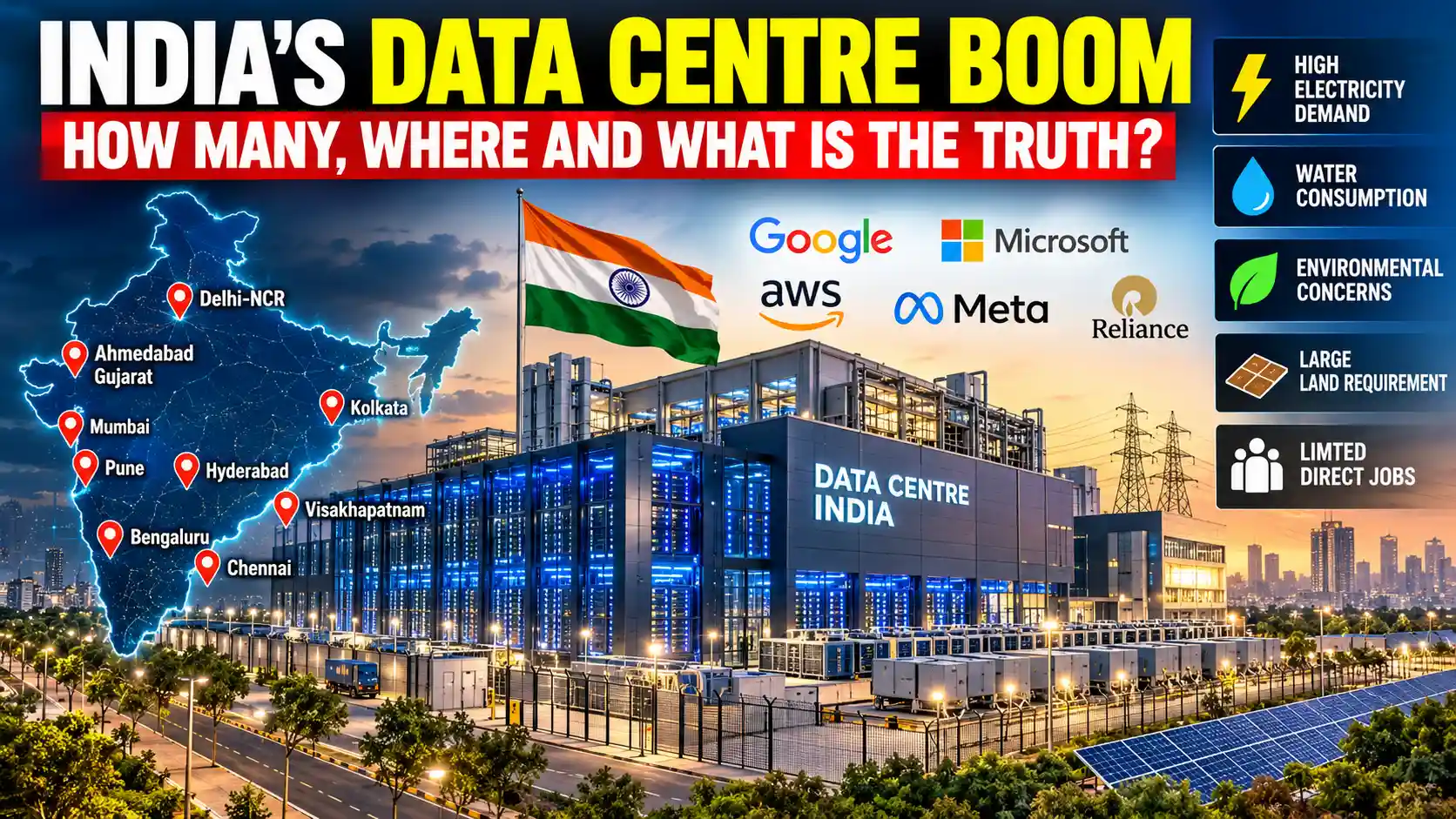
Data centers in India are expanding rapidly as cloud computing, artificial intelligence (AI), digital payments, online services, and increasing internet usage create enormous demand for computing infrastructure. These large facilities house thousands of servers and networking systems that store, process, and deliver digital information to millions of users.
India is now entering a new phase of data center construction, particularly because of cloud computing and artificial intelligence. But behind the billions of dollars being announced lies a more complicated story involving electricity, water, land, subsidies, jobs, and environmental costs.
Every time an Indian user watches a YouTube video, makes a UPI payment, stores a photograph in the cloud, uses an AI chatbot, books a ticket, or accesses an online hospital or banking service, huge amounts of computing infrastructure are working somewhere in the background.
That infrastructure needs a physical home.
These facilities are called data centers—large, highly secured buildings filled with servers, networking equipment, storage systems, backup power, and cooling systems.
India is now entering a new phase of data center construction, particularly because of cloud computing and artificial intelligence (AI).
But an important question needs to be asked:
Is India becoming a data-center superpower because other countries do not want these facilities—or because India has become an attractive business opportunity?
The truth is much more interesting.
Data Centers in India: How Many Are There?
There is no single number that perfectly answers this question because different organizations count data centers differently.
A January 2026 analysis by the Council on Energy, Environment and Water (CEEW) estimated that India had around 271 data centers. A separate data center directory currently tracks hundreds of facilities and related network sites across the country.
But for understanding the size of the industry, power capacity is often more useful than simply counting buildings.
According to the Government of India, India’s data center capacity increased from approximately 375 MW in 2020 to more than 1,500 MW by 2025.
Cushman & Wakefield reported approximately 1,789 MW of operational capacity across India’s top seven data center markets in the first half of 2026.
CBRE, using a different reporting period and methodology, put India’s operational stock at approximately 1,530 MW at the end of September 2025.
So, rather than saying “India has exactly X data centers,” it is more accurate to say:
India has hundreds of data center facilities, with roughly 1.5–1.8 GW of operational capacity depending on the date and measurement method, and several gigawatts more are under construction or planning.
Where are India’s data centers located?
The industry is heavily concentrated in a few major technology and connectivity hubs.
The principal locations include:
- Mumbai and Navi Mumbai
- Chennai
- Delhi-NCR
- Bengaluru
- Hyderabad
- Pune
- Kolkata
- Gujarat
- Emerging locations such as Visakhapatnam
Mumbai is currently the biggest market.
CBRE reported that Mumbai accounted for approximately 53% of India’s data center capacity in September 2025, followed by Chennai at about 20%, Delhi-NCR at 10%, and Bengaluru at 7%. Together, these four markets represented nearly 90% of India’s capacity at that time.
Why Mumbai?
One major reason is submarine cable connectivity.
India connects to the global internet through undersea fiber-optic cables. Mumbai is one of the country’s most important international connectivity gateways, making it particularly attractive for facilities that need fast connections to international networks.
Chennai is also strategically important because of its submarine cable infrastructure.
Hyderabad, Bengaluru, and Pune benefit from India’s technology workforce and enterprise demand, while Delhi-NCR provides proximity to government, financial, and corporate customers.
The next big battleground: Visakhapatnam
One of the most ambitious new projects is being developed in Visakhapatnam, Andhra Pradesh.
Google announced a roughly $15 billion investment over five years from 2026 to 2030 to develop an AI hub in Visakhapatnam. The project includes gigawatt-scale data center capacity, renewable-energy infrastructure, and subsea connectivity.
Google broke ground on the project in April 2026 in partnership with AdaniConneX and Nxtra by Airtel. The companies describe it as a gigawatt-scale AI ecosystem.
This is important because AI data centers are much more power-intensive than conventional facilities.
A traditional enterprise data center might contain relatively moderate computing loads. AI facilities can contain thousands of high-performance GPUs operating simultaneously.
That changes the economics completely.
Why are companies choosing India?
It is not because other countries “do not want” data centers.
In fact, the opposite is true.
The United States, Europe, China, Singapore, Japan, Australia, and countries across the Middle East are all investing heavily in data-centre infrastructure.
India is attractive because several factors come together.
1. Huge digital population
India has one of the world’s largest internet and smartphone user bases.
Digital payments, streaming, cloud software, e-commerce, online government services, and AI applications are generating enormous amounts of data.
The demand for computing infrastructure therefore exists inside the country.
2. Growing AI demand
Artificial intelligence is changing the data center business.
AI models require enormous computing resources, particularly GPUs and other accelerators.
JLL estimates that India’s data center capacity could rise from around 1.6 GW in mid-2026 to approximately 6 GW by 2029.
Cushman & Wakefield estimates another 3,860 MW of supply could come across India’s leading markets by 2030, including capacity under construction and in planning.
3. Data sovereignty and regulation
Companies operating in regulated sectors such as banking, finance, healthcare, and government increasingly need strong controls over where data is stored and processed.
Keeping infrastructure inside India can make compliance and latency management easier for many organizations.
4. Availability of technology talent
India already has a large IT and engineering workforce.
That does not mean specialized data center skills are unlimited, but the existing technology ecosystem makes India attractive to hyperscale companies.
5. Government and state incentives
States are competing aggressively for data center investment.
Policies can include electricity-related incentives, land support, infrastructure facilitation, tax benefits, and faster approvals.
Importantly, the Government of India has stated that it does not provide a direct subsidy for establishing data centers, while much of the incentive competition takes place through state-level policies and broader investment frameworks.
Microsoft is already expanding heavily.
Microsoft provides a good example of India’s changing data center landscape.
In 2026, Microsoft operates four cloud regions in India:
- Pune
- Chennai
- Mumbai
- Hyderabad
Microsoft’s India South Central region in Hyderabad became generally available in 2026, giving the company four cloud regions in the country.
Microsoft has also announced a total $20.5 billion commitment to India associated with its AI and cloud infrastructure expansion, including its Hyderabad development.
Other major players—including Google, Amazon, Meta, Reliance, Adani, Airtel, Yotta, CtrlS, Sify, and NTT—are also involved in India’s expanding digital infrastructure ecosystem.
This is therefore not simply a government project.
It is a major commercial investment race.
So why don’t other countries want to build them?
This is where the popular narrative becomes misleading.
Other countries absolutely want data centers.
The real question is
Where is it economically and physically sensible to build them?
Data centers require five things in enormous quantities:
- Electricity
- Reliable power infrastructure
- High-speed network connectivity
- Land
- Cooling
And AI makes all five requirements more demanding.
A company may therefore decide to build in India instead of another country because India offers a better combination of market demand, land availability, connectivity, energy arrangements, incentives, and expected returns.
This is not charity.
It is business.
The hidden problem: electricity
A data center cannot tolerate frequent power interruptions.
Even a short interruption can cause serious problems unless sophisticated backup systems are available.
Large facilities therefore require multiple layers of power:
Grid → substations → UPS → batteries → generators → cooling systems
AI data centers are making this problem even bigger.
Deloitte estimates that India’s data center electricity consumption could rise substantially as capacity expands and AI workloads grow. It estimates AI-led demand could require an additional 40–45 TWh of electricity.
This creates a major question:
Where will all this electricity come from?
If the electricity comes primarily from fossil fuels, India’s data center expansion could increase carbon emissions.
If companies purchase renewable electricity, the environmental impact can be reduced—but renewable energy also requires transmission networks, storage, and reliable backup power.
The second hidden problem: water
Servers generate enormous amounts of heat.
That heat must be removed continuously.
Many data centers therefore require cooling systems that can consume significant amounts of water, although the amount varies substantially depending on the technology.
CEEW estimates that India’s data centers used approximately 150 billion liters of water in 2024, while noting that water and electricity demand could more than double by 2030.
Modern operators are trying to reduce this problem through technologies such as
- liquid cooling
- direct-to-chip cooling
- immersion cooling
- closed-loop systems
- air cooling
- recycled water
- more efficient cooling infrastructure
The Government of India has also noted the industry’s movement toward direct-to-chip liquid cooling, adiabatic cooling, immersion cooling and closed-loop systems.
Microsoft, for example, says its new Hyderabad region uses high-efficiency mechanical cooling designed for effectively zero water use for cooling.
But that does not mean every data centre has zero water impact.
The land problem
Large hyperscale campuses can occupy enormous areas.
This creates another difficult question:
What happens to the land and communities where these facilities are built?
The issue has become particularly visible around the planned Google AI hub in Visakhapatnam.
The project has been welcomed by government and industry as a major technology and investment opportunity. However, a recent Guardian investigation reported allegations from some local residents concerning land acquisition, compensation and environmental impacts. Google and authorities have disputed aspects of those allegations and maintain that the project will bring economic and infrastructure benefits.
This illustrates an important point:
A project can be economically valuable while still creating legitimate local questions about land, water, electricity, employment and environmental impact.
Both sides need to be examined.
Do data centres create lots of jobs?
This is another area where expectations can sometimes become unrealistic.
Building a large data centre can create substantial temporary employment in:
- construction
- electrical work
- civil engineering
- mechanical engineering
- security
- networking
- maintenance
But once the facility becomes operational, the number of permanent employees may be much smaller than the size of the investment suggests.
A $10-billion data-centre project does not automatically mean millions of permanent jobs.
The larger economic benefit may instead come indirectly through:
- cloud services
- software companies
- AI startups
- telecom networks
- construction supply chains
- electricity infrastructure
- engineering services
- local businesses
- digital transformation
Therefore, investment value and direct employment should not be treated as the same thing.
Another truth: India still has a capacity gap
India produces and consumes enormous amounts of digital information, but its share of global data-centre capacity remains relatively small.
A Takshashila Institution analysis noted that India generated approximately 20% of the world’s data while having around 1% of global data-centre capacity as of April 2025, illustrating the gap between India’s digital activity and its physical computing infrastructure.
This explains why companies see an opportunity.
India is not building data centres because the rest of the world has abandoned the industry.
India is building because demand is growing faster than existing infrastructure.
The major drawbacks India must not ignore
The data-centre boom can bring significant economic benefits, but the risks are equally important.
Electricity pressure
Large facilities can consume enormous amounts of electricity and require highly reliable grid infrastructure.
Water stress
Cooling requirements can become controversial in areas already facing water shortages.
Land acquisition
Large campuses can require significant land, creating social and environmental conflicts.
Carbon emissions
If electricity comes from fossil fuels, digital infrastructure can have a substantial carbon footprint.
Public subsidies and incentives
Governments must examine whether tax concessions, land benefits and infrastructure support generate sufficient long-term public value.
Concentration risk
If too much infrastructure is concentrated in Mumbai, Chennai or a few other cities, natural disasters, flooding, grid failures or network disruptions could create systemic risks.
Skilled manpower
Operating advanced AI data centres requires specialised electrical, mechanical, networking, cybersecurity and AI infrastructure skills.
Electronic waste
Servers, batteries, networking equipment and other hardware eventually need replacement and responsible disposal.
The real story behind India’s data-centre boom
India’s data-centre expansion is neither a miracle nor a conspiracy.
It is the result of a powerful combination of population-scale digital demand, cloud computing, AI, data-sovereignty requirements, telecommunications infrastructure, investment incentives and expectations of future growth.
India’s operational capacity has grown dramatically from about 375 MW in 2020 to well above 1.5 GW, while several gigawatts of additional capacity are being planned.
Mumbai and Chennai remain major hubs, while Hyderabad, Bengaluru, Pune, Delhi-NCR and emerging locations such as Visakhapatnam are becoming increasingly important.
But the most important question is not simply:
“How many data centres can India build?”
The bigger question is:
“Can India build them without creating unacceptable pressure on electricity, water, land and the environment?”
If India can combine data-centre growth with renewable energy, efficient cooling, responsible land acquisition, transparent incentives, strong cybersecurity and resilient power infrastructure, the industry could become an important part of the country’s digital economy.
If the expansion is measured only in billions of dollars invested and gigawatts announced, while ignoring electricity, water, land and environmental costs, the headline numbers may look impressive while the hidden bill continues to grow.
That is the real story behind India’s data-centre boom.
India is not attracting data centres because other countries do not want them. India is attracting them because the global technology industry believes India’s demand for computing—and especially AI computing—is going to become much larger. The challenge now is making sure that growth is economically useful, environmentally sustainable and socially responsible.