
Introduction
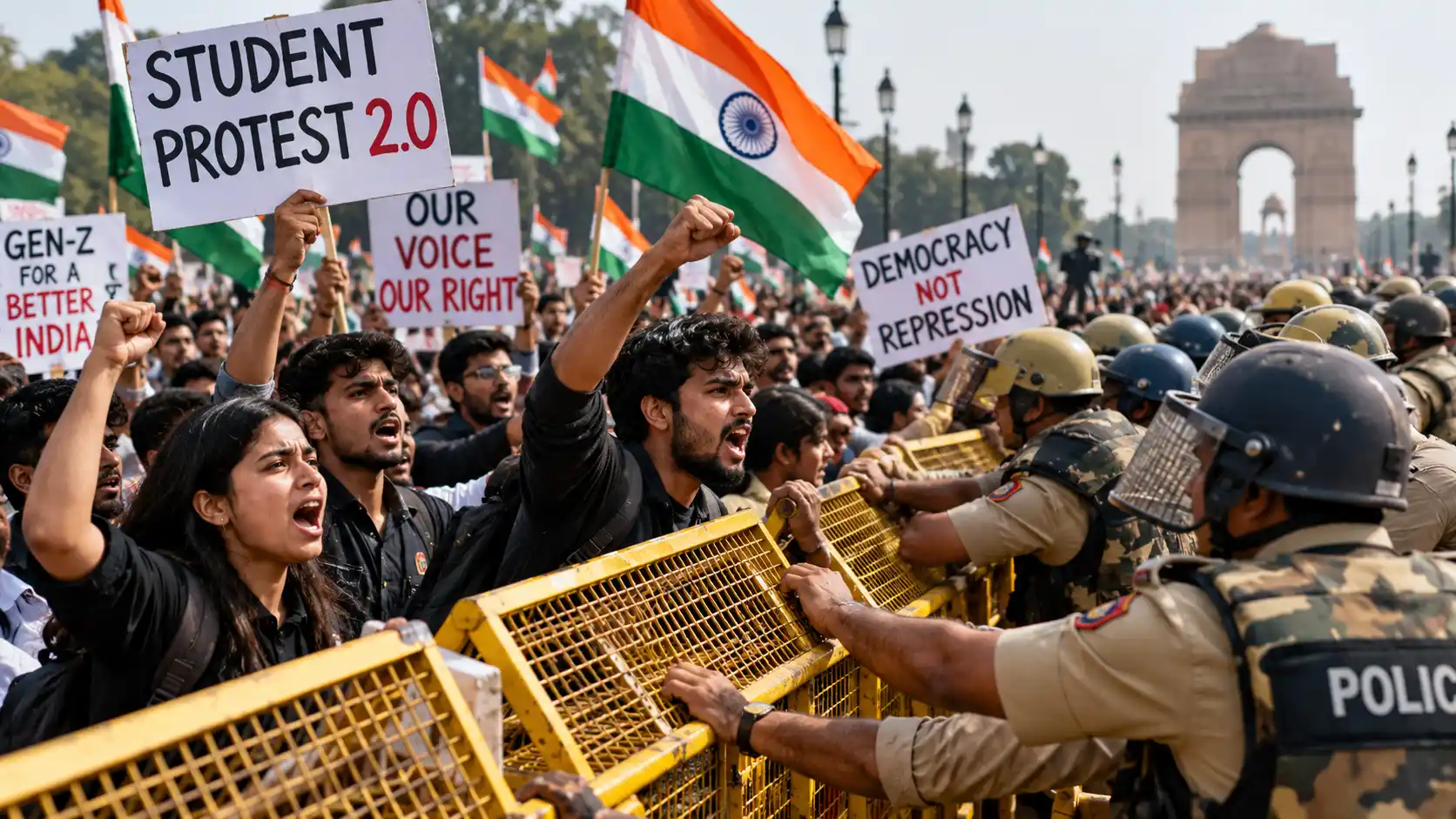
Student Protest 2.0 Delhi October 2026, has brought a difficult question back into the national conversation: how should a democracy respond when students, young activists and opposition leaders take to the streets to challenge the authorities?
The demonstrations associated with the Cockroach Janta Party (CJP), student organisations like All India Students’ Association (AISA) and opposition groups centred on demands for the resignation of Chief Election Commissioner Gyanesh Kumar. Protesters raised concerns about alleged irregularities in the revision of electoral rolls and demanded accountability from the Election Commission. These allegations remain contested and should be assessed against official records and evidence.
Police detained several prominent figures, including CJP founder Abhijeet Dipke, co-convenors Saurav Das and Ashutosh Ranka, All India Students’ Association president Neha Bora, and YouTuber Dhruv Rathee. Opposition politicians and other demonstrators were also detained during the wider protests. The scale of the police operation and allegations of rough treatment prompted questions about the limits of law enforcement and the protection of democratic freedoms.
What happened during Student Protest 2.0?
The latest demonstrations followed earlier protests in Delhi over electoral-roll revision due to a massive malpractice in “SIR” and the role of the Chief Election Commissioner. Youth groups and political organisations called for public mobilisation, arguing that concerns about electoral transparency required a public response.
Delhi Police imposed restrictions around protest locations and maintained a substantial security presence. Police cited concerns about unauthorised gatherings, traffic disruption, public order and compliance with lawful directions.
On October 10, police detained Dipke, Das and Ranka after their flight arrived at Indira Gandhi International Airport. Reporting by The Indian Express said the three were taken to different police facilities as authorities sought to prevent a gathering of supporters. Police invoked preventive provisions of the Bharatiya Nagarik Suraksha Sanhita (BNSS). But on the other hand, many political analysts, senior journalists and opposition leaders directly condemn and blame that it is the fear of Amit Shah, Narendra Modi and the BJP also.
Further detentions occurred during subsequent demonstrations. On October 16, Dipke and Neha Bora were among those detained in connection with a planned march in central Delhi. Media reports also described clashes and allegations that protesters had been pushed, dragged or beaten during police operations. and the field journalist reports that some goons of RSS and other BJP supporters attack the protester and try to vandalise the silent protest. and police do not take action against those who come with sticks and other weapons. Those allegations warrant independent examination rather than being treated as established findings against every officer involved.
Why were Dipke, Saurav Das and Ashutosh Ranka detained?
The legal explanation reported for the October 10 detentions involved two provisions of the BNSS:
- Section 126, BNSS: Provides for proceedings requiring a person to show cause why they should not be ordered to execute a bond for keeping the peace.
- Section 170, BNSS: Provides for arrest to prevent the commission of certain cognisable offences when the statutory conditions are met.
These provisions concern preventive action. They are not, by themselves, proof that a person has committed a crime or that the allegations against that person have been established in court. Some advocates also condemn Delhi Police brutality, and some police persons admit in the presence of Dhruv Rathee that they are just following the instructions of seniors when he has been detained in jail. If they don’t follow, he will lose the job. That indicates the fear of the Home Minister.
The legal situation later became more complicated. Reports published in October described additional proceedings involving the leaders, including allegations that they had breached earlier peace bonds and had protested at a location subject to restrictions. Saurav Das and Ashutosh Ranka were subsequently remanded to judicial custody and were reported released on October 21 after submitting written undertakings concerning future protests.
The distinction matters: the legal basis for an initial preventive detention may differ from the provisions cited in a later FIR or a separate proceeding.
What happened to Neha Bora and Dhruv Rathee?
Neha Bora, president of the All India Students’ Association, was among the student activists detained during the October demonstrations. Reports also carried allegations by student organisers that protesters had been dragged, shoved or beaten during the police action. Police and BJP leaders answer, ‘Such claims should be investigated using video evidence, witness accounts, medical records and official responses. When all the evidence is available live on social media and news portals, that also indicates the police are directly supporting BJP and lingering the case in a roundabout game
YouTuber Dhruv Rathee was also house-arrested and reported detained during the wider protest crackdown. His presence attracted attention because of his large online audience and his commentary on public affairs. However, detention should not be confused with a criminal conviction, and the precise legal basis for an individual’s detention must be established from the relevant police documentation.
For each person, a responsible report should distinguish among preventive detention, formal arrest, registration of an FIR, remand to judicial custody and eventual release. These terms describe different legal stages and are not interchangeable or clarified yet.
Were opposition leaders also detained?
Yes. Reporting on the October 10 demonstration described the detention of several opposition figures, including former chief ministers Arvind Kejriwal, Mamata Banerjee and Pinarayi Vijayan, alongside student activists and other participants. The reported detentions took place amid restrictions intended to prevent demonstrators from assembling at the proposed protest location. However, the so-called BJP minister must know that protection is not done by a single person; it is the issue of the maximum number of people in India, so obviously gathering is a common format that was previously shown, like farmer protests also. It’s only the cruelty of the government to avoid his fault.
The participation of opposition leaders gave the protests a broader political dimension. It also raised questions about whether restrictions were being applied consistently to different groups and whether the authorities had provided a proportionate response to the planned demonstrations.
Those questions require evidence about the orders in force, the conduct of the individuals involved, the reasons given for each detention and the treatment of those detained. A politician’s detention does not, by itself, prove political persecution; equally, the existence of a prohibitory order does not automatically establish that every police action was lawful or proportionate.
Did the police use excessive force?
Allegations of police brutality are among the most serious issues arising from the demonstrations. Student organisations and protesters have alleged rough handling and physical assaults. Some media reports described confrontations and showed security personnel taking demonstrators away during the dispersal operations. Some police don’t have any name, batch, shoes, or civil dress, and they continuously attacked the protestor, and they are not arrested yet and also not identified, as asked by our journalists Ajit Anjum, Ravish Kumar, Deepak Sharma, and many more.
The question is not simply whether police were entitled to maintain public order. It is whether the force used in any particular incident was necessary, lawful and proportionate to the situation.
An independent assessment should examine:
- Whether protesters were given clear and reasonable directions to disperse.
- Whether officers explained the grounds for detention where legally required.
- Whether physical force was used against peaceful, non-resisting participants.
- Whether detained individuals had access to legal assistance and were informed of their rights.
- Whether injured people received timely medical attention.
- Whether available CCTV, body-camera footage and public videos were preserved and reviewed.
If evidence establishes that officers assaulted peaceful protesters or used disproportionate force, the conduct should be investigated and appropriate accountability measures pursued. Allegations should not be dismissed simply because they concern police conduct, nor should individual officers be declared guilty without a fair investigation.
What does the Constitution say about the right to protest?
The Constitution of India protects freedom of speech and expression and the right to assemble peacefully and without arms.
Article 19(1)(a) protects freedom of speech and expression, while Article 19(1)(b) protects peaceful assembly without arms. These rights are fundamental to democratic participation, public debate and the ability of citizens to challenge decisions made by those in power.
However, the rights are not unlimited. Article 19 permits reasonable restrictions under specified constitutional conditions, including considerations of public order. Authorities may regulate the location, route and manner of a demonstration where legally justified.
The Supreme Court has recognised peaceful protest as an important constitutional freedom while also acknowledging that reasonable restrictions may be imposed. The legal question in any particular case is whether those restrictions and the resulting police action meet the applicable constitutional and statutory standards.
This creates two obligations for the state: to maintain public order and to respect the rights of citizens exercising lawful freedoms. Neither obligation automatically cancels the other.
Indian Student Protests: An Analysis of Government Response and International Perspectives
Is the government under Amit Shah suppressing Gen-Z’s democratic rights?
The role of the Union government and Home Minister Amit Shah has become part of the political debate because Delhi Police operates under the Union Ministry of Home Affairs. That administrative relationship is relevant when examining responsibility for policing policy and the oversight of Delhi Police.
The claim that the government deliberately sought to suppress Gen-Z or ordered particular acts of brutality requires evidence. but the behaviour of police, judge and BJP politicians speech, action shows that clearly and also the silence of Amit Shah and Narendra Modi making confusion to public on the other hand international media also condemed the cituation hapen in india is samless. student have all the rights to protest against govt peacfully is legally aceptable.
Critics may argue that repeatedly restricting demonstrations, detaining organisers before a rally and allegedly using force against protesters can discourage young people from participating in public life. From this perspective, even measures described as preventive can create a chilling effect if they are applied too broadly or without adequate justification.
The authorities, on the other hand, may argue that restrictions are necessary to protect public safety, traffic movement and the rights of other residents. The validity of those explanations depends on the evidence, the applicable orders and the proportionality of the action taken.
The essential democratic test is whether the government can demonstrate that its actions were lawful, necessary and proportionate—and whether independent scrutiny is available when allegations of abuse arise.
Also Read: Gyanesh Kumar SIR Controversy
Why Gen-Z’s voice matters
Young people are not merely spectators in a democracy. Students and first-time voters have a legitimate interest in electoral transparency, public accountability, employment, education and the institutions that shape their future.
Peaceful demonstrations provide a way to bring concerns into public discussion when citizens believe ordinary channels have not produced sufficient answers. Governments do not have to agree with every demand raised by protesters, but disagreement alone is not a reason to deny constitutional freedoms.
At the same time, organisers and participants have responsibilities. Peaceful conduct, compliance with lawful directions and respect for other people’s rights help preserve the legitimacy of a demonstration. Violence, threats and damage to property can undermine the stated objectives of a movement and may attract lawful consequences.
A democratic society should seek to protect both peaceful dissent and public safety rather than treating them as mutually exclusive.
The resignation demand of gyanesh kumar is fully valid because its a known crime and his other 2 CEC also admited publically. history show in india lots of resignation happen before so why Modi save gyanesh its a big question now?
What accountability should follow?
The controversy calls for transparent answers to several practical questions:
- What exact orders and legal provisions were cited for each detention?
- Were the relevant prohibitory orders properly issued and communicated?
- What evidence supports allegations of assault or excessive force?
- Were detainees informed of the grounds for their detention and afforded the applicable legal safeguards?
- Were complaints against police personnel registered and investigated independently?
- Were restrictions applied consistently across political groups?
The answers should be based on official documents, court orders, credible reporting and verifiable evidence. Where wrongdoing is established, accountability should follow through lawful procedures. Where allegations are not substantiated, the findings should also be made clear.
Conclusion: Democracy must protect dissent and public order
Student Protest 2.0 in Delhi has brought the relationship between youth activism, policing and democratic freedoms into focus. The reported detentions of Dipke, Saurav Das, Ashutosh Ranka, Neha Bora, Dhruv Rathee and opposition figures have intensified public scrutiny of the restrictions imposed around the demonstrations.
The constitutional right to peaceful assembly is not a licence to commit violence or disregard every lawful restriction. Equally, maintaining public order is not a blank cheque for arbitrary detention or excessive force.
The lasting measure of a democracy is how fairly it handles disagreement. Young citizens must be able to question institutions, demand accountability and express dissent peacefully. Authorities must be able to maintain public safety while remaining accountable for their decisions and conduct.
The central question is therefore not whether a government must accept every protest demand. It is whether citizens can raise difficult questions, receive reasoned answers and exercise their constitutional rights without unlawful intimidation.
Sources and further reading
- The Indian Express — How Delhi Police detained CJP leaders at IGI Airport
- Scroll.in — CEC protest: Student activists, opposition figures and others detained
- The Week — Detentions amid Delhi’s Tiranga march
- The New Indian Express — CJP leaders released after preventive detention
- The Indian Express — Saurav Das and Ashutosh Ranka released after judicial custody
- The Print — Jantar Mantar protest and detention updates
- Constitution of India, Article 19
- Supreme Court of India judgment discussing peaceful protest and reasonable restrictions
Editorial note: This article reflects reporting available as of October 21, 2026. Legal allegations and claims about police conduct should be updated if new official records, court orders or independently verified evidence become available.