
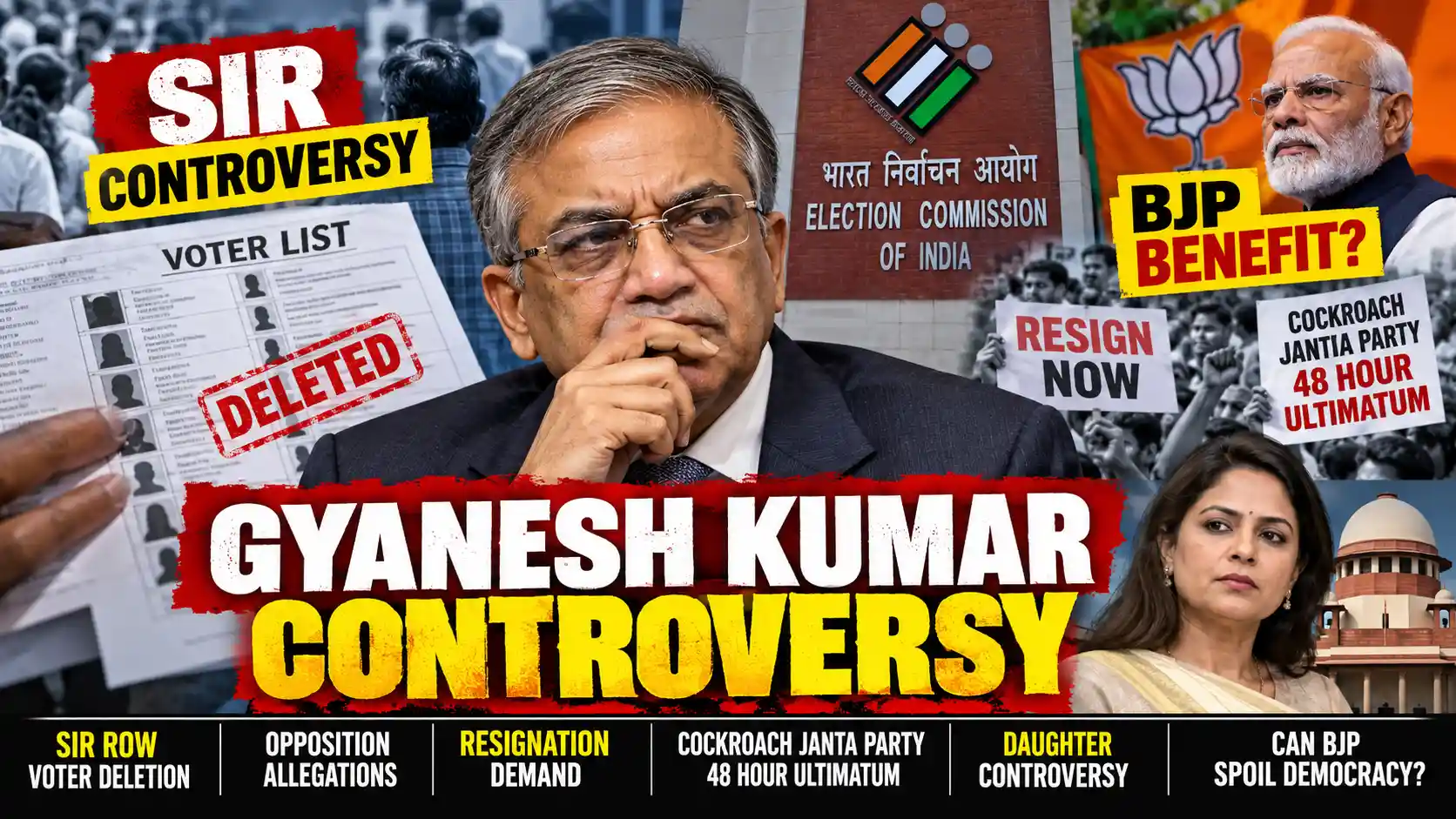
The Gyanesh Kumar SIR controversy has moved far beyond a normal political argument over voter-list revision.
What began as a dispute over the Election Commission of India’s Special Intensive Revision (SIR) of electoral rolls has now expanded into questions about the Commission’s internal decision-making, the control of its electoral software, voter deletions, the role of Election Commissioners, demands for the resignation of Chief Election Commissioner Gyanesh Kumar, and fresh legal challenges.
The controversy has also raised an important technology question: Who actually controls the software through which India’s enormous voter database is being managed?
Recent reports have focused on ECINet and ERONet, the Election Commission’s digital systems, after two Election Commissioners reportedly raised repeated objections about centralized control of electoral-roll software. The Election Commission has rejected the suggestion that its final decisions were not unanimous.
At the same time, Opposition parties have accused the Election Commission of acting in a manner that could benefit the BJP.
So what is actually happening?
What is the Gyanesh Kumar SIR controversy?
The Gyanesh Kumar SIR controversy centers on the Special Intensive Revision of electoral rolls.
SIR is intended to verify electoral rolls and identify eligible voters while removing entries that are no longer valid, such as duplicate, shifted, deceased, or otherwise ineligible entries.
The controversy concerns the scale, process, and technology used during the exercise.
A major Indian Express investigation reported that Election Commissioners Sukhbir Singh Sandhu and Vivek Joshi had recorded objections at least 14 times over roughly 10 months on issues involving electoral-roll management, voter registration and deletion, software access, and other decisions.
The two Election Commissioners reportedly raised concerns about the gradual centralization of electoral-roll data and the ability of ground-level statutory authorities to perform their functions through the software.
The Election Commission, however, has said that its decisions, including those relating to SIR, were taken unanimously by the full Commission.
That creates the central dispute:
Were the objections simply part of normal institutional discussion, or did the technology and administrative structure actually reduce the authority of officers legally responsible for electoral rolls?
ECINet and ERONet: Why is the software important?
To understand the Gyanesh Kumar SIR controversy, it is necessary to understand two names: ECINet and ERONet.
ECINet was launched by the Election Commission in January 2026 as a unified technology platform bringing together more than 40 applications and portals.
ERONet is the electoral-roll management system used by election officials for activities including adding, deleting, and updating voter records.
The controversy is not simply about whether computers are being used.
The important question is who controls the permissions inside the system.
According to the Indian Express investigation, Election Commissioners Sandhu and Joshi raised concerns that state-level Chief Electoral Officers, District Election Officers, and Electoral Registration Officers did not always have complete access to ERONet.
Sandhu reportedly argued that the statutory authorities responsible for electoral rolls should not have their access controlled in a way that prevents them from performing their legal duties.
The Election Commission has disputed the suggestion that ECINet is designed to take statutory powers away from field officers and has maintained that the system operates with decentralized statutory functions.
The Goa case: 97 voters and a software problem
One of the most important developments in the Gyanesh Kumar SIR controversy comes from Goa.
According to reports, 97 voters were initially flagged for logical discrepancies during SIR. Election Registration Officers examined the cases and reportedly found the voters eligible.
But the names still did not appear in the final electoral roll.
Why?
A major issue was the software’s lack of a rollback facility to reverse a deletion after the Form 7 process had been completed. Where AI is trending today, who designed the software without a undo facility? It’s a common question that a layman also asks. Did NIC develop the software, or did ECI intentionally remove it? That’s a big question.
The Goa Chief Electoral Officer’s office reportedly sent eight(8) requests between February 11 and 17 asking for the necessary action before the final roll was published.
The Election Commission later confirmed to India Today that ECINet did not have a rollback provision that allowed EROs to reverse the deletion after Form 7 had been used.
This case raises a simple but serious technology question:
If an authorized election officer discovers that a voter was wrongly deleted, why should the software make immediate correction difficult?
This does not by itself prove election manipulation.
But it does demonstrate why software design, access control, and audit mechanisms matter in an election system.
Is AI being used to delete voters?
This is another area where social media claims have gone beyond the available evidence.
There is evidence that the SIR process uses automated software, data matching, discrepancy detection, and digital processing.
However, that does not automatically mean that an artificial-intelligence system independently decides which voters should be deleted.
The important distinction is
Automated software is not necessarily generative AI.
Electoral software can use databases, rules, matching algorithms, transliteration, document processing, and other automated techniques without using an AI system like ChatGPT.
Therefore, it would be inaccurate to state as a proven fact that “AI is deleting Indian voters.”
The more precise question is:
What automated matching and discrepancy-detection rules does ECINet/ERONet use, who approves the result, and what human review occurs before a voter’s name is removed?
That is the question that deserves transparency.
Who provides the software?
Another question being asked online is whether a private company controls India’s voter database.
Recent reporting by The Indian Express identifies Tata Consultancy Services (TCS) as a vendor involved with the Commission’s software.
In the Goa case, Goa Electronics Limited reportedly communicated with TCS about the missing rollback/reversion functionality and document re-upload facility.
That does not mean TCS controls India’s elections or independently deletes voters.
The Election Commission remains the constitutional authority responsible for elections.
The relevant question is instead:
What exactly is outsourced to technology vendors, what remains under ECI control, who has administrative access, and are all changes logged and independently auditable?
These are reasonable questions for any large-scale public digital system handling electoral data.
Why are the Opposition parties accusing Gyanesh Kumar?
Opposition parties have accused the Election Commission under Gyanesh Kumar of favoring the BJP through the way SIR is being conducted.
Some Opposition leaders have argued that large-scale voter deletions could affect electoral competition and have demanded Kumar’s resignation or removal.
Congress leader Rahul Gandhi has demanded Kumar’s resignation, while Opposition parties have announced protests and discussed parliamentary action.
But an important distinction must be maintained:
An allegation that SIR could benefit the BJP is not the same as proof that Gyanesh Kumar deliberately helped the BJP win an election. but it’s somehow pointing out the relation and communication between BJP and Ganesh Kumar.
The reported internal objections and voter-list problems justify questions about transparency and administration. They do not, by themselves, establish intentional electoral manipulation.
What does the BJP say?
The BJP has rejected the Opposition’s allegations.
BJP leaders have defended the Election Commission and argued that reported disagreements between Election Commissioners do not prove that the final decisions were taken illegally or without the Commission’s approval.
The Election Commission has similarly said that its decisions were unanimous.
Therefore, there are currently competing narratives:
Opposition argument: The SIR process, software centralization, and voter deletions raise serious questions about electoral fairness.
ECI/BJP position: The process is lawful, the Commission’s final decisions were unanimous, and allegations of partisan manipulation are not established.
The evidence should be examined independently rather than treating either political narrative as automatically proven.
Also Read: West Bengal Election Fraud
Did Gyanesh Kumar misuse his power?
This is perhaps the most sensitive question in the entire controversy.
The available reporting documents internal objections, disputes over software access, and questions about electoral-roll management.
A current Supreme Court petition is seeking action against Kumar and an independent investigation into alleged irregularities connected with SIR. Another petition has challenged 14 ECI actions before the Bombay High Court. These are legal allegations and requests for judicial scrutiny, not court findings that Kumar committed the alleged wrongdoing. But people also watch some high court and supreme court judges standing and defending the BJP and saying to the student as parasite.
The distinction is important because an accusation can be investigated without being treated as an established fact.
Why are people demanding Gyanesh Kumar’s resignation?
The resignation campaign has intensified following the reports of internal objections.
Opposition parties have demanded Kumar’s removal.
The Cockroach Janta Party (CJP) has also issued a separate 48-hour resignation ultimatum.
CJP founder Abhijeet Dipke and other leaders announced that if Kumar did not resign, the organization would begin a nationwide campaign and protest. The group has called its campaign “Election Commission Thik Karo” and threatened another Jantar Mantar-style protest.
As of the latest reports, there is no confirmed report that Gyanesh Kumar has resigned.
What exactly does the Cockroach Janta Party want?
The CJP has made several demands in connection with the controversy.
Among them are demands for Kumar’s resignation, a freeze on the SIR process, and restoration of affected voter records.
The group has threatened nationwide protests if its 48-hour deadline is not met.
These are the demands of a political organization and should not be confused with findings by the Election Commission, courts, or another independent authority.
What is the controversy involving Gyanesh Kumar’s daughter?
A separate controversy has also put Medha Roopam, an IAS officer and Gautam Buddha Nagar District Magistrate, in the news. She is the daughter of Gyanesh Kumar.
The issue is unrelated to the SIR software controversy.
The Allahabad High Court had quashed the National Security Act detention of Delhi University student Akriti Chaudhary in a case arising from a workers’ protest in Noida. The High Court also directed compensation of ₹5 lakh and made adverse observations concerning officials involved, including Roopam.
Roopam and the Uttar Pradesh government challenged the order in the Supreme Court.
On September 24, the Supreme Court clarified that its interim stay applied to the High Court’s strictures and compensation direction, not to the High Court’s decision quashing Chaudhary’s detention.
A separate lawyers’ organization has now questioned the manner in which Roopam’s Supreme Court matter was listed and the muting of the virtual proceedings. Those concerns are allegations by the organization and are not a judicial finding of preferential treatment.
The fact that Roopam is Gyanesh Kumar’s daughter has increased political attention, but the two matters should not be automatically connected without evidence. but people connecting with the father and daughter’s nature of action.
Can the BJP spoil Indian democracy?
This is the question behind much of the current political debate.
The real test is institutional.
Can an eligible voter find out why their name was flagged?
Can an ERO who has examined the documents correct a wrong deletion?
Can the voter challenge the decision?
Is there a complete audit trail showing who changed a record?
Can software administrators override statutory election officials?
Can political parties and citizens independently examine the process?
And, most importantly, can the Election Commission demonstrate that the same rules are being applied to voters regardless of their political identity?
If those safeguards are strong, allegations can be tested against evidence.
The real issue is not simply BJP versus Opposition.
The Gyanesh Kumar SIR controversy has increasingly become a debate about something bigger than the BJP and Congress.
It is about the relationship between law, election officials, and technology.
India has one of the world’s largest electoral databases. Managing hundreds of millions of voters inevitably requires technology.
But technology must remain accountable to the law.
A computer system cannot become more powerful than the statutory officer who is legally responsible for the electoral roll.
Likewise, an algorithm should not become an invisible decision-maker whose operation voters cannot understand.
The Goa case involving 97 voters illustrates why this matters. Election officials reportedly found the voters eligible, yet the software’s limitations meant their names were not restored.
What should voters ask?
Instead of simply believing either side, ordinary voters can ask practical questions:
- Is my name present in the electoral roll?
- If my name has been flagged, what is the exact reason?
- Who made the decision?
- Was the decision made by an ERO or through an automated process?
- Can the ERO reverse a wrong deletion?
- Is there an audit trail?
- Can an independent authority verify the software?
- How quickly can a wrongly deleted voter be restored?
These questions are more important to democracy than any political slogan.
The Gyanesh Kumar SIR controversy now enters a legal phase.
The controversy has now moved beyond television debates and political speeches.
Petitions have reached the Supreme Court, while another petition before the Bombay High Court challenges 14 ECI actions and raises questions about SIR, voter deletion, restoration, ERO functioning, and ECINet.
Meanwhile, protests and resignation demands are continuing.
This means the coming legal proceedings may become particularly important because courts can examine documents, statutory powers, software processes, and the legality of specific decisions.
Conclusion: What is proven, and what is alleged?
The Gyanesh Kumar SIR controversy currently contains several different layers.
Documented: There have been reported internal objections by two Election Commissioners concerning electoral-roll administration and software access.
Documented: ECINet/ERONet are central to the digital management of electoral rolls.
Documented: A Goa case involved 97 voters who were reportedly found eligible but remained absent from the final roll, with the lack of a rollback facility becoming a major issue.
Reported: TCS is a technology vendor involved in the software ecosystem, including communications about the Goa rollback functionality.
Political allegation: Opposition parties say the SIR process could favor the BJP and have demanded action against Gyanesh Kumar.
ECI/BJP position: The Commission says its decisions were unanimous and rejects the interpretation that the reported objections prove an institutional breakdown.
Political demand: The Cockroach Janta Party has issued a 48-hour resignation ultimatum and threatened nationwide protests.
Legal development: Petitions seeking investigation and challenging ECI decisions have now reached the courts.
The biggest question is simply whether BJP can spoil democracy.
The bigger question is whether India’s election system can provide enough transparency for every citizen to independently verify that their right to vote has been protected.
That is the question that the Election Commission, political parties, courts, and technology providers will ultimately have to answer.
Sources: Indian Express — ECINet and electoral-roll software investigation
Indian Express — Goa’s 97-voter case
India Today — ECINet rollback issue