
You use UPI every day.
You pay your child’s school fees.
You pay your electricity bill.
You pay a shopkeeper.
You pay a loan.
You buy groceries.
You scan a QR code and the money moves in seconds.
For ordinary Indians, UPI has become almost as important as cash.
That is why the new UPI MDR decision deserves more than a technical explanation.
The government says the new system is necessary to make UPI financially sustainable.
That may be part of the explanation.
But ordinary Indians have another right:
If the system is changing, we have the right to know why, who benefits and who ultimately pays.
And this article explains that question in simple language.
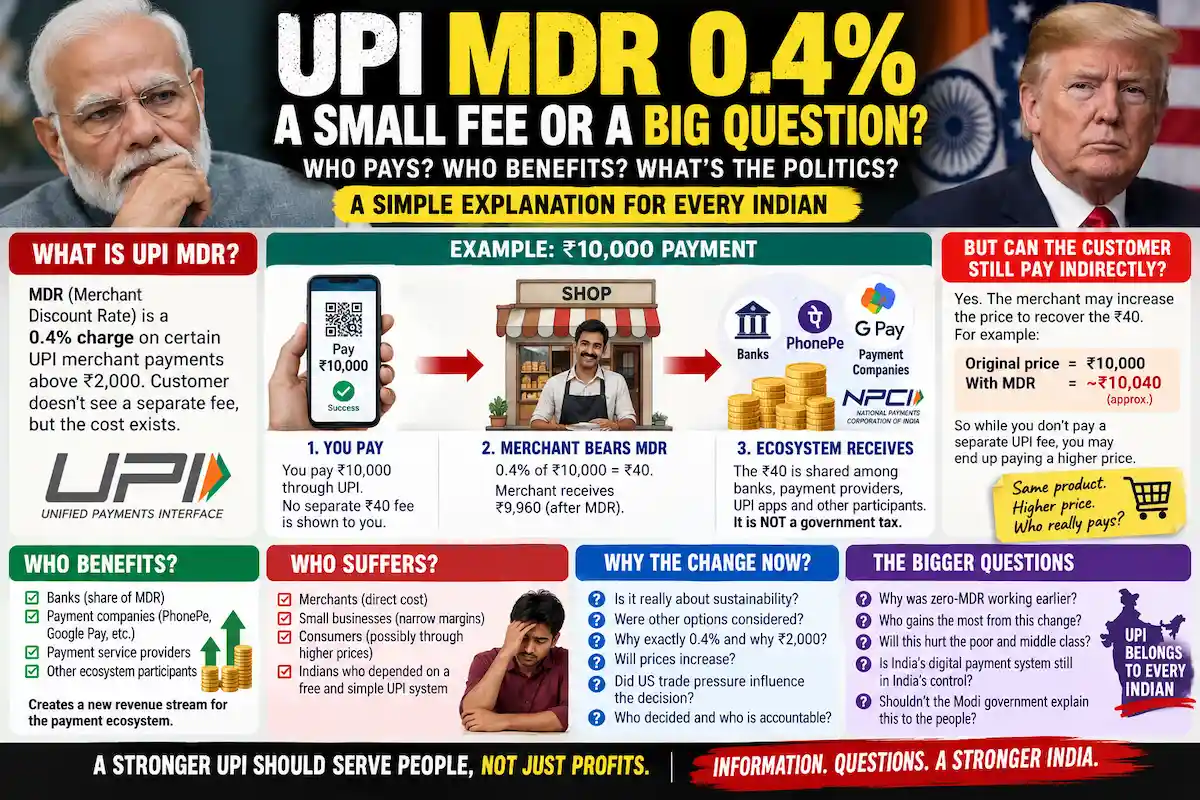
First: What Is UPI MDR?
MDR means Merchant Discount Rate.
Don’t worry about the complicated name.
Think of it simply as:
A cost associated with processing certain merchant payments.
Under the new framework, a 0.4% MDR applies to specified UPI merchant transactions above ₹2,000, with exemptions and special rates for certain categories. Person-to-person UPI payments remain free. (pib.gov.in)
So if an eligible merchant transaction is ₹10,000:
0.4% = ₹40
The customer does not normally see a separate ₹40 UPI fee.
But that does not mean the ₹40 disappears.
Somebody has to bear the cost.
Who Pays the ₹40?
Let’s make this extremely simple.
Imagine you buy a product for ₹10,000.
You pay:
₹10,000 through UPI
The merchant-side MDR is:
₹40
The merchant therefore has a payment-processing cost of ₹40.
The ₹40 then moves through the payment ecosystem according to the applicable distribution arrangements.
So:
Customer pays ₹10,000
↓
Merchant bears ₹40 MDR
↓
Payment ecosystem receives/distributes the MDR
The government says the MDR is not a tax collected by the government. (pib.gov.in)
That is the first fact Indians should understand.
But Wait — Can the Merchant Recover That ₹40?
This is where the real economic argument begins.
Suppose the merchant normally sells something for ₹10,000.
Before MDR:
Customer pays ₹10,000
Merchant receives ₹10,000
After MDR:
Customer pays ₹10,000
Merchant has a ₹40 processing cost
Now the merchant has a choice.
The merchant can:
- absorb the ₹40;
- reduce profit by ₹40;
- increase prices;
- prefer cash;
- or find another way to recover the cost.
Not every merchant will make the same choice.
But if the merchant increases the price to recover the payment cost, the customer can ultimately bear the economic burden.
This is why saying:
“The customer doesn’t pay MDR”
doesn’t tell the entire story.
The customer may not pay a separate UPI fee.
But the customer can potentially pay a higher price.
A Simple Example
Suppose a shopkeeper sells a product for ₹1,000.
His profit is ₹100.
If MDR creates a ₹4 cost:
Sale = ₹1,000
MDR = ₹4
His effective margin falls.
The merchant may decide:
“I don’t want to lose ₹4.”
So the merchant increases the price.
The customer might then pay approximately:
₹1,004
The merchant recovers approximately the payment cost.
The customer doesn’t see:
“UPI MDR ₹4.”
Instead, the customer simply sees:
Price: ₹1,004
That is why the question of who formally pays is different from who ultimately bears the cost.
So Is UPI MDR a Tax on the Customer?
Not directly.
Calling the 0.4% MDR a direct government tax on every UPI user would be incorrect.
But calling the change completely irrelevant to consumers would also be misleading.
The possible chain is:
MDR → merchant cost → merchant pricing decision → consumer price
Whether this actually happens depends on competition, margins and merchant behaviour.
That is something that should be monitored after implementation.
Then Who Benefits?
This is another question ordinary Indians should ask.
The MDR doesn’t simply disappear.
It creates revenue within the payment ecosystem.
Banks, payment-service providers, payment applications and other participants can receive portions of the MDR according to the applicable rules.
Reuters has reported analyst estimates suggesting a substantial new revenue pool for banks and payment companies. These are estimates rather than guaranteed amounts. (reuters.com)
This means the new MDR has two sides:
Merchant: pays the cost.
Payment ecosystem: receives revenue.
That doesn’t automatically mean the policy is wrong.
Banks and payment companies have genuine operating costs.
But it creates a legitimate question:
Why should merchants finance the payment ecosystem through MDR after UPI operated under a zero-MDR model for years?
Why Does UPI Need Money?
The government has an answer.
UPI is enormous.
It requires investment in:
- cybersecurity;
- fraud prevention;
- servers;
- network infrastructure;
- reliability;
- customer support;
- innovation;
- rural expansion.
The government says the new MDR framework will help make UPI sustainable. (pib.gov.in)
That argument deserves consideration.
But there is another question:
Was MDR the only possible way to finance UPI?
That is where public debate should begin.
UPI Worked Without MDR. So Why Change It Now?
This is perhaps the simplest question.
UPI did not start yesterday.
It has operated on an enormous scale while merchant transactions were largely under the zero-MDR model.
In August 2026, UPI processed around 24.5 billion transactions worth ₹29.8 lakh crore, according to Reuters. (reuters.com)
So an ordinary citizen can reasonably ask:
If UPI became one of the world’s biggest payment systems under zero MDR, why does the model need to change now?
The government says the answer is sustainability.
Critics ask whether there were other ways to finance the system.
Both questions deserve examination.
Now Comes the Political Question: Why Is Modi Being Mentioned?
Because this isn’t just a technical change inside an app.
The Union government under Prime Minister Narendra Modi is responsible for the broader policy framework and legislation surrounding India’s payment system.
That means citizens have every right to ask the Modi government:
Why was this policy introduced?
Why now?
Why 0.4%?
Why ₹2,000?
Who benefits financially?
What alternatives were considered?
Those are democratic questions.
Nobody needs to accuse Modi personally of calculating every transaction fee.
But the elected government is still accountable for the policy direction.
And Then There Is Trump and the United States
This is where the issue becomes politically sensitive.
The United States has previously raised concerns about India’s digital-payment policies, including UPI and RuPay.
US trade officials have argued that some Indian policies give domestic payment systems an advantage over American payment companies.
That creates an obvious question:
Did US trade pressure influence India’s decision to move away from zero-MDR UPI?
Indian opposition leaders have made exactly that allegation.
The Wire has also reported on the US pressure surrounding India’s payment system. (m.thewire.in)
But there is an important distinction.
There is a difference between:
“The United States raised pressure on India’s payment policies.”
and:
“Donald Trump personally ordered Narendra Modi to impose 0.4% MDR.”
The first has documented reporting behind it.
The second requires direct evidence that has not been publicly established.
That doesn’t mean the question should be abandoned.
It means journalists should investigate the negotiations, documents and timeline.
Why Does America Care About India’s UPI?
Because payment systems are also businesses.
Traditional global payment companies such as Visa and Mastercard have a major commercial interest in India’s payment market.
UPI changed the Indian market by creating an extremely efficient account-to-account payment system.
Instead of every transaction depending on traditional card networks, UPI allows money to move directly between participating bank accounts through India’s payment infrastructure.
That has enormous economic significance.
And some of the biggest UPI apps themselves have foreign corporate connections.
PhonePe is backed by Walmart.
Google Pay belongs to Google.
Therefore, the real debate isn’t simply:
India vs America.
It is more complicated:
Indian public infrastructure + Indian banks + NPCI + foreign and Indian technology companies + global payment businesses + international trade negotiations.
That is the real battlefield.
Should India Ban Google Pay or PhonePe?
No.
Banning them is not automatically a solution.
Millions of Indians use them.
Merchants use their QR systems.
Consumers depend on them.
A ban could create disruption without solving the underlying financing question.
Instead, India could focus on:
- stronger competition;
- Indian payment applications;
- interoperability;
- consumer protection;
- transparent MDR distribution;
- protection for small merchants;
- data protection;
- prevention of excessive market concentration;
- and transparency about the cost of running UPI.
The objective should be:
India should control and protect its digital payment infrastructure without unnecessarily restricting consumer choice.
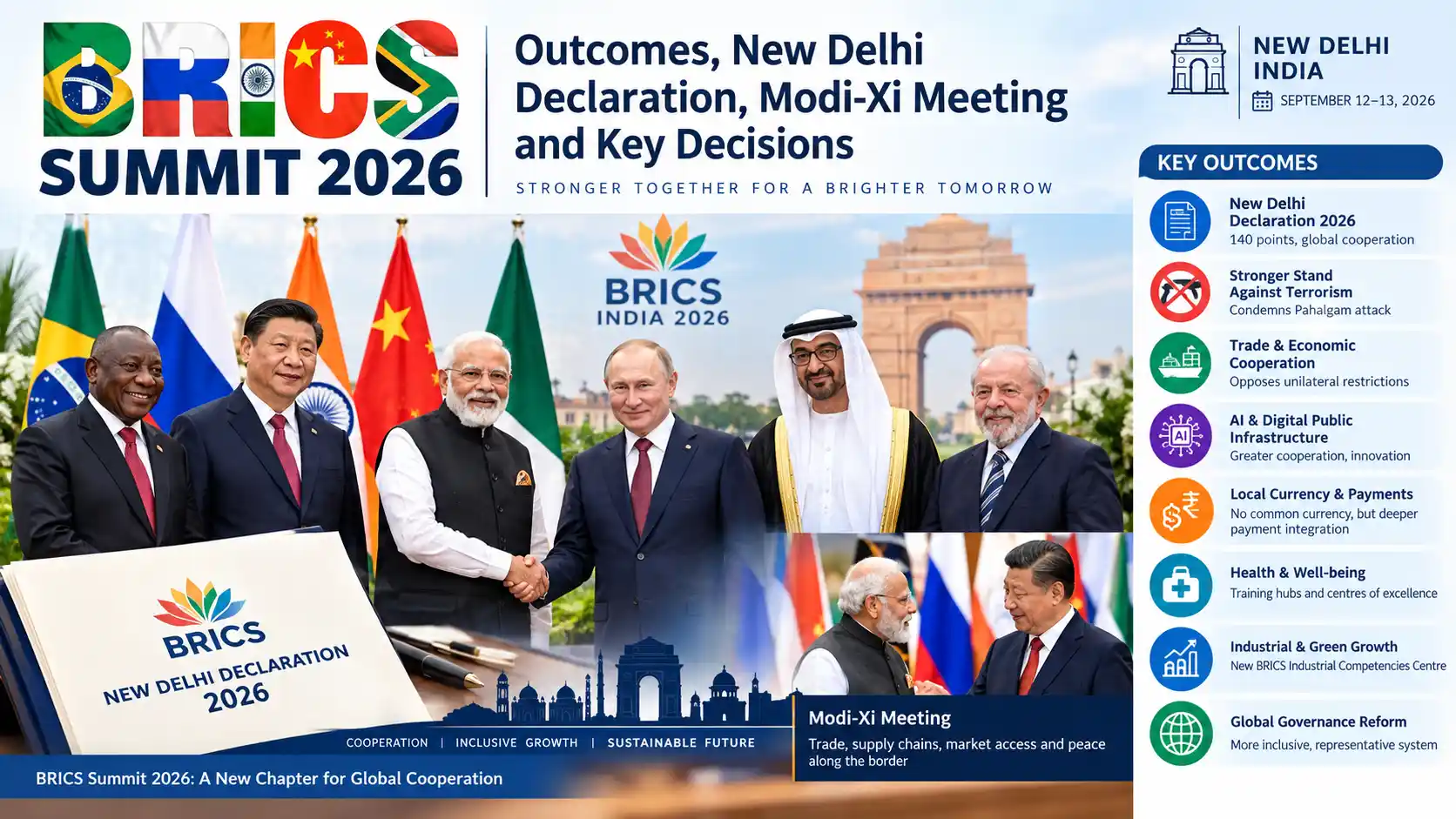
Also Read: India’s payment infrastructure is also becoming part of a broader discussion about cross-border payments and local currencies.
What About the Poor and Middle Class?
This is where the debate becomes much more than a percentage.
For a wealthy consumer, ₹4 or ₹40 might not matter much.
For a small business with a narrow profit margin, it can matter.
And if businesses recover the cost through prices, ordinary customers can eventually feel it.
That’s why the government should monitor:
Are prices increasing because of MDR?
Are merchants refusing UPI?
Are cash transactions increasing?
Are small businesses being affected?
Are customers being charged indirectly?
Which companies receive the MDR revenue?
These numbers should be publicly available.
What the Modi Government Should Explain
Instead of simply saying “UPI remains free,” the government should provide a complete public explanation.
Question 1
What is the actual annual cost of running UPI?
Question 2
Why exactly 0.4%?
Question 3
Why was ₹2,000 selected as the threshold?
Question 4
How much money will the MDR generate every year?
Question 5
Exactly which banks, payment providers and apps receive the money?
Question 6
What alternatives to MDR were considered?
Question 7
What safeguards prevent merchants from indirectly passing the cost to consumers?
Question 8
Did India-US trade negotiations influence the decision?
These are reasonable questions for a democratic government.
The Common Indian’s Simple Understanding
Forget the complicated words.
Remember this:
You pay ₹10,000.
You don’t normally see a ₹40 UPI charge.
The merchant may have a ₹40 MDR cost.
That money goes into the payment ecosystem.
The government says it is needed to make UPI sustainable.
Payment companies and banks can receive part of the revenue.
The merchant may absorb the cost — or may try to recover it through prices.
Therefore, the customer may not pay MDR directly but can potentially bear its economic cost indirectly.
And that is why the public debate matters.
The Bigger Question
UPI was not just another private app.
It became part of India’s digital public infrastructure.
India should therefore ask a fundamental question:
Who is India’s digital payment system ultimately designed to serve — the citizen, the merchant, the banks, the payment companies, or all of them?
There is nothing wrong with paying companies for genuine services.
There is nothing wrong with financing infrastructure.
There is also nothing wrong with the government changing a policy when circumstances change.
But when a system used by hundreds of millions of Indians changes from zero MDR to a paid merchant model, the public deserves to understand the complete economic and political reasoning.
And if international trade pressure played any role, citizens deserve transparency about that as well.
Prime Minister Narendra Modi and his government should therefore be questioned — not because every allegation against them is automatically true, but because an elected government must be answerable to the people for major policy decisions affecting everyday life.
The final question is therefore not simply:
“Who pays 0.4%?”
It is:
“Why was this system introduced, who gains from it, who ultimately bears the cost, and was India’s decision influenced by domestic economic needs, international trade pressure, or both?”
Those are questions worth asking.
Because UPI belongs to India’s digital future — and Indians have the right to know how that future is being financed.