
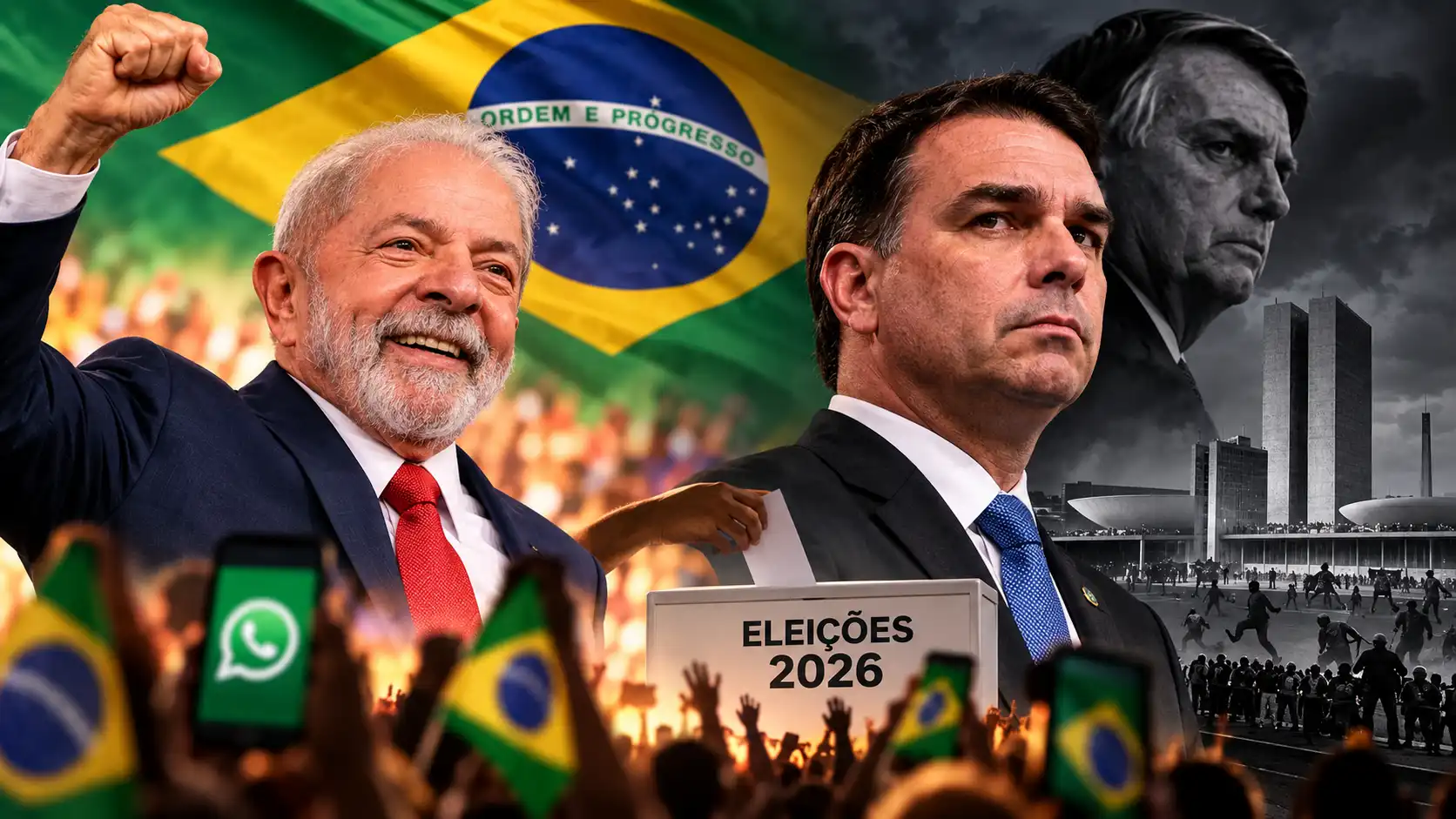
The Brazil election 2026 ended with one of the most dramatic comebacks in the country’s recent politics. President Luiz Inácio Lula da Silva beat Senator Flávio Bolsonaro in the 25 October runoff, a result that defied the first round and most polls. The loser has not accepted defeat. For readers in India, the contest raises familiar questions about WhatsApp campaigning, press freedom and trust in election bodies. This article sets out what happened in Brazil and where the comparison with India holds and where it doesn’t.
Brazil Election 2026 Results: Lula Wins a Fourth Term
Brazil’s electoral court (TSE) gave Lula 64,256,232 votes, or 51.79% of valid votes, against 59,826,041 votes (48.21%) for Flávio Bolsonaro. That is a gap of about 4.4 million votes. Lula became the first Brazilian president to win a fourth term, and he did so days before turning 81.
The first round on 4 October had pointed the other way. Flávio led with 47.03% of valid votes to Lula’s 45.16%. The result ran against most final polls, and the right also made gains in congressional races. In the runoff, Lula reversed it.
Why Lula Won the Runoff
No single factor explains the Brazil election 2026 result, and analysts caution against simple stories. Two things are well documented.
Turnout rose. Pollsters said better-than-expected turnout powered Lula’s victory. The TSE reported that 128.2 million of more than 158 million eligible voters turned out, with abstention at about 19.2%, down from 21.08% in the first round. In a race this close, getting first-round non-voters to the polls mattered.
The campaign moved online and onto the streets. Lula’s team and its allies pushed hard on digital mobilization between the rounds, which is covered below. Follower counts are not ballots, so it is safest to treat digital organizing as one part of a wider push rather than the cause of the win.
A Disputed Finish: The Voting Extension
Election day itself was messy. Shortly after polls were due to close, Supreme Court Justice Cristiano Zanin gave voters two more hours. Lula’s campaign had asked for more time because of bus problems in nine states, and Flávio’s had asked because of heavy rain in the south.
The TSE president later described the extension as unprecedented. Thousands of voting machines had already shut down, so the court had to pause the receipt of vote-count files temporarily. The episode is now the centre of Flávio’s challenge.
Flávio Bolsonaro Refuses to Concede
Flávio refused to accept defeat and said he would ask for the result to be annulled because of the extension ruling. His position echoes his father’s. Jair Bolsonaro never accepted his 2022 loss and was later sentenced to 27 years for plotting a coup.
There are important differences, though. Flávio is pointing to a specific court decision, and it is a decision his own campaign had asked for in a different form. Analysts say annulment is unlikely, given the margin of more than 4 million votes. Whether a challenge is filed and how the courts respond are the next things to watch.
WhatsApp and the Brazil Election 2026 Campaign
Messaging apps were a central battleground. The pro-Lula channel “Exército do Lula” (“Lula’s Army”), run by congressman André Janones, passed 10 million followers on 23 October and became the second-largest channel on WhatsApp in Brazil. It shared campaign content and set “missions” asking followers to spread posts.
The right had its own network. Congressman Nikolas Ferreira launched “Tropa do Flávio”, which had around 1.9 million subscribers in mid-October. The channels were also fought over in court. The TSE ordered the Lula channel suspended after Flávio’s campaign alleged disinformation, and it was allowed to resume after Lula’s campaign registered it as electoral propaganda. Janones’s side called the suspension censorship.
The lesson is about method, not outcome. Both camps built large, centrally coordinated networks that turn ordinary supporters into distributors. That raises real questions about how misinformation is policed in private channels.
What the Brazil Election 2026 Means for India
Brazil and India are very different democracies, with different constitutions, electoral systems and histories. A direct comparison would overreach. But several of the debates in Brazil have counterparts in India, and each has two sides.
Also Read: The Ground Reality of the West Bengal Election:
1. Messaging platforms and campaigns
WhatsApp is one of the most widely used apps in India, and parties across the spectrum use it to organize supporters and spread messages. The Brazilian experience shows how quickly a coordinated channel can scale, and how disputes over what counts as propaganda versus misinformation end up in front of election authorities. The practical question for any country is the same: who decides what gets removed from a private channel, and by what process?
2. Press freedom
This is where the two countries are most often compared, and also where the facts are most contested. In the 2026 World Press Freedom Index, published by Reporters Without Borders on 30 April, India ranked 157th out of 180 countries. That was a fall of six places from 151st in 2025. RSF described a rise in violence against journalists, highly concentrated media ownership and outlets with increasingly overt political alignment. It also named India’s data protection rules, published in November 2025, as a primary driver of the decline.
The government has long disputed such rankings. In earlier years, ministers told Parliament that the methodology was questionable and non-transparent, and said the government was committed to the free speech guarantee in Article 19. One reasonable reading is that rankings are useful signals but not final verdicts, and that specific cases are the better test: whether journalists can report on powerful people and institutions without legal or physical retaliation.
3. Trust in election administration
In Brazil, the electoral court ran a high-turnout election and then defended its handling of a chaotic finish. In India, the Election Commission’s voter-roll revision, known as the Special Intensive Revision (SIR), has been the main flashpoint. Opposition parties have made “vote chori” (vote theft) allegations, and many have taken the revision to the Supreme Court. More recently, a newspaper investigation alleged internal disagreements within the commission over the revision, and the Supreme Court has asked the government and the commission to explain related decisions.
The commission rejects the criticism. It says all its decisions were unanimous and legally valid. It has also argued that only eligible citizens should be on the rolls and that the voter list must be kept current. These disputes are still unresolved, so the fairest approach is to follow the court record and the commission’s published data rather than the claims of either side.
4. How losers contest results
Brazil’s challenge is going through courts, and that is the point: a disputed result can be tested through legal channels instead of the street. In India, election disputes also go through petitions and the courts. The common standard in both countries is that claims of fraud should be backed by evidence and decided by independent institutions.
Key Takeaways from the Brazil Election 2026
- Lula won with 51.79% of valid votes after trailing in the first round.
- Turnout rose between rounds and appears to have helped him, according to pollsters.
- A last-minute, unprecedented voting extension is now the basis of Flávio Bolsonaro’s challenge, which analysts consider unlikely to succeed.
- WhatsApp channels were central for both sides, and both faced disputes over content.
- For India, the useful comparisons are about process: how private-channel messaging is handled, how press freedom is measured and defended, and how election bodies earn trust.
FAQ
Who won the Brazil election 2026? Lula, with 51.79% of valid votes in the 25 October runoff, according to the TSE.
Has Flávio Bolsonaro accepted the result? No. He has said he will seek annulment over the voting-hours extension, though analysts say success is unlikely.
Why is Brazil’s result relevant to India? Not because the countries are alike, but because both debate WhatsApp campaigning, press freedom and the credibility of election bodies.
Sources
- Brazil’s Superior Electoral Court (TSE), announcement of the 2026 runoff result, 25-26 October 2026
- Reuters, AP, CNN and CNBC coverage of the runoff, 25-26 October 2026
- Congresso em Foco, Diário de Pernambuco and other Brazilian outlets on the “Exército do Lula” channel
- Reporters Without Borders, World Press Freedom Index 2026, as reported by The Wire and Newsreel Asia
- PTI, Khaleej Times and News Arena reporting on the Special Intensive Revision and the Election Commission dispute