
Introduction: A Former Supreme Court Judge Breaks His Silence
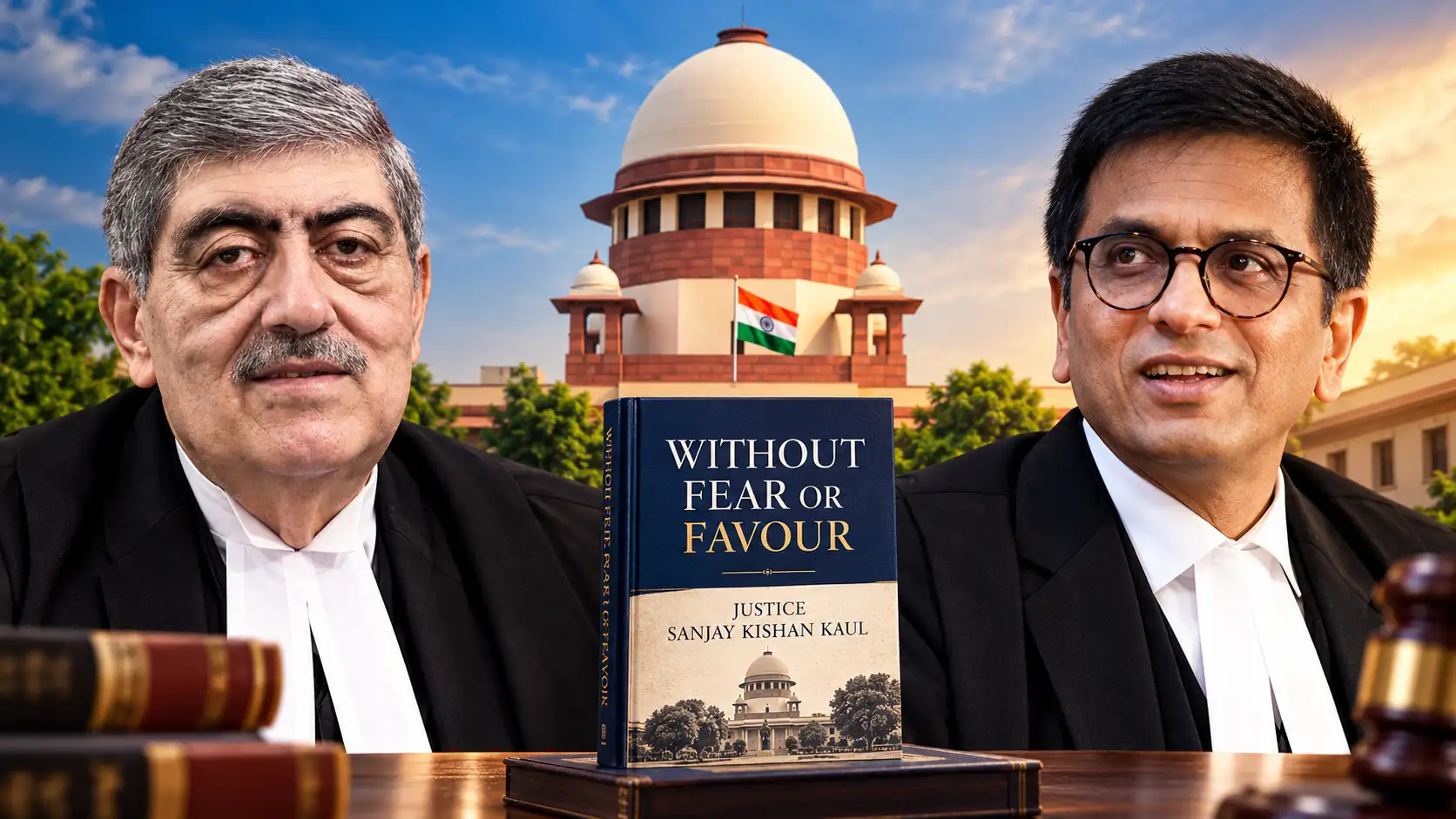
The Justice Sanjay Kishan Kaul memoir, titled Without Fear or Favour, has reignited debate over judicial independence in India and the relationship between the Supreme Court and the Union government. In revelations reported by The Indian Express and discussed in his interview with Karan Thapar for The Wire, former Supreme Court judge Justice Sanjay Kishan Kaul raises concerns about former Chief Justice of India D.Y. Chandrachud’s approach to judicial appointments and the functioning of the Collegium system. His account raises an important constitutional question: can India’s judiciary protect its independence if its senior leadership becomes too accommodating towards the executive?
These difficult questions have returned to the centre of India’s constitutional debate following revelations from former Supreme Court judge Justice Sanjay Kishan Kaul’s memoir, Without Fear or Favour.
In an account reported by The Indian Express on October 25–26, 2026, Justice Kaul raises serious concerns about the approach adopted by former Chief Justice of India (CJI) D.Y. Chandrachud during discussions concerning judicial appointments. According to Kaul, Chandrachud was, on some occasions, too deferential to the government, particularly when the Supreme Court Collegium was considering candidates for higher judicial office.
The controversy gained further attention after Justice Kaul discussed his experiences in an interview with journalist Karan Thapar for The Wire. During the conversation, he said Chandrachud had not lived up to his expectations and expressed his view that the Chief Justice should have been firmer in dealing with the executive, particularly on judicial appointments.
These are significant allegations because judicial appointments are not simply administrative decisions. They determine who will interpret the Constitution, protect fundamental rights, adjudicate disputes involving the government and hold public authorities accountable under the law.
However, the issue is more complicated than a disagreement between two former colleagues. Justice Kaul’s account also criticises the Collegium system itself, acknowledges the inevitability of executive pressure and questions the judiciary’s own institutional shortcomings.
Chandrachud, meanwhile, has disputed aspects of Kaul’s recollection, saying he could not recall the reported walkout and that their Collegium meetings had generally been respectful and constructive.
The central question, therefore, is not merely who was right in a private disagreement. It is whether India’s system of judicial appointments provides sufficient safeguards against political influence, opaque decision-making and the concentration of power.
Sources: The Indian Express report and The Wire’s interview coverage.
1. What Does Justice Sanjay Kishan Kaul Reveal in His Memoir?
Justice Sanjay Kishan Kaul retired from the Supreme Court in December 2023 after a judicial career spanning more than two decades. During the final phase of his Supreme Court tenure, he served as the senior-most puisne judge after the Chief Justice, commonly referred to as J1.
His memoir describes disagreements with Chandrachud over the way the Collegium should engage with the Union government when recommending judges for appointment to the Supreme Court and High Courts.
Kaul’s principal concern is the distinction between consulting the government and seeking its approval before the Collegium has even formally deliberated.
According to his account, there were instances when Chandrachud appeared willing to ascertain the government’s position before the judicial body’s decision-making process had been completed. Kaul regarded this approach as potentially compromising the independence of the appointment process.
His argument is rooted in a basic institutional principle: the government may legitimately participate in the constitutional process, but its political preferences should not become a determining factor in who is elevated to the judiciary.
The memoir describes an episode involving a proposal to fill six vacancies in the Supreme Court. Kaul says the Collegium had discussed five names before Chandrachud introduced a sixth name on the day of the meeting. Kaul suspected that the additional proposal originated with the government and objected when, according to his recollection, Chandrachud considered contacting the executive to ascertain its view.
The five names proceeded, while the sixth did not.
This account raises an important procedural question: should the executive’s views be considered before judicial deliberations have reached a formal conclusion, or should the Collegium first establish its independent position and then engage with the government through the prescribed process?
There can be legitimate arguments for communication between constitutional institutions. However, if communication becomes a form of prior approval, it risks reversing the relationship between consultation and decision-making.
It is important to note that Kaul’s account reflects his recollection of the events. Chandrachud has said he would need to read the relevant passages in context before responding in detail.
Also Read: Gyanesh Kumar SIR Controversy: ECINET, Voter Deletions, BJP Allegations, and Resignation Row
2. Why the Alleged Rift Between Justice Kaul and D.Y. Chandrachud Matters
Disagreements among judges are not inherently a problem. In fact, reasoned disagreement is one of the foundations of judicial independence.
Supreme Court judges frequently differ over constitutional interpretation, individual rights, the limits of state power and the appropriate remedy in a particular case. Such disagreements are ordinarily resolved through judicial opinions, not personal authority.
The reported tension between Kaul and Chandrachud is different because it concerns the internal functioning of the Collegium and the relationship between the judiciary and the executive.
As Chief Justice of India, Chandrachud occupied a position of considerable institutional responsibility. The CJI chairs the Supreme Court Collegium and plays a central role in judicial administration, including the recommendation of candidates for higher judicial office.
Kaul’s argument is that the Chief Justice should have used this position to engage the government from a firmer institutional standpoint.
In his interview with Karan Thapar, Kaul reportedly explained that he had offered to support Chandrachud in dealing with the government. He believed the two could adopt complementary roles, allowing the Chief Justice to manage the relationship while the senior puisne judge took a firmer line where necessary.
According to Kaul, Chandrachud generally preferred to manage that relationship himself.
The disagreement highlights a broader dilemma for constitutional leadership. A Chief Justice must maintain working relationships with other branches of government, but that relationship cannot come at the expense of the judiciary’s constitutional responsibilities.
Too much confrontation can make institutional cooperation difficult. Too much accommodation, on the other hand, can create the impression that judicial decisions or appointments are being shaped by executive preferences.
The objective should be neither permanent confrontation nor automatic agreement. It should be principled engagement, supported by transparent procedures and a clear understanding of constitutional boundaries.
Read Also: India’s Data Center Boom
3. The Minority-Faith Judge Controversy: A Question of Equality and Merit
One of the most sensitive episodes described by Kaul concerns a judicial candidate belonging to a minority faith.
According to the memoir excerpts reported by The Indian Express, the government raised questions about the representation of minority faiths in the judiciary and subsequently raised a question concerning the caste background of the candidate’s family.
Kaul reportedly considered the caste-related query inappropriate and irrelevant to the candidate’s suitability for judicial office. He also objected to the broader approach that he believed was emerging from the government’s intervention.
In his recollection, the disagreement became sufficiently serious that he closed the file and walked out of the room. He says the meeting was adjourned and that the government eventually relented, after which the candidate was recommended.
These allegations require careful examination because questions of religion, caste and representation in judicial appointments touch on the constitutional commitment to equality.
India’s Constitution prohibits discrimination on specified grounds and guarantees equality before the law. At the same time, the judiciary has a responsibility to ensure that its composition reflects a broad range of professional experience, regional backgrounds and social perspectives.
Representation and merit should not automatically be treated as opposing objectives. A credible appointment process should be capable of considering the diversity of the country while assessing candidates through relevant professional and constitutional criteria.
However, neither religion nor caste should become a tool for political favouritism or exclusion. If a candidate’s background is examined, the process must have a legitimate and transparent rationale rather than rely on informal political preferences.
The reported episode also raises an accountability question: who decides which personal characteristics are relevant to judicial appointments, and what safeguards prevent such questions from becoming instruments of political pressure?
Because the detailed exchange described by Kaul has not been independently established through a complete public record in the reporting cited here, it should be treated as an allegation and recollection, not as a judicial finding against any individual.
Nevertheless, the underlying concern deserves public scrutiny. Judicial appointments must command confidence across religious and social communities, not create suspicion that candidates are selected according to political convenience.
4. What Did Justice Kaul Tell Karan Thapar in The Wire Interview?
The interview with Karan Thapar brought the memoir’s central argument into sharper public focus.
According to The Wire, Kaul said that Chandrachud had not lived up to his expectations. He explained that he had expected a more assertive approach to government relations, particularly in the matter of judicial appointments.
The significance of this statement lies in Kaul’s position within the institution. He was not an outsider commenting on the Supreme Court from a political platform. He was a former member of the Collegium describing his experience of its internal functioning.
That does not make every recollection automatically conclusive. It does, however, make the account relevant to any serious examination of the judicial appointment process.
The interview also addressed a separate controversy concerning a case related to the Prevention of Money Laundering Act, or PMLA.
Kaul described his concern that a matter before a bench he headed had subsequently surfaced before another bench without, in his account, adequate communication with him. The underlying question was whether cases should be moved between benches because of concerns about how a particular bench might decide them.
This is a serious institutional issue because the allocation of cases is a central aspect of judicial administration.
The Chief Justice of India is traditionally described as the master of the roster, meaning that the CJI has authority over the allocation of cases and constitution of benches, subject to applicable rules and legal principles.
That authority is necessary for the orderly functioning of the court. But it must also be exercised consistently with institutional fairness, procedural regularity and public confidence.
The important distinction is between legitimate administrative decisions and decisions that could reasonably appear to be influenced by the anticipated outcome of litigation.
The memoir does not, by itself, establish that a case was improperly transferred. It does, however, bring attention to the importance of clear procedures, communication between judges and defensible reasons for changes in case allocation.
For readers seeking the original discussion, the relevant reports are available through The Wire’s interview coverage and its video interview page.
5. Chandrachud’s Response: Why the Other Side Must Be Heard
A balanced analysis must include Chandrachud’s response to the allegations.
In comments reported by The Indian Express, the former CJI said he had not read the book and therefore could not offer a detailed reaction to Kaul’s account without understanding the passages in context.
He also described the Collegium meetings during his tenure as respectful and constructive, characterised his relationship with Kaul as respectful and said he could not recall an occasion when Kaul walked out of a Collegium meeting.
Chandrachud further noted that he had made a practice of issuing resolutions after Collegium meetings and did not recall recorded dissent in those resolutions. He also pointed out that the government has a role in the appointment process, noting that the President formally signs the warrants of appointment.
These remarks are important for two reasons.
First, the public currently has competing recollections of some private interactions. Kaul’s memoir provides his account, while Chandrachud has disputed at least part of that recollection. A responsible article should not present the allegations as if every detail has already been independently verified.
Second, the absence of recorded dissent does not necessarily settle every question about informal discussions. A formal resolution may accurately record a final decision without documenting all disagreements that preceded it.
Conversely, an individual’s recollection of a disagreement does not establish that the institution acted unlawfully or that another judge intended to compromise judicial independence.
The appropriate way forward is to examine the relevant records, published Collegium resolutions and applicable procedures wherever available.
The objective should not be to turn the disagreement into a personal contest. It should be to understand whether existing institutional safeguards are adequate.
6. Understanding India’s Collegium System
To appreciate the controversy, it is necessary to understand how judges of the higher judiciary are appointed.
The Collegium system is a judicially developed mechanism through which senior judges recommend appointments and transfers to the higher judiciary. At the Supreme Court level, the Collegium is led by the Chief Justice of India and includes the senior-most judges specified under the applicable conventions.
The system emerged from the Supreme Court’s interpretation of constitutional provisions concerning judicial appointments, particularly through the so-called Second Judges Case of 1993 and the 1998 Presidential Reference.
Its central justification is that the judiciary must retain a decisive role in selecting judges so that the executive cannot use appointment powers to reward political allies or marginalise independent-minded candidates.
Supporters argue that judicial participation is indispensable in a constitutional democracy where courts may have to rule against the government.
Critics, however, point to the system’s limited transparency, the concentration of appointment power in a small group of judges and the absence of a fully independent, publicly accountable mechanism for assessing candidates.
The controversy involving Kaul and Chandrachud highlights a possible weakness: even where judicial primacy exists formally, informal executive pressure may still influence the process if discussions and decisions are not sufficiently transparent.
The problem is therefore not simply whether the judiciary or government should have more power. It is whether the process can prevent either institution from exercising that power arbitrarily.
A credible appointment system should ideally provide:
- Clear, published criteria for evaluating candidates.
- Consistent treatment of recommendations and reconsiderations.
- Appropriate consideration of professional competence, integrity and diversity.
- Transparent reasons for delays and departures from established procedures, subject to legitimate confidentiality.
- Effective safeguards against political favouritism.
- Meaningful institutional accountability without allowing politicians to control judicial selection.
Without such safeguards, the Collegium risks being criticised from two directions: as an opaque institution that selects judges without sufficient accountability and as a body vulnerable to pressure from the government.
7. The NJAC Debate: Was the Judiciary Right to Reject a Different Model?
Justice Kaul’s memoir also revisits one of the most consequential constitutional disputes of recent decades: the National Judicial Appointments Commission (NJAC).
The NJAC was created through constitutional amendments and legislation intended to replace the existing Collegium arrangement with a commission involving judicial and non-judicial members.
In 2015, the Supreme Court struck down the constitutional amendments establishing the NJAC, holding that the arrangement violated the Constitution’s basic structure because it threatened judicial independence.
The ruling preserved the Collegium system despite longstanding criticism of its opacity and limited external accountability.
Kaul has expressed the view that the NJAC system should have been given an opportunity to work rather than being rejected outright. This position differs from the conclusion reached by the Supreme Court majority in the 2015 judgment.
His view deserves consideration as part of the continuing debate, but it should not be mistaken for a change in the law. The NJAC judgment remains a landmark constitutional decision.
The underlying dilemma is difficult.
If politicians exercise decisive control over judicial appointments, a government may be able to influence the very institution responsible for reviewing its actions. This creates a potential conflict of interest.
If judges exercise appointment authority without sufficient transparency, however, the system may become vulnerable to favouritism, professional networks and unaccountable internal decision-making.
Neither risk can be dismissed.
A possible reform path would be to retain meaningful judicial independence while introducing clearer criteria, stronger disclosure requirements, structured consultation and transparent procedures for dealing with disagreements.
Any new framework must protect the judiciary from political capture without treating the judiciary as exempt from legitimate accountability.
The ultimate test is whether the appointment system produces independent, competent and diverse judges who can decide cases according to law rather than institutional pressure.
8. Does the Government Respect Judges Who Stand Their Ground?
One of the most striking themes in Kaul’s account is his assertion that the government respects judges who demonstrate firmness.
The argument is that constitutional institutions are often tested at their boundaries. If a judge or institution allows a political authority to influence a decision before the formal process has concluded, the authority may seek to exercise greater influence in future cases.
If, by contrast, the judiciary clearly communicates its independent position and follows consistent procedures, the government may ultimately accept its recommendations.
Kaul’s account cites examples in which, according to him, the government accepted recommendations after he intervened directly, including matters involving High Court appointments and the appointment of a minority-faith candidate.
These examples are relevant because they suggest that institutional disagreement does not necessarily make cooperation impossible.
However, they remain examples presented through Kaul’s account and should not be generalised into a universal claim about how every government responds to judicial firmness.
The larger principle is that judicial independence depends partly on institutional design and partly on the willingness of officeholders to use their authority responsibly.
An independent judiciary cannot rely solely on the personal courage of individual judges. Its rules and conventions must make it difficult for political pressure to influence appointments, case allocation or adjudication.
Otherwise, the protection of constitutional independence becomes dependent on who happens to occupy the office at a particular time.
That is an inadequate safeguard for a democracy of India’s size and complexity.
9. Judicial Independence Does Not Mean Automatically Opposing the Government
Another important aspect of Kaul’s position is his warning that the Supreme Court should not become an instrument of political opposition.
He has argued that the court exists to act as a constitutional check and balance, not as a substitute for an opposition party.
This distinction is essential.
Judicial independence does not mean that judges must rule against the government to prove their independence. Nor does it mean that every government decision must be defended merely because it was taken by an elected administration.
The judiciary must examine each dispute on its legal merits, applying the Constitution, statutes and binding precedents.
For example, a court may uphold a government decision if it falls within constitutional and statutory limits. It may also strike down a decision if it violates fundamental rights or exceeds the authority granted by law.
Both outcomes can demonstrate judicial independence.
The same principle applies to politically sensitive disputes involving elections, national security, economic policy, civil liberties and investigations by enforcement agencies.
A judiciary that consistently rules against the government without adequate legal reasoning would be no more independent than one that consistently favours it.
The standard must be impartiality, not political alignment.
This is why Kaul’s criticism of Chandrachud should be read alongside his defence of the judiciary’s limited constitutional role. His argument, as reported, is not that judges should act as political opponents. It is that they must resist attempts to compromise their institutional autonomy.
10. What Does This Mean for Indian Democracy?
India’s democratic system relies on a distribution of power among the legislature, executive and judiciary. Each branch has its own constitutional responsibilities, and none should be able to dominate the others.
Elections provide democratic legitimacy to governments, but electoral victory does not remove constitutional limits on executive power.
Similarly, the judiciary’s responsibility to enforce constitutional limits does not mean that judges can exercise unlimited authority without accountability.
The appointment of judges is one of the most important points at which these institutional relationships intersect.
A government has an interest in ensuring that judicial appointments are efficient and that vacancies do not remain unfilled. The judiciary has an interest in selecting candidates who possess legal ability, integrity and independence. Citizens have an interest in a system that is fair, representative and trusted.
When appointments become a source of prolonged conflict, the consequences can extend beyond the individuals involved.
Vacancies may affect the administration of justice. Delays can undermine public confidence. Disputes over selection criteria can fuel suspicions of political influence or judicial favouritism.
The Kaul memoir controversy therefore presents an opportunity to move beyond personalities and examine the structural weaknesses that make such disputes possible.
The most useful questions are not simply whether Chandrachud was too deferential or Kaul was too confrontational. They are whether appointment procedures were followed, whether the relevant decisions were adequately documented, whether executive views were considered at the appropriate stage and whether the system provides sufficient protection against arbitrary influence.
These questions are relevant regardless of which political party forms the government.
Judicial independence is not a privilege belonging to judges. It is a safeguard for citizens who may one day need protection from unlawful state action.
11. Justice Kaul’s Own Judicial Record Adds Context
Justice Kaul’s public criticism should also be understood in the context of his judicial career.
He joined the Delhi High Court in 2001, later served as Chief Justice of the Punjab and Haryana High Court and the Madras High Court, and was elevated to the Supreme Court in February 2017.
During his time in the higher judiciary, he participated in several significant legal developments.
He authored a concurring opinion in the 2017 privacy judgment in Justice K.S. Puttaswamy v. Union of India, which recognised privacy as a fundamental right. His opinion addressed the concept of a right to be forgotten.
In the 2023 judgment on Article 370, Kaul wrote a separate opinion recommending a truth and reconciliation commission for Jammu and Kashmir.
He also served on the bench that dismissed challenges to the Rafale fighter aircraft deal and participated in the Supreme Court proceedings concerning same-sex marriage.
These aspects of his record demonstrate that his judicial career encompassed questions involving civil liberties, constitutional governance and the boundaries of state power.
They do not, by themselves, establish that every criticism in his memoir is correct. They do, however, provide important context for understanding why his reflections on judicial independence and institutional functioning deserve serious examination.
A former judge’s account is neither infallible nor irrelevant. It should be assessed against available records, the applicable law and the responses of those whose conduct is discussed.
12. What Reforms Could Strengthen Judicial Appointments in India?
The controversy suggests several areas where institutional reform could improve confidence in the appointment process.
A. Publish clearer appointment criteria
The Collegium should use clear, consistently applied criteria for evaluating candidates. These may include professional competence, integrity, judicial experience, legal scholarship and diversity.
Clear criteria would not eliminate disagreement, but they could help explain why one candidate is recommended while another is not.
B. Improve transparency without compromising legitimate confidentiality
Judicial appointments involve sensitive assessments, and complete disclosure of every internal discussion may be neither practical nor desirable.
Nevertheless, the institution could provide more consistent explanations of its decisions, delays and reconsiderations. Transparency should be sufficient to establish that decisions follow defensible criteria without exposing confidential personal information unnecessarily.
C. Establish clearer protocols for government consultation
Consultation with the executive is part of the constitutional appointment process. The problem arises when consultation becomes indistinguishable from prior approval.
A clear protocol should establish when government views may be sought, how they are communicated and how the Collegium records its independent assessment.
D. Create safeguards against arbitrary delays
Delays in processing recommendations can undermine the appointment system even when no candidate is formally rejected.
A more predictable process, with appropriate explanations for prolonged delays, would reduce uncertainty and strengthen institutional accountability.
E. Protect judicial independence in case allocation
The controversy surrounding the reported PMLA matter highlights the importance of clear, consistent procedures for transferring cases and constituting benches.
The Chief Justice’s administrative authority must be respected, but it should operate within transparent rules that preserve confidence in the fairness of the process.
F. Encourage constructive institutional disagreement
Judges should be able to disagree with the Chief Justice without fear that their views will be disregarded. Equally, disagreement should be handled through reasoned discussion and established procedures.
Institutional independence is strongest when it does not depend entirely on personal relationships or the willingness of an individual judge to confront a colleague.
Conclusion: The Real Test Is the Independence of the Institution
Justice Sanjay Kishan Kaul’s memoir, Without Fear or Favour, has brought renewed attention to the internal functioning of India’s highest court and its relationship with the government.
His account raises serious questions about the handling of judicial appointments, the limits of executive consultation, the transparency of the Collegium system and the responsibilities of the Chief Justice of India.
Chandrachud has offered a different perspective, emphasising the respectful nature of their professional relationship and saying he could not recall the reported walkout. The allegations and response must therefore be examined with care rather than treated as a settled finding of wrongdoing.
Yet the broader institutional questions remain important regardless of the outcome of this personal disagreement.
The government must have its constitutionally prescribed role in judicial appointments, but it must not be allowed to dictate the composition of the judiciary for political convenience. The judiciary must retain meaningful independence, but it must also address legitimate concerns about opacity, concentrated power and accountability.
The answer is neither unquestioning faith in the Collegium nor unrestricted executive control. It is a process built on clear rules, defensible decisions, procedural fairness and institutional integrity.
A strong democracy does not require judges to be enemies of the government. It requires judges to be independent of it when deciding matters entrusted to the courts.
Likewise, a strong judiciary does not depend on every judge agreeing with the Chief Justice. It depends on an institution in which disagreements can be expressed, examined and resolved without compromising constitutional principles.
The most important lesson from Kaul’s revelations is therefore not a verdict on the character of either former judge. It is a reminder that constitutional safeguards must be stronger than individual personalities.
Judicial independence is meaningful only when it survives disagreement, political pressure and changes in leadership. India’s democratic institutions will be stronger when the selection of judges is trusted not because the public is asked to believe in the personal integrity of particular officeholders, but because the process itself demonstrates fairness, independence and accountability.
Sources and Further Reading
- The Indian Express: Government respects judges with spine; Chandrachud was too deferential, says Justice Kaul’s memoir
- The Wire: CJI Chandrachud had already taken government approval for judicial appointments, says former Supreme Court judge Kaul
- The Wire — Video Interview: Justice Kaul tells Karan Thapar that Chandrachud did not live up to his expectations
Frequently Asked Questions (FAQs)
Who is Justice Sanjay Kishan Kaul?
Justice Sanjay Kishan Kaul is a retired Supreme Court judge who served on the Supreme Court of India from 2017 until his retirement in December 2023. He has written about judicial independence, the Collegium system and his experiences within the higher judiciary.
What is the main controversy in Justice Kaul’s memoir?
The principal controversy concerns Kaul’s allegation that former CJI D.Y. Chandrachud was too deferential to the government in certain judicial appointment discussions. Kaul also describes disagreements concerning a minority-faith candidate, case allocation and other aspects of judicial administration.
What did Justice Kaul say in his interview with Karan Thapar?
According to The Wire, Kaul said Chandrachud had not lived up to his expectations and expressed the view that the former CJI should have taken a firmer position in dealings with the government, particularly over judicial appointments.
Did D.Y. Chandrachud respond to Justice Kaul’s allegations?
Yes. In comments reported by The Indian Express, Chandrachud said he had not read the book and needed to examine the passages in context. He described his Collegium meetings with Kaul as respectful and said he could not recall the reported walkout.
What is the Collegium system in India?
The Collegium system is the judicially developed process through which senior judges recommend appointments and transfers to India’s higher judiciary. It is intended to preserve judicial independence while remaining subject to the constitutional appointment framework.
What was the National Judicial Appointments Commission?
The National Judicial Appointments Commission was an alternative judicial appointment mechanism established through constitutional amendments and legislation in 2014–15. The Supreme Court struck it down in 2015, ruling that it violated the Constitution’s basic structure by threatening judicial independence.
Why is judicial independence important in a democracy?
Judicial independence enables courts to decide disputes impartially, protect fundamental rights and review government actions against constitutional and legal standards. It helps ensure that the law applies to public authorities as well as ordinary citizens.
Editorial disclaimer: This article analyses publicly reported allegations, recollections and responses. It does not claim that the reported disagreements establish misconduct or a legal violation by either former judge.