
Published: September 13, 2026
Updated: September 13, 2026
The BRICS Summit 2026 Day 2 entered its final day in New Delhi on Sunday, September 13, with leaders discussing global economic cooperation, geopolitical tensions, technology, artificial intelligence, supply-chain resilience and the future role of the expanded BRICS grouping.
The summit, hosted by India at Bharat Mandapam, follows the adoption of the New Delhi Declaration 2026 on September 12. The declaration was adopted by consensus and covers issues ranging from international trade and global governance to terrorism, AI, sustainable development and cross-border payments.
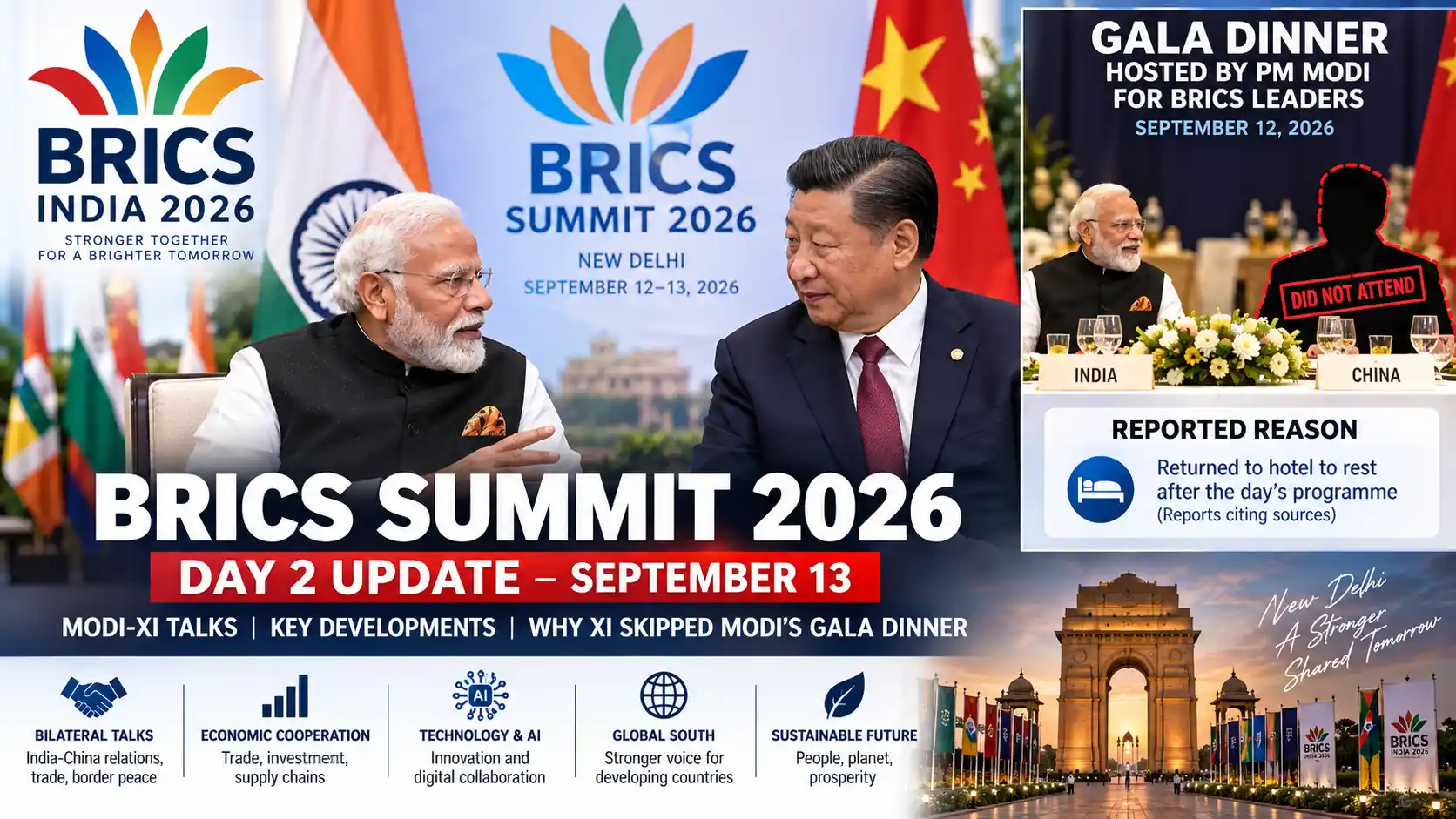
One of the most closely watched developments surrounding the summit has been the interaction between Prime Minister Narendra Modi and Chinese President Xi Jinping, particularly after Xi skipped a gala dinner hosted by Modi for BRICS leaders on Saturday evening.
But was it a diplomatic snub?
There is currently no official evidence to conclude that, but some how its create matter.
BRICS Summit 2026 Day 2: What Happened on September 13?
The second day of the summit focused on the theme of resilience, innovation, cooperation and sustainability, with BRICS members and partner countries discussing inclusive global growth.
Prime Minister Narendra Modi warned that geopolitical tensions, supply-chain disruptions and climate-related challenges are increasingly affecting countries around the world.
He also highlighted concerns about the weaponisation of technology and critical minerals, arguing that such developments could undermine global development and shared prosperity.
Chinese President Xi Jinping also addressed the summit, calling for stronger cooperation among Global South countries in areas including artificial intelligence, trade, digital industries, manufacturing and science and technology.
Xi argued that international rules should be created through broader participation rather than being dictated by a small group of countries.
Modi-Xi Meeting: What Did India and China Discuss?
The Modi-Xi meeting was one of the most important bilateral engagements during the BRICS Summit.
The two leaders held talks on the sidelines of the summit after Xi arrived in New Delhi for his first India visit in seven years.
According to China’s official account of the meeting, Xi said China and India should view each other as partners rather than rivals and called for a strategic, long-term approach to bilateral relations.
The discussions covered several sensitive and important issues.
Border peace
India stressed that peace and tranquillity along the border remain essential for the continued development of bilateral relations.
The two sides also reaffirmed their commitment to finding a fair, reasonable and mutually acceptable solution to the boundary question.
Trade imbalance
Economic relations were another important issue.
India wants to address its large trade imbalance with China and improve market access for Indian companies.
The two leaders discussed economic and trade concerns, supply chains and business links.
This is particularly significant because China’s role in India’s imports remains very large.
Direct flights and people-to-people relations
The two countries also discussed improving people-to-people exchanges and mobility, including direct air connectivity.
Improved connectivity could help tourism, education, business and family travel between the two countries.
Why Did Xi Jinping Skip Modi’s Gala Dinner?
This is probably the most searched question following the first day of the BRICS Summit.
Prime Minister Narendra Modi hosted a gala dinner for BRICS leaders, delegates and representatives of international organisations on September 12.
Xi Jinping was notably absent.
Reports based on sources said that Xi returned to his hotel after the day’s summit activities and rested instead of attending the dinner. China’s Foreign Minister Wang Yi represented China at the dinner.
Was Xi’s absence a diplomatic snub to Modi?
There is no confirmed evidence of that.
This distinction is important.
Xi had already held a substantial bilateral meeting with Modi earlier that day. During that meeting, the two sides discussed improving India-China relations, border peace, economic cooperation and trade concerns. China’s official statement described the discussions as sincere and in-depth and said the two leaders reached the view that China and India should be partners.
Therefore, it would be premature to describe Xi’s dinner absence as a deliberate rejection of Modi.
So why didn’t Xi attend?
The official reason has not been publicly established.
Several reports citing sources said that Xi returned to his hotel to rest after the day’s programme.
Another important point is that Xi was not the only senior dignitary absent from the dinner. Abu Dhabi Crown Prince Sheikh Khaled bin Mohamed bin Zayed Al Nahyan also did not attend, having left for home after the summit’s daytime proceedings.
Therefore, headlines suggesting that Xi “refused Modi’s invitation” or “snubbed India” go beyond what has been officially established.
Why Xi’s Dinner Absence Still Attracted Attention
Even though there is no confirmed evidence of a diplomatic snub, Xi’s absence naturally attracted attention because of the complicated history of India-China relations.
Relations between the two countries suffered a major setback following the 2020 border clashes.
At the same time, both countries have been trying to stabilise relations through high-level meetings and diplomatic engagement.
Xi’s 2026 visit itself was significant because it was his first visit to India in seven years.
Against this background, every public interaction between Modi and Xi receives considerable attention.
The fact that Xi attended the BRICS summit, held a bilateral meeting with Modi and participated in summit discussions suggests that the dinner absence should be treated separately unless further evidence emerges.
Xi Jinping’s Message at BRICS Summit 2026
On September 13, Xi called for stronger cooperation among BRICS and other Global South countries.
He argued that the expanded BRICS grouping should cooperate more closely in:
- Artificial intelligence
- Trade
- Digital industries
- Manufacturing
- Science and technology
- Supply chains
- Finance
Xi also rejected the idea that international relations should be based on a “might makes right” approach and called for greater respect for sovereign equality and international law.
China also proposed deeper cooperation in AI and other technology-related areas. Reuters reported that Xi promoted stronger economic integration within the expanded BRICS grouping.
What Did PM Modi Say on the Second Day?
Prime Minister Modi used the second day of the summit to highlight challenges facing developing economies.
He warned that geopolitical tensions and disruptions to supply chains could undermine global growth.
India also emphasised the importance of cooperation among Global South countries in areas such as:
- Technology
- Energy
- Critical minerals
- Trade
- Climate change
- Food security
- Sustainable development
Modi also argued that emerging economies need greater representation in global institutions.
The message is consistent with India’s broader objective of using BRICS to strengthen the voice of developing countries in global decision-making.
BRICS Summit 2026 and the Middle East Conflict
The geopolitical situation in the Middle East remained another major challenge for BRICS.
The New Delhi Declaration expressed deep concern about escalating tensions and called for maximum restraint.
However, the declaration did not directly condemn the United States, Israel or Iran by name in the relevant section, reflecting the differences among BRICS members.
This demonstrates both the strength and limitation of BRICS.
The bloc can reach consensus on some broad principles, but differences between member countries can make strong common positions on major geopolitical conflicts difficult.
What Are the Biggest Economic Issues for India?
India’s economic priorities at BRICS remain significant.
The government has been pushing for:
More balanced BRICS trade
India wants greater access to foreign markets for Indian businesses.
Local-currency trade
BRICS countries are exploring ways to increase trade using national currencies and improve payment connectivity.
Supply-chain resilience
India wants more diversified and reliable global supply chains.
Technology cooperation
Artificial intelligence, digital infrastructure and advanced manufacturing are increasingly important.
Investment
India wants BRICS cooperation to encourage greater investment and business partnerships.
These issues are particularly important because India’s trade deficit with BRICS countries remains a major challenge.
Related: BRICS Summit 2026: How Much Is India Spending, What Will India Gain and Why Does It Matter?
What Happens After the BRICS Summit?
The 2026 summit marks the end of India’s BRICS chairship, but many of the initiatives discussed during the year will continue.
India has organised hundreds of BRICS-related meetings and engagements across the country during its chairship.
The next challenge is implementation.
The success of India’s BRICS presidency will ultimately depend on whether agreements and proposals translate into:
- More exports
- More investment
- Better market access
- Technology partnerships
- Improved payment systems
- Stronger supply chains
- Greater cooperation among developing economies
China will take over the BRICS chairship in 2027.
BRICS Summit 2026: Key Takeaways From September 13
1. Modi and Xi held important bilateral talks
The two leaders discussed India-China relations, border peace, economic cooperation, trade and people-to-people exchanges.
2. Xi skipped Modi’s gala dinner
Xi did not attend the dinner hosted by Modi on September 12. Reports citing sources said he returned to his hotel to rest. There is no confirmed evidence that the absence was a diplomatic snub.
3. China was still represented
Chinese Foreign Minister Wang Yi attended the dinner on behalf of China.
4. Xi promoted greater BRICS cooperation
The Chinese president called for stronger cooperation in AI, trade, manufacturing, digital industries and technology.
5. India highlighted global economic risks
Modi warned about geopolitical tensions, supply-chain disruptions and the weaponisation of technology and critical minerals.
Frequently Asked Questions
Did Xi Jinping refuse to have lunch with Narendra Modi?
No confirmed report says Xi refused a lunch invitation from Modi. The reported incident concerns a gala dinner hosted by Modi for BRICS leaders on September 12, which Xi did not attend.
Why did Xi Jinping skip Modi’s BRICS dinner?
The exact reason has not been officially confirmed. Reports citing sources said Xi returned to his hotel to rest after the day’s summit activities.
Was Xi’s absence a diplomatic snub?
There is no confirmed evidence that it was a diplomatic snub. Xi had already held a bilateral meeting with Modi and participated in the summit. China’s official account described the bilateral discussion as substantive and said the countries should develop their relationship from a strategic and long-term perspective.
What did Modi and Xi discuss?
They discussed bilateral relations, border peace, trade and economic concerns, people-to-people exchanges, connectivity and cooperation in international forums.
What was the biggest outcome of BRICS Summit 2026?
The adoption of the New Delhi Declaration 2026 was the main formal outcome, while the Modi-Xi meeting was one of the most important bilateral developments for India.
Conclusion
The BRICS Summit 2026 on September 13 highlighted both the opportunities and challenges facing the expanded grouping.
For India, the Modi-Xi meeting was particularly significant because both countries are attempting to stabilise their relationship while dealing with unresolved border issues and a large trade imbalance.
Xi Jinping’s decision to skip Prime Minister Modi’s gala dinner certainly attracted attention, but there is currently no reliable evidence that he deliberately rejected Modi or that the absence was a diplomatic snub. Available reporting indicates that Xi returned to his hotel to rest, while Foreign Minister Wang Yi represented China at the dinner.
The more important development was the bilateral meeting itself.
India and China have significant differences, but both governments have an interest in preventing those differences from becoming a permanent obstacle to economic and regional cooperation.
The real test after BRICS 2026 will be whether the diplomatic momentum seen in New Delhi translates into greater border stability, stronger economic ties, more balanced trade and wider cooperation between the world’s two most populous countries.
Sources: