
8th Pay Commission 2026 in India: The Truth Behind the Salary Hike, Delays and Fitment Factor
Discover the real story behind the 8th Pay Commission 2026 in India: who benefits, why implementation is delayed, the fitment factor truth, and how it affects central government employees and pensioners. Read the full untold analysis here.
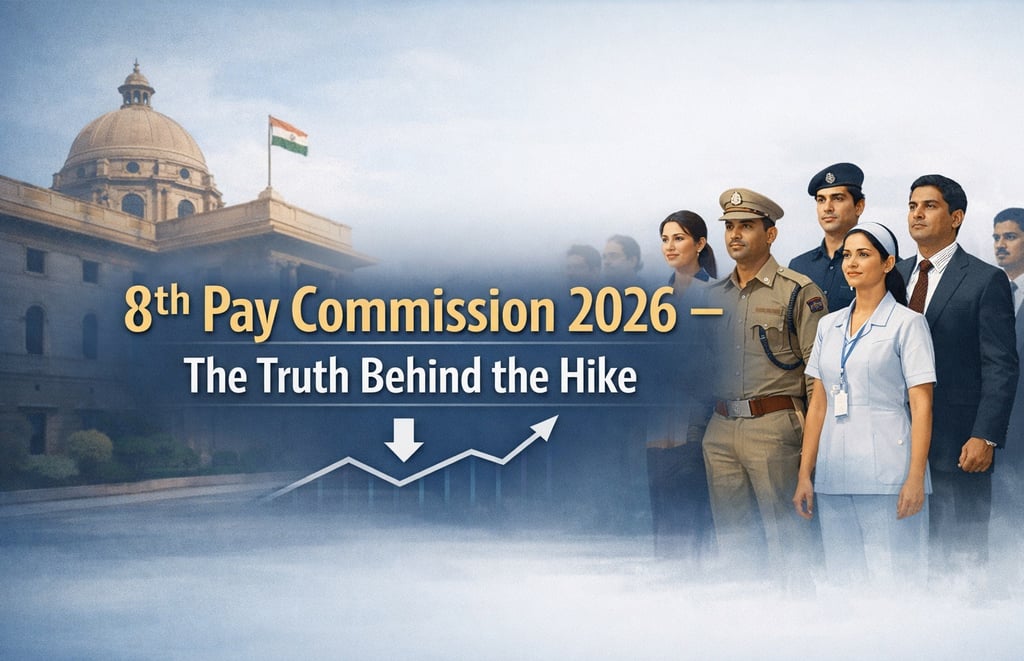

The 8th Pay Commission in India has become one of the most talked‑about issues in 2026, not just for central government employees and pensioners, but also for the broader public who see it as a barometer of economic fairness, fiscal priorities, and political promises. While the government officially talks about “enhancing the financial well‑being” of 49 lakh employees and 65 lakh pensioners, there is a growing debate behind the scenes about delays, fitment factors, and the real “truth” politicians don’t highlight in press conferences.
8th Pay Commission in India: The Hype, the Delay, and the Untold Truth
In 2026, the 8th Central Pay Commission (8th CPC) has become more than just a technical exercise in salary revision. It has become a political flashpoint, a symbol of inflation‑linked anxiety for millions of central government employees, and a test case for how the Union government balances welfare promises with the harsh realities of fiscal deficit and revenue‑to‑GDP limits.
On the surface, the narrative is simple: a new pay commission means higher salaries, better pensions, and some long‑overdue relief amid food‑price‑driven inflation. But dig a little deeper, and you uncover a story of broken timelines, unmet expectations, and a gap between what the government “says” and what it can actually afford.
What is the 8th Pay Commission?
The Central Pay Commission (CPC) is a body set up by the Government of India every 10 years or so to review the salaries, allowances, pensions, and service conditions of central government employees.
It revises the pay matrix (the grid that defines pay levels for different grades).
It recommends a fitment factor, essentially a multiplier that converts the old basic pay into the new basic pay.
It also looks at pensions, retirement benefits, and cost‑of‑living adjustments.
Historically, each CPC has led to a significant jump in emoluments, but it has also imposed a recurring upward pressure on the Union budget. The 8th CPC is expected to follow this pattern, but with a crucial twist: the timing, implementation date, and fiscal reality around 2026–27 are far more uncertain than the official headlines suggest.
Official Timeline vs the Ground Reality
The government has announced that the 8th CPC will be implemented from January 1, 2026, with the commission constituted on November 3, 2025, and given 18 months to submit its report.
In theory, this means:
Report by mid‑2027
Parliamentary and budgetary approval
Actual pay hikes and arrears disbursed sometime after
However, previous pay commissions have taken 18–24 months or more from formation to full implementation. Several experts and pensioner associations argue that the January 1, 2026 date is more of a symbolic promise than a realistic deadline, especially given the compressed working period of the 8th CPC.
In other words, the “truth” is that most employees may not actually see revised salaries and arrears until 2027 or even 2028, despite the official narrative of a 2026 rollout.
The Fitment Factor Game
One of the most critical numbers in any pay commission cycle is the fitment factor—a multiplier applied to the existing basic pay to arrive at the new basic pay.
Under the 7th CPC, the fitment factor was 2.57, which lifted the minimum basic pay from ₹7,000 to ₹18,000.
Trade unions and employee bodies are now demanding a fitment factor in the range of 2.86 to 3.25 for the 8th CPC, arguing that inflation and the cost of living have risen sharply since 2016.
However, government insiders and economists hint at a much more cautious stance.
Some projections talk of a fitment factor between 1.83 and 2.46, which would still be lower than what unions expect.
A lower fitment factor keeps the fiscal burden manageable, but it also dilutes the gap between expectations and reality.
So the truth behind the fitment factor debate is that employees are hoping for a generous multiplier, while the government is quietly preparing for a more modest, fiscally “safe” figure.
How Many People Will Actually Benefit?
The Union government claims that over 49 lakh central government employees and 65 lakh pensioners will benefit from the 8th CPC. That’s roughly 1.14 crore people whose salaries, pensions, allowances, and cost‑of‑living adjustments will be under review.
That number is massive and has far‑reaching implications:
Consumption boost: Higher salaries mean more spending on housing, vehicles, education, and services, which can stimulate parts of the economy.
Fiscal pressure: Every percentage point increase in the pay package can add thousands of crores of rupees to the Union budget.
Behind the scenes, there is an unspoken concern: whether the benefits will be equally distributed across:
Field‑level staff (postal, railways, defence, paramilitary forces)
Clerks and lower‑grade employees
Higher‑grade officers and decision‑makers
There is a growing fear that any 8th CPC will again tend to widen the gap between lower and higher grades, because the percentage‑based hikes and allowances inherently favour those at the top of the pay matrix.
The Inflation Trap and the “Real” Hike
One of the main arguments in favour of the 8th CPC is inflation.
Between 2016 (7th CPC implementation) and 2026, India has seen spikes in food prices, fuel, and housing costs, which have eaten into the real value of salaries.
Many middle‑level employees argue that, in real terms, their purchasing power has declined, even though their nominal salaries have risen through DA (Dearness Allowance) hikes and step‑increments.
So the truth is:
Technically, employees may get a nominal hike of 15–20% or more from the 8th CPC.
But after adjusting for inflation and rising taxation, the real hike may feel far smaller to employees struggling with EMIs, school fees, and health‑care costs.
In other words, the headline “percentage hike” is not the same as the real‑life improvement that employees are hoping for.
Why the Delay? Is It a Breach of Trust?
The appointment of Justice Ranjana Prakash Desai as the Chairperson of the 8th CPC in November 2025 marked the formal constitution of the commission. But the timeline gap between the 7th CPC (2016) and the 8th CPC (2025–26) has already sparked criticism.
Many pensioners and unions argue that a seven‑month gap between the announcement and the formal constitution is unacceptable, especially when millions are already feeling the pinch of inflation.
Pensioner bodies like Bharat Pensioners Samaj (BPS) have sent formal appeals to the Ministry of Finance and DoPT, demanding clarity and faster action.
The truth here is that pay commissions are inherently political instruments.
Announcing a new CPC too early in a government’s term can create a huge fiscal burden.
Announcing it too late risks electoral backlash from employees and pensioners.
So the delay in constituting the 8th CPC is not just a bureaucratic hiccup; it is a deliberate calibration of timing to balance fiscal prudence and political optics.
The Fiscal Tightrope: Budget Headlines vs Real Numbers
The Union Finance Ministry has repeatedly stressed that any 8th CPC recommendations will be examined through the lens of fiscal impact.
In simple terms:
The government cannot commit to a specific percentage hike upfront, because it does not want to lock itself into a budget it may not be able to bear.
Once the 8th CPC report is submitted, the Cabinet and Finance Ministry will negotiate, trim, and sometimes dilute certain recommendations.
Historically, CPCs have influenced the structure of the Union budget for years, because:
Higher salaries mean higher revenue expenditure (wages and pensions).
This can crowd out spending on infrastructure, education, health, and welfare schemes, unless the government raises more revenue or runs a higher deficit.
So the truth behind the 8th CPC is that it is not just a “salary revision” issue; it is part of a larger fiscal debate about how much India can afford to spend on its own bureaucracy versus its citizens.
The Pensioners’ Angle: Arrears vs Ongoing Pensions
One of the most emotional and politically sensitive parts of the 8th CPC debates is pensions and arrears.
For pensioners, the 8th CPC can mean:
Higher monthly pension (based on the new fitment factor and revised pay matrix).
Arrears for the period between the effective date (January 1, 2026) and the date when the revised pension is actually implemented.
However:
Arrears are often taxed, which can reduce the net benefit for pensioners.
If the implementation is delayed, the “arrears” clock stretches, and what looks like a large lump sum on paper can be eroded by time and tax.
Behind the scenes, there is a growing concern among pensioners that:
They may not get the full benefit of the 8th CPC fitment factor.
The government may introduce “rationalisation” measures (like capping minimum pension or adjusting DA structures) to keep the cost under control.
States vs Centre: Will the 8th CPC Trigger a Domino Effect?
The 8th CPC applies only to central government employees and pensioners. But in practice, it often sets a de facto benchmark for state governments, autonomous bodies, and even the private sector.
State governments with tight budgets may struggle to match the centre’s revisions, leading to agitations, strikes, and service disruptions.
Public sector undertakings (PSUs) and paramilitary forces often tie their pay scales to the latest CPC, so the 8th CPC will indirectly influence them too.
The truth is that the 8th CPC is not an isolated central government decision; it is a trigger for a nationwide wage‑revision cycle, which can strain the fiscal health of poorer states and create asymmetry in employee satisfaction across regions.
The Social Media Hype vs Ground Expectations
In 2026, social media and WhatsApp forwards are flooded with “8th CPC” memes, salary calculators, and “your salary will be X” posts.
While these tools can help employees estimate possible hikes, they often assume best‑case scenarios:
Maximum fitment factor
Full DA hike
No tax or deductions
The reality is that the final notification will likely bring surprises both positive and negative.
Some employees may find that only a small percentage of their expectations are met.
Others may discover new conditions or caps they did not anticipate.
So the truth behind the hype is that much of the 8th CPC optimism is based on speculation, not statute or final rules.
What Employees and Pensioners Should Really Watch For
If you are a central government employee or pensioner, the 8th CPC will matter deeply to your monthly income, savings, and retirement planning.
Here are the key indicators to watch closely:
Aspect to Watch | What It Means
Final fitment factor Determines how much your basic pay is multiplied; higher = better hike.
Effective date notification When the new pay/pension actually starts; may differ from Jan 1, 2026.
Arrears structure How much you get backdated, and how it is taxed.
Pension minimum and DA rules Whether there are new caps or rationalisation measures.
Fiscal statements by Finance How much the government admits this will cost the exchequer.
By focusing on these concrete parameters, rather than just the headline percentage hikes, employees can separate politics from policy and set realistic expectations.
Conclusion: The Truth in a Nutshell
The 8th Pay Commission in India is, in many ways, a symbol of broader tensions:
Between expectations and affordability
Between inflation‑driven demands and fiscal constraints
Between political promises and bureaucratic reality
The truth behind it is that:
Most employees and pensioners will get some increase, but it may fall short of the social‑media hype.
Implementation will likely be delayed, meaning the real benefit may arrive in 2027 or later.
The final fitment factor and pension rules will reflect a compromise between welfare and fiscal prudence.
For content creators, analysts, and informed citizens, the 8th CPC is not just a salary story—it is a window into India’s evolving social contract with its public servants and exchequer.
If you want, I can next help you:
add a section with sample salary calculations (current grade → projected grade under 8th CPC),
or optimize this blog for SEO with keyword‑rich subsections and meta‑tags tailored for 2026.
Sources:- angelone, drishtiias, bajajfinserv, ndtv, staffnews
MicroNews © 2025
MicroNews empowers the generation of tomorrow for a brighter future and hope for every individual.
Thanks For Touch with us
We care about your data in our privacy policy.
Popular Post
Top 10 Calcium-Rich Vegetables for Strong Bones & Better Health
Patala Garuda (Rauvolfia serpentina): Health Benefits, Ayurvedic Uses
Ganga Siuli (Parijata Tree): Benefits, Uses, and Medicinal Properties
Freelancing Explained: How to Start, Earn, and Succeed as a Freelancer
Turmeric Benefits: Uses, Nutrition, Ayurveda Importance & Side Effects
Science of Longevity: New Research Reveals How Diet May Shape Lifespan