
Automate Your Business with Artificial Intelligence
Discover how artificial intelligence can make studying and managing your business easier and more efficient. Save time and increase productivity. #artificial intelligence
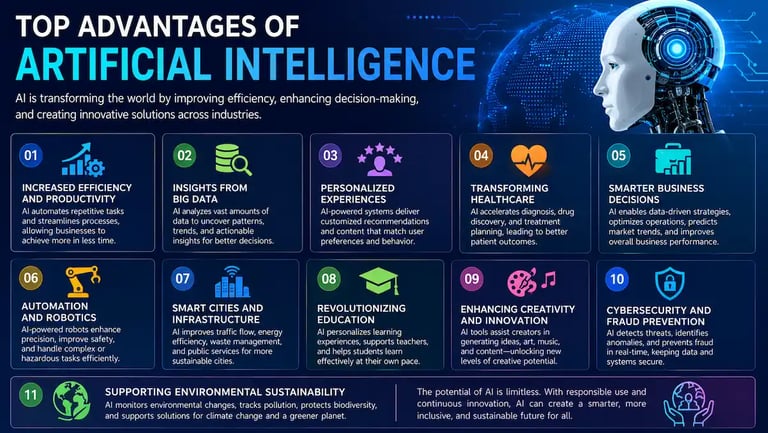
Advantages of Artificial Intelligence (AI): How AI is Transforming Industries and Everyday Life
Artificial Intelligence (AI) has emerged as one of the most revolutionary technologies of the 21st century. From improving business operations to enhancing healthcare and education, AI is reshaping the way people live, work, and interact with technology. By automating tasks, analyzing large amounts of data, and providing intelligent solutions, AI offers countless benefits across various industries.
In this article, we explore the major advantages of Artificial Intelligence and how it is driving innovation worldwide.
1. Increased Efficiency and Productivity
One of the most significant advantages of AI is its ability to improve efficiency and productivity. AI-powered systems can process massive amounts of information quickly and accurately while operating continuously without fatigue.
Businesses use AI to automate repetitive tasks such as data entry, customer support, scheduling, and inventory management. This automation allows employees to focus on strategic, creative, and high-value activities, leading to improved productivity and better business outcomes.
Key Benefits:
Faster task completion
Reduced human errors
Improved workflow automation
Enhanced operational efficiency
2. Powerful Insights from Big Data
In today's digital world, organizations generate enormous amounts of data every day. Analyzing this data manually is often impossible. AI helps by identifying patterns, trends, and valuable insights hidden within large datasets.
Machine learning algorithms can analyze customer behavior, market trends, and operational performance to support informed decision-making.
Benefits of AI in Data Analysis:
Real-time analytics
Better forecasting and predictions
Identification of hidden trends
Improved strategic planning
3. Personalized User Experiences
AI has revolutionized personalization across digital platforms. Companies use AI-powered recommendation systems to understand user preferences and deliver customized content, products, and services.
Popular platforms like streaming services, e-commerce websites, and social media networks rely heavily on AI to enhance user engagement.
Examples:
Personalized product recommendations
Customized content suggestions
Targeted advertising
Improved customer satisfaction
As a result, users enjoy more relevant experiences while businesses achieve higher conversion rates.
4. Transforming Healthcare Services
Artificial Intelligence is making healthcare smarter, faster, and more effective. AI-powered tools assist healthcare professionals in diagnosing diseases, interpreting medical images, and developing personalized treatment plans.
Machine learning models can detect health conditions such as cancer, heart disease, and neurological disorders at earlier stages, increasing the chances of successful treatment.
AI Applications in Healthcare:
Medical imaging analysis
Early disease detection
Drug discovery and development
Predictive healthcare analytics
Virtual health assistants
These advancements contribute to better patient outcomes and more efficient healthcare systems.
also read: How MRI works and its advantages
5. Smarter Business Decision-Making
Organizations across industries are using AI to gain a competitive advantage. AI systems analyze market data, customer preferences, and business performance metrics to support strategic decision-making.
Businesses can optimize operations, improve supply chain management, and identify emerging market opportunities more effectively.
Business Benefits:
Demand forecasting
Risk management
Customer behavior analysis
Marketing optimization
Cost reduction
AI enables companies to make data-driven decisions and adapt quickly to changing market conditions.
6. Automation and Robotics
AI-powered robots are transforming industries such as manufacturing, logistics, and transportation. These intelligent machines can perform repetitive, dangerous, and precision-based tasks with remarkable accuracy.
Automation reduces operational costs while improving safety and productivity.
Common Applications:
Manufacturing assembly lines
Warehouse automation
Quality control inspections
Autonomous vehicles
Hazardous environment operations
This technological advancement creates safer workplaces and enhances overall efficiency.
7. Development of Smart Cities
AI plays a crucial role in building smart cities by improving urban planning and public services. Through connected sensors and advanced analytics, AI helps cities manage resources more effectively.
Smart City Applications:
Intelligent traffic management
Energy consumption optimization
Waste management systems
Public safety monitoring
Water resource management
These innovations improve the quality of life for citizens while supporting sustainable urban development.
8. Revolutionizing Education
Artificial Intelligence is transforming the education sector by providing personalized learning experiences tailored to individual student needs.
AI-powered educational platforms analyze learning patterns and adjust content, difficulty levels, and learning pace accordingly.
Educational Benefits:
Personalized learning paths
Automated assessments
Virtual tutoring
Improved student engagement
Better learning outcomes
This approach helps students learn more effectively while supporting teachers with valuable insights.
9. Enhancing Creativity and Innovation
Contrary to common misconceptions, AI is not replacing creativity—it is enhancing it. AI-powered tools assist artists, musicians, writers, and designers by generating ideas, content, and creative inspiration.
Creative Applications:
AI-generated artwork
Music composition assistance
Content creation tools
Graphic design support
Video editing automation
These technologies expand creative possibilities and help professionals work more efficiently.
10. Strengthening Cybersecurity and Fraud Detection
As cyber threats become more sophisticated, AI has become an essential tool for cybersecurity. AI systems continuously monitor networks and detect unusual patterns that may indicate security breaches or fraudulent activities.
Cybersecurity Advantages:
Real-time threat detection
Fraud prevention
Network monitoring
Risk assessment
Automated incident response
Organizations can respond faster to security threats and better protect sensitive information.
11. Supporting Environmental Sustainability
Artificial Intelligence is helping scientists and organizations address some of the world's most pressing environmental challenges. AI analyzes data from satellites, sensors, and climate models to monitor environmental changes and develop sustainable solutions.
Environmental Applications:
Climate change monitoring
Deforestation detection
Wildlife conservation
Pollution tracking
Renewable energy optimization
By improving environmental management, AI contributes to a more sustainable future.
The Future of Artificial Intelligence
The advantages of Artificial Intelligence continue to expand as technology evolves. From healthcare and education to business and environmental protection, AI is driving innovation across virtually every sector.
As AI becomes more advanced, it will unlock new opportunities for economic growth, scientific discovery, and improved quality of life. However, it is equally important to ensure the responsible and ethical use of AI technologies to maximize their benefits while minimizing potential risks.
Conclusion
Artificial Intelligence is transforming the modern world by increasing efficiency, enhancing decision-making, improving healthcare, strengthening cybersecurity, and creating personalized experiences. Its impact extends across industries and everyday life, making it one of the most powerful technologies of our time.
With continued research, innovation, and responsible implementation, AI has the potential to create a smarter, more connected, and more sustainable future for generations to come.
Related Stories
MicroNews © 2025
MicroNews empowers the generation of tomorrow for a brighter future and hope for every individual.
Thanks For Touch with us
We care about your data in our privacy policy.
Popular Post
Top 10 Calcium-Rich Vegetables for Strong Bones & Better Health
Patala Garuda (Rauvolfia serpentina): Health Benefits, Ayurvedic Uses
Ganga Siuli (Parijata Tree): Benefits, Uses, and Medicinal Properties
Freelancing Explained: How to Start, Earn, and Succeed as a Freelancer
Turmeric Benefits: Uses, Nutrition, Ayurveda Importance & Side Effects
Science of Longevity: New Research Reveals How Diet May Shape Lifespan