
Cockroach Janta Party: Top Indian Judge’s Comment Sparks Satire and Protest
What happens when a top judge calls India's youth "cockroaches"? You get a massive viral political movement. Inside the rise of the Cockroach Janta Party.
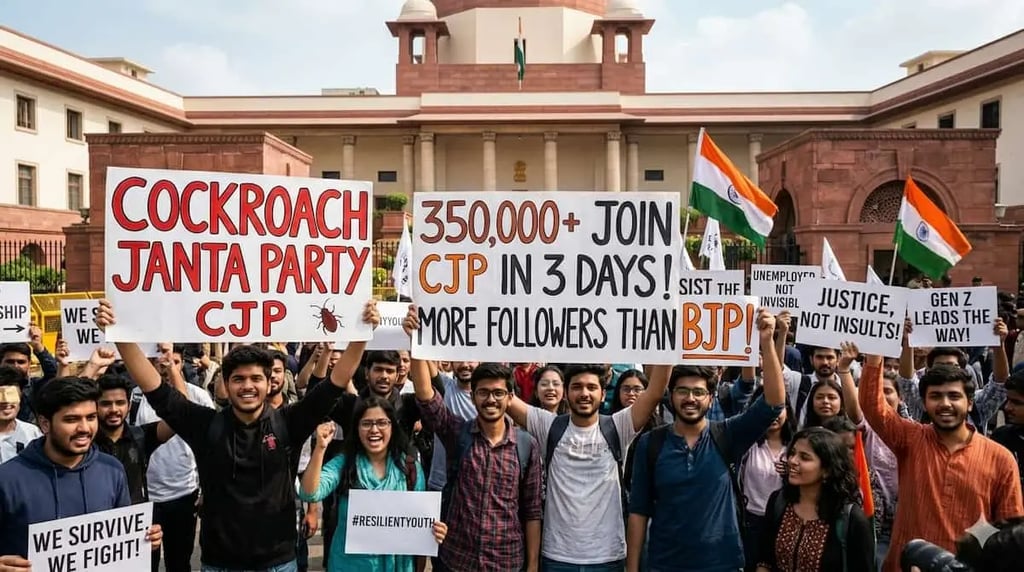
The Rise of the 'Cockroach Janta Party': How a Chief Justice’s Insult Sparked India’s Biggest Gen Z Revolt
What happens when one of the most powerful men in India calls the nation's youth "cockroaches"?
You don’t get an apology—you get a political revolution.
In a staggering convergence of judicial elitism, severe economic anxiety, and the raw power of internet culture, a casual joke has mutated into a massive countercultural movement. The Cockroach Janta Party (CJP) has taken India by storm, capturing the attention of millions and leaving traditional political establishments scrambling to understand what just happened.
1. The Spark: A Chief Justice's Remarks Hit a Raw Nerve
The controversy erupted in an open courtroom when the Chief Justice of the Supreme Court of India, Surya Kant, made a highly controversial analogy. Addressing cases involving institutional critics, Kant stated:
"There are youngsters like cockroaches, who don’t get any employment or have any place in the profession. Some of them become media, some of them become social media, RTI activists and other activists, and they start attacking everyone."
Though Chief Justice Kant later clarified that his remarks were directed at individuals with fraudulent degrees rather than the general youth, the damage was already done.
Why the Metaphor Exploded
For India’s massive Gen Z demographic—which makes up more than a quarter of the country’s population—the comment felt like a direct assault. The insult landed in the middle of a brutal week marked by nationwide student protests over government exam paper leaks, soaring inflation, and a staggering 29.1% unemployment rate among college graduates (nine times higher than for those who never attended school).
2. The Birth of the 'Cockroach Janta Party' (CJP)
As public anger mounted across social media, Abhijeet Dipke, a 30-year-old public relations graduate, posted a simple question on X: "What if all cockroaches come together?"
Within 24 hours, leveraging AI tools to design a logo and manifesto, Dipke officially launched the Cockroach Janta Party (CJP)—a direct satirical play on Prime Minister Narendra Modi’s ruling Bharatiya Janata Party (BJP).
COCKROACH JANTA PARTY (CJP) ELIGIBILITY CRITERIA:
1. Unemployed 2. Lazy 3. Chronically Online 4. Can Rant Professionally
The party’s official motto? "A political front of the youth, by the youth, for the youth. Secular – Socialist – Democratic – Lazy."
3. By the Numbers: Outpacing the World’s Largest Party
The digital momentum of this movement is unprecedented. The satirical party has effectively beaten traditional political machines at their own game.
Bharatiya Janata Party (BJP)
Instagram Followers = 8.8 Million
Signed Members = Traditional Database
Core Demographic = Broad Spectrum
Cockroach Janta Party (CJP)
Instagram Followers = 11.1 Million (Achieved in 3 Days)
Signed Members = 350,000+ (Via Google Form)
Core Demographic = Dominantly Gen Z & Millennials
The movement is no longer just an underground internet club. High-profile opposition figures, including parliamentarian Mahua Moitra and former lawmaker Kirti Azad, have officially signed up alongside retired federal bureaucrats.
also read: Modi’s Norway Visit and Its Diplomatic Importance
4. Deeper Frustrations: Why Satire is Saving Indian Democracy
India, the world’s most populous nation, has been facing its own set of simmering issues. While its economy has ballooned, income inequality, coupled with unemployment and high cost of living, has reached historic highs.
While India produces more than 8 million graduates a year, the unemployment rate among them stands at 29.1%, 9 times higher than for those who never attended school. More than a quarter of India’s population is Gen Z – also the biggest cohort in the world.
Bhushan said he has been feeling for a long time that India needs a youth uprising, since its “economy and society are bleeding for the benefit of crony capitalists like Ambani and Adani,” referring to the Indian billionaires seen close to Modi.
The outrage over Kant’s remarks also coincides with a rather difficult week for Indian diplomats, who are facing scrutiny from the Norwegian press after Modi avoided questions from journalists during his tour of the European country.
Since coming to power in 2014, Narendra Modi has not taken any questions at a news conference, instead relying on carefully managed interviews conducted by journalists sympathetic to the BJP.
Some people connect with satire, like is the case with the Cockroach Janta Party (CJP), because it’s funny, while others connect because they are frustrated,” said Bhushan. “People are finally asking questions and demanding accountability.
While the CJP is fueled by humor, the undercurrents are deeply serious. Activists and political commentators point out that the party has become a vital safety valve for dissent in an increasingly restrictive political environment.
A Shield Against Fear: Retired bureaucrat Ashish Joshi noted that after a decade of crackdowns on dissent, "India has become so hateful that the Cockroach Janta Party is like a breath of fresh air."
The Symbolism of the Insect: Joshi added a poignant flip side to the judge's insult: "Cockroaches are resilient insects; they survive. And apparently, they can form a party and crawl over your system."
A Critique of Reality: YouTuber and commentator Meghnad S pointed out the tragic irony of the movement: "It’s a satirical, nonexistent party, yet people believe that it is a better alternative to reality. That’s a giant commentary on Indian political parties in general."
5. The Bigger Picture: South Asia’s Gen Z Awakening
The explosive rise of the CJP does not exist in a vacuum. It follows a historic pattern across South Asia, where intense youth-led movements have recently upended governments in Sri Lanka, Nepal, and Bangladesh.
Prominent Supreme Court lawyer and rights activist Prashant Bhushan argues that India is ripe for its own youth uprising, given how the economy is perceived to be rigged in favor of crony capitalists while millions of educated youths face bleak financial futures.
What started as a frantic, sleepless 72 hours for Abhijeet Dipke has evolved into a legitimate political experiment. As the movement continues to mushroom, one thing is abundantly clear: India’s youth are no longer willing to be quiet, and they are using the system's own words to demand accountability.
also read : Nepals Gen Z Protest
MicroNews © 2025
MicroNews empowers the generation of tomorrow for a brighter future and hope for every individual.
Thanks For Touch with us
We care about your data in our privacy policy.
Popular Post
Top 10 Calcium-Rich Vegetables for Strong Bones & Better Health
Patala Garuda (Rauvolfia serpentina): Health Benefits, Ayurvedic Uses
Ganga Siuli (Parijata Tree): Benefits, Uses, and Medicinal Properties
Freelancing Explained: How to Start, Earn, and Succeed as a Freelancer
Turmeric Benefits: Uses, Nutrition, Ayurveda Importance & Side Effects
Science of Longevity: New Research Reveals How Diet May Shape Lifespan