
Sonam Wangchuk 'Kidnapping' & CJP Sansad Chalo: What Is the Chronology?
Inside the massive Sansad Chalo (Parliament March) protest in Delhi. Explore the truth behind Sonam Wangchuk's forced removal, the rise of the CJP, and today's clashes.
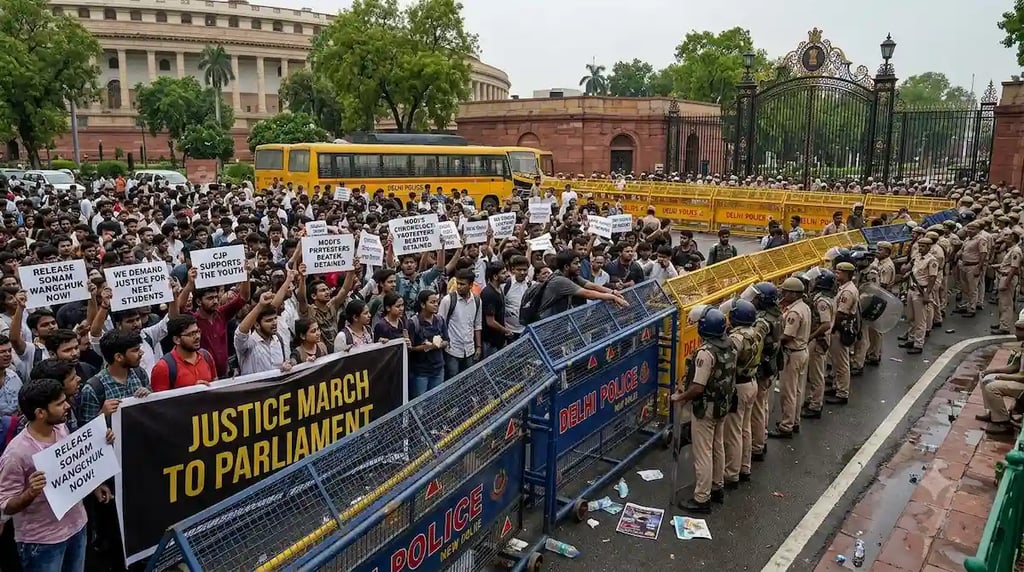
Breaking: The "Second Freedom Movement"? Inside Sonam Wangchuk’s Forcible Removal and the CJP’s Parliament March
The streets of New Delhi are witnessing a historic, high-stakes political showdown. What started as a viral, youth-led internet movement has transformed into a massive, boots-on-the-ground resistance. At the heart of this storm are two major flashpoints: the alleged "forceful kidnapping" (or forced hospitalization) of renowned activist and education reformer Sonam Wangchuk and today’s chaotic "Sansad Chalo" (March to Parliament) protest.
If you are trying to understand the sudden explosion of outrage on your social feeds, here is a complete breakdown of the ongoing crisis and the political "chronology" driving the narrative.
1. The Trigger: The "Forcible Removal" of Sonam Wangchuk
For over 20 days, 59-year-old Sonam Wangchuk sat on an indefinite, peaceful hunger strike at Jantar Mantar. Surviving only on water and salt, he was striking in solidarity with the Cockroach Janta Party (CJP)—a viral youth movement demanding systemic accountability and the resignation of Union Education Minister Dharmendra Pradhan over the massive NEET-UG exam paper leaks that derailed the futures of millions of students.
However, on Saturday, July 18, the dynamic completely shifted:
The Crackdown: Plainclothes Delhi Police officers abruptly swaddled the protest stage with white sheets and whisked a weakened Wangchuk away into a waiting vehicle.
The "Kidnapping" Allegation: While the Delhi Police and authorities stated that the intervention was a "much-needed medical move" in compliance with monitoring orders from the Delhi High Court, the CJP and Wangchuk's supporters labeled it a forceful kidnapping and illegal detention.
The Hospital Lockdown: From his bed at Safdarjung Hospital, Wangchuk refused IV fluids and medication. In a handwritten note smuggled out by his wife, Gitanjali Angmo, Wangchuk declared the situation India’s "Second Freedom Movement"—demanding "freedom from injustice (paper leaks) and freedom from fear (his detention)."
2. Today’s Showdown: The Parliament March
Today, Monday, July 20, marked the beginning of the Monsoon Session of Parliament. It also marked the day the CJP vowed to take their protest directly to the steps of democracy.
Despite a heavy security blanket, closed metro gates, and strict prohibitory orders, thousands of students, parents, and opposition leaders gathered at Jantar Mantar.
What Happened on the Ground Today:
Clashes & Tear Gas: As protesters attempted to march down Sansad Marg, security forces deployed heavy barricading, batons (lathi-charge), and tear gas to halt the crowd just 200 meters from Parliament. Several student leaders and citizens were injured or detained.
Wangchuk’s Ultimatum: Seeing the police action, Wangchuk issued a fresh statement from the hospital, announcing that he will continue his indefinite fast until youth leaders are officially allowed to meet parliamentarians to present their grievances.
High-Level Talks: In a bid to defuse the escalating tension, CJP spokespersons met Health Minister J.P. Nadda today to formally submit their demands: the immediate release of Wangchuk, the resignation of the education minister, and financial compensation for affected NEET aspirants.
BJP supporter: There is more doubt about some police or force wearing dresses without a batch or simple dress; protestors doubt those people are RSS people, and a full truck containing stones is there. Also, those BJP supporters are attacking police and protestors to vandalize the situation and also shutting down the internet and phone network using jammers.
3. The Oppositions' Take: Deconstructing the "Chronology"
For critics of the current administration, the dramatic handling of Sonam Wangchuk and the student protesters fits into a deeply entrenched political pattern. On social media, commentators and opposition figures are heavily invoking a famous phrase often used by the ruling dispensation: "Aap chronology samajhiye" (Understand the chronology).
To the protestors, the "chronology" of how dissent is handled looks like this:
Step 1: Systemic Failure Occurs (e.g., major exam leaks impacting millions of youth).
▼
Step 2: Citizens initiate a peaceful, Gandhian, non-violent protest.
▼
Step 3: The state applies pressure (internet blackouts, heavy police presence).
▼
Step 4: The face of the protest is "forcibly removed" under the guise of health/law & order.
▼
Step 5: Dissent is cast as a threat to national security, dispersing the movement by force.
Leader of the Opposition Rahul Gandhi, along with former Delhi CM Arvind Kejriwal and other top leaders, roundly condemned the police action, arguing that treating peaceful, non-violent student dissent as a threat undermines the very fabric of democratic obligation.
The Takeaway
Whether viewed as a necessary medical intervention to save an activist's life or a heavy-handed suppression of democratic protest, one thing is undeniable: the combination of Sonam Wangchuk's moral authority and the raw frustration of India's Gen Z student body has created a potent political cocktail.
As Parliament begins its session under a cloud of tear gas and slogans, all eyes remain on Safdarjung Hospital and the volatile streets of the capital.
What are your thoughts on today's protests? Is the forced hospitalization of an activist a bridge too far, or a necessary measure? Let us know in the comments below.
The Cockroach Janta Party (CJP) has evolved from a satirical online joke into one of the most unexpected, youth-driven grassroots political challenges facing the Indian establishment.
Here is the breakdown of what the CJP is, who started it, and how it dramatically jumped from social media feeds to the streets of New Delhi.
What is the Cockroach Janta Party (CJP)?
The CJP is a youth-centric satirical political movement. The name itself is a sharp, direct parody of the ruling Bharatiya Janata Party (BJP).
Self-described on its portal as a front that is "Secular, Socialist, Democratic, and Lazy," the CJP’s mock manifesto targets systemic government failures—specifically youth unemployment, corporate favoritism, and transparency. Its official website proudly presents itself as the "Voice of the Lazy & Unemployed," stating that to be eligible, one must be "chronically online and able to rant professionally". Despite the heavy layers of Gen-Z internet humor, the CJP functions as a hyper-focused advocacy group fighting for systemic educational and economic reforms.
Who Founded It and Why?
The movement was founded on May 16, 2026, by Abhijeet Dipke, a 30-year-old political communications strategist and university graduate.
The Catalyst: On May 15, 2026, during a Supreme Court hearing, the Chief Justice of India (CJI) reportedly referred to certain activists and unemployed youth as "cockroaches" and "parasites of society."
Enraged that such a statement came from the custodian of the Constitution, Dipke posted a simple, satirical question online: "What if all cockroaches came together?" He decided to weaponize the insult, creating a mock political entity that immediately struck a chord with millions of frustrated young Indians.
The Transition: From Viral Sensation to Ground Protests
The CJP's shift from digital virality to massive street presence occurred in distinct phases:
May 2026: The Digital Spark: CJP launches online. Within two weeks, its Instagram surpasses 22 million followers, outpacing the official handle of the ruling BJP.
▼
Late May / June 2026: Offline Mobilization] The party coordinates community service events. Volunteers show up in the real world doing clean-up drives dressed in literal cockroach costumes.
▼
June 2026: The Core Grievance (NEET Paper Leaks) The movement pivots from general satire to an agonizing real-world issue: mass irregularities and paper leaks in the NEET-UG medical entrance exams.
▼
June 28, 2026: The Entry of Sonam Wangchuk Renowned climate activist and educator Sonam Wangchuk lends heavy moral authority by joining the CJP's sit-in at Jantar Mantar and launching a hunger strike.
▼
July 2026: Direct Political Confrontation. Following Wangchuk's forced hospitalization by police, the movement reaches a boiling point, culminating in massive street clashes during the "Sansad Chalo" Parliament March.
1. The Power of Virality
The CJP’s initial explosion was purely digital. Within days of its launch, its Instagram page racked up over 22 million followers, effectively eclipsing the ruling party's digital footprint. When the government attempted to block their accounts on X (formerly Twitter) on national security grounds, it only fueled the fire, transforming the digital joke into a symbol of anti-censorship.
2. Channeling Real-World Rage (The NEET Fiasco)
Satire can only sustain a movement for so long; the true transition to the ground happened when the CJP adopted a tangible, painful cause: the NEET-UG medical exam paper leaks. With nearly 40% of India’s graduates under 25 facing unemployment and millions of families draining their life savings into exam coaching, the paper leaks were a breaking point. The CJP gave these students a platform to demand the resignation of Education Minister Dharmendra Pradhan.
3. The Sonam Wangchuk Factor
The movement gained immense mainstream gravity when Sonam Wangchuk declared himself an "honorary cockroach" and officially joined the CJP's dharna at Jantar Mantar on June 28, 2026, launching an indefinite hunger strike. Wangchuk brought the eyes of the entire nation to the protest.
4. The Flashpoint Escalation
When Delhi Police wrapped the protest stage in white sheets and forcefully removed a weakened Wangchuk to Safdarjung Hospital, it acted as a massive accelerant. Founder Abhijeet Dipke immediately began his own fast in retaliation, and the CJP effectively converted millions of online clicks into thousands of bodies on the pavement for the chaotic Parliament March.
MicroNews © 2025
MicroNews empowers the generation of tomorrow for a brighter future and hope for every individual.
Thanks For Touch with us
We care about your data in our privacy policy.
Popular Post
Top 10 Calcium-Rich Vegetables for Strong Bones & Better Health
Patala Garuda (Rauvolfia serpentina): Health Benefits, Ayurvedic Uses
Ganga Siuli (Parijata Tree): Benefits, Uses, and Medicinal Properties
Freelancing Explained: How to Start, Earn, and Succeed as a Freelancer
Turmeric Benefits: Uses, Nutrition, Ayurveda Importance & Side Effects
Science of Longevity: New Research Reveals How Diet May Shape Lifespan