
Appendix and Appendicitis: Symptoms, Causes, Functions & Treatment
Learn about the appendix, its functions, causes of appendicitis, common symptoms, treatment options, and when to seek emergency medical care.
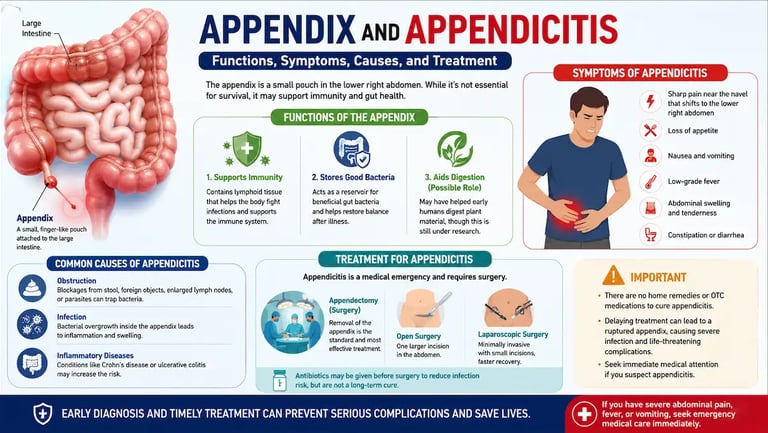
Appendix and Appendicitis: Functions, Symptoms, Causes, and Treatment
The appendix is a small, tube-shaped organ located in the lower right side of the abdomen where the small intestine meets the large intestine. For many years, scientists believed the appendix was a vestigial organ with no significant function. However, recent research suggests that the appendix may play an important role in supporting the immune system and maintaining gut health.
In this article, we'll explore the functions of the appendix, the causes and symptoms of appendicitis, and the available treatment options.
What Is the Appendix?
The appendix is a narrow, finger-like pouch attached to the beginning of the large intestine. Although it is relatively small, researchers now believe it may contribute to immune function and digestive health.
Functions of the Appendix
While the exact purpose of the appendix remains under study, experts believe it may perform several important functions.
1. Supports the Immune System
The appendix contains lymphoid tissue, which helps produce and regulate white blood cells. These cells are essential for fighting infections and strengthening the body's immune response, particularly during childhood and early adulthood.
2. Maintains Healthy Gut Bacteria
One of the most widely accepted theories is that the appendix acts as a storage reservoir for beneficial gut bacteria. After illnesses such as severe diarrhea or intestinal infections, these healthy bacteria can help repopulate the digestive system and restore balance in the gut microbiome.
3. Possible Role in Digestion
Some researchers suggest that the appendix may have assisted early humans in digesting plant-based foods rich in cellulose. However, this theory remains controversial and requires further scientific evidence.
Can You Live Without an Appendix?
Yes, you can live a completely healthy life without an appendix. Many people undergo an appendectomy (appendix removal surgery) due to appendicitis and experience no long-term health problems afterward.
Since the appendix is not considered essential for survival, its removal does not usually affect digestion or overall health.
What Is Appendicitis?
Appendicitis is a condition in which the appendix becomes inflamed and swollen. It is a medical emergency that requires immediate treatment. If left untreated, the appendix can rupture, leading to severe infection and potentially life-threatening complications.
Common Causes of Appendicitis
The exact cause of appendicitis is not always known, but it often occurs due to a blockage or infection inside the appendix.
Obstruction
Blockages may occur due to:
Hardened stool (fecal matter)
Foreign objects
Enlarged lymph nodes
Intestinal parasites
Bacterial Infection
When bacteria multiply inside the appendix, inflammation and swelling can develop, increasing the risk of infection.
Inflammatory Bowel Diseases
Chronic digestive conditions such as Crohn's disease and ulcerative colitis may increase the likelihood of developing appendicitis.
Symptoms of Appendicitis
Recognizing the symptoms of appendicitis early can help prevent serious complications.
Common symptoms include:
Sharp abdominal pain that usually starts near the belly button and moves to the lower right abdomen
Loss of appetite
Low-grade fever
Abdominal swelling and tenderness
Difficulty passing gas
Increased pain while walking, coughing, or moving
If you experience these symptoms, seek medical attention immediately.
How Is Appendicitis Treated?
Appendicitis typically requires prompt surgical treatment. Delaying treatment can increase the risk of a ruptured appendix and serious infection.
Appendectomy (Appendix Removal Surgery)
The standard treatment for appendicitis is an appendectomy. This procedure can be performed using:
Open Surgery
A traditional surgical method involving a single incision in the abdomen.
Laparoscopic Surgery
A minimally invasive technique that uses small incisions and a camera, resulting in faster recovery and less scarring.
Antibiotics
Doctors often prescribe antibiotics before surgery to control infection and reduce complications. However, antibiotics alone are generally not considered a permanent solution for appendicitis.
Can Appendicitis Be Treated at Home?
No. There are no proven home remedies or over-the-counter medications that can cure appendicitis. Attempting to self-treat the condition can be dangerous and may lead to a ruptured appendix.
Always seek emergency medical care if appendicitis is suspected.
Complications of Untreated Appendicitis
Without timely treatment, appendicitis can lead to serious health risks, including:
Ruptured appendix
Peritonitis (infection of the abdominal lining)
Abscess formation
Severe bloodstream infections (sepsis)
Life-threatening complications
Conclusion
Although scientists continue to study the exact role of the appendix, current evidence suggests it may support immune function and help maintain healthy gut bacteria. Despite these benefits, the appendix is not essential for survival, and people can live normal, healthy lives after its removal.
Appendicitis, however, is a serious medical condition that should never be ignored. Symptoms such as severe lower-right abdominal pain, nausea, vomiting, and fever require immediate medical attention. Early diagnosis and prompt surgical treatment can prevent complications and ensure a faster recovery.
Frequently asked questions
❓ What is the appendix?
The appendix is a small, tube-shaped organ located in the lower right abdomen, near where the small and large intestines meet. While once thought to be useless, it may support immune function and help maintain gut health.
❓ What does the appendix do?
Though not fully understood, the appendix may:
Support the immune system with lymphoid tissue.
Serve as a backup storage for beneficial gut bacteria.
Possibly aid in digesting plant fibers (though this is debated).
❓ Can you live without your appendix?
Yes. The appendix is not a vital organ. People can live normal, healthy lives after it is removed through an appendectomy.
❓ What are the first signs of appendicitis?
Common early symptoms include:
Sudden pain near the belly button that shifts to the lower right abdomen.
Nausea or vomiting.
Fever and abdominal swelling.
Loss of appetite.
❓ What causes appendicitis?
Appendicitis is usually caused by:
A blockage inside the appendix (e.g., feces, foreign object).
A bacterial infection.
Inflammatory conditions like Crohn’s disease.
Related Stories
MicroNews © 2025
MicroNews empowers the generation of tomorrow for a brighter future and hope for every individual.
Thanks For Touch with us
We care about your data in our privacy policy.
Popular Post
Top 10 Calcium-Rich Vegetables for Strong Bones & Better Health
Patala Garuda (Rauvolfia serpentina): Health Benefits, Ayurvedic Uses
Ganga Siuli (Parijata Tree): Benefits, Uses, and Medicinal Properties
Freelancing Explained: How to Start, Earn, and Succeed as a Freelancer
Turmeric Benefits: Uses, Nutrition, Ayurveda Importance & Side Effects
Science of Longevity: New Research Reveals How Diet May Shape Lifespan